Last Updated on February 23, 2024
ENO Strikes Wagnerian Gold
In 2021, English National Opera announced a five-year plan to stage Richard Wagner’s The Ring cycle of four operas at the London Coliseum in a co-production with New York’s Metropolitan Opera. The ENO kicked things off in 2021 with The Valkyrie, the second of the operas, directed by eight-time Olivier Award-winner Richard Jones, who was set to be in the director’s chair for the whole cycle. This is Jones’ second London Ring with his 1995 cycle having been produced for the Royal Opera at Covent Garden. The Arts Council in an act of uninformed vandalism has recently withdrawn much of ENO’s funding. The resulting uncertainty has meant that the Met has pulled out of the project with productions of the final two instalments of the tetralogy having been ‘postponed’, possibly indefinitely.
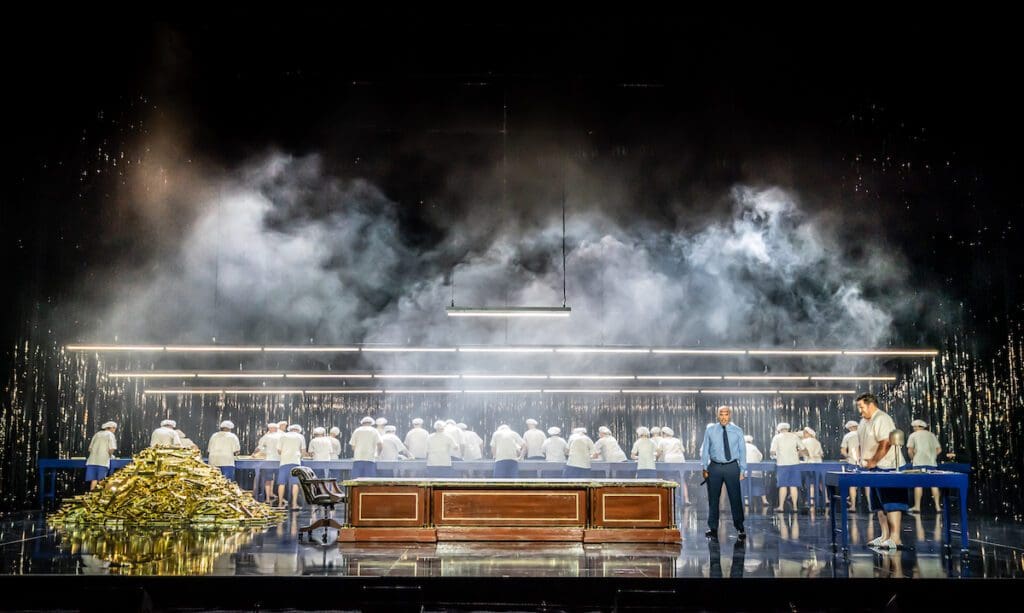
Productions of The Ring are often controversial with the strong coterie of Wagner traditionalists bemoaning the trend for ‘Regie’ (director-led) opera. But whether you were a fan of Richard Jones’ Nordic survivalist take on The Valkyrie, with the cast decked out in outfits from the Millets sale, and I was (see my review), there is no denying the continuing centrality of Wagner’s work both to Western high art as well as to popular culture. Censoring a new take on The Ring with its critique of unfettered free market capitalism, which is in effect what is happening, is a crudely political act by a weak and compromised administration.
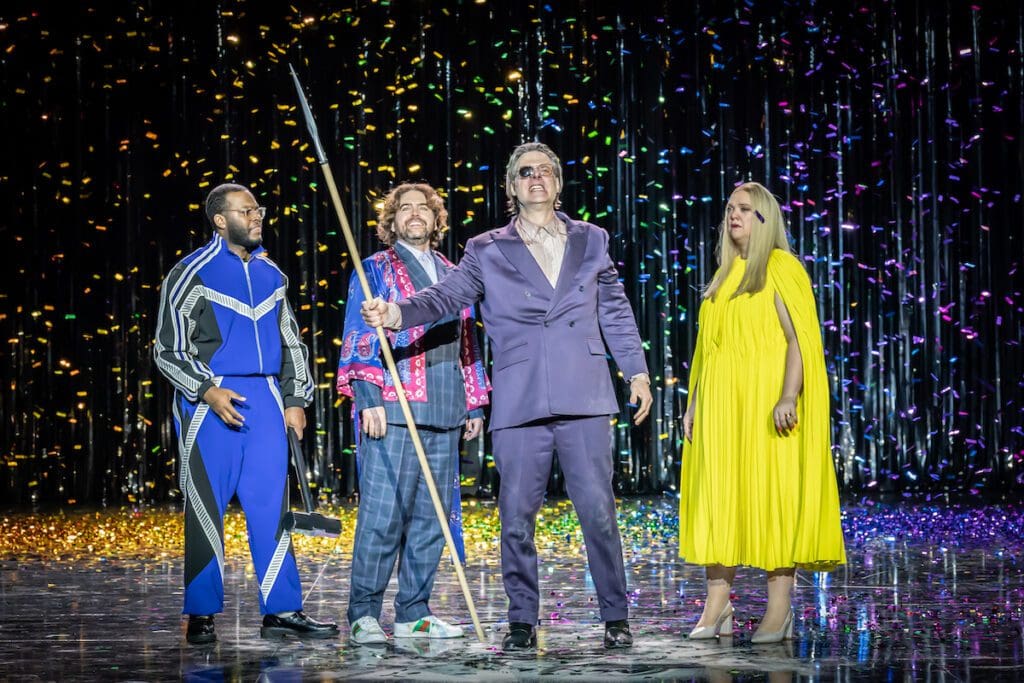
Jones’ The Valkyrie is set in a Nordic backwoods ‘survivalist’ society where men are men, women are downtrodden and sibling incest is normalised. The Rhinegold, in contrast, is located in a series of mythic spaces and is only populated by gods and other mythological beings and as such the production engages with a more abstract aesthetic. The opera functions as a prequel in the cycle and sets up the context and world of the following three (think The Hobbit and The Lord of the Rings, and yes, Tolkien was very aware of Wagner’s work). Written between 1853-54 The Rhinegold was first performed in 1869 with the first complete performance of the Ring being in 1876 on four successive nights at Wagner’s bespoke theatre at Bayreuth. Wagner was an extraordinary innovator and visionary who created modern performance protocols such as turning the lights off in the theatre and demanding silence from the audience. He broke away from the recitative/aria model creating a more through-composed composition with musical ‘leitmotifs’ attached to characters and situations signposting the drama just as now happens in contemporary film scoring.

The opera opens with an extraordinary prelude, now recognised as the precursor of much of the minimalist and systems music from the 20th century. It starts with a low Eb drone on the detuned double basses with the bassoons adding a perfect 5th above. Waves of ascending brass and then string arpeggios add momentum but the overall impression is of 136 bars of stasis.
Also returning for The Rhinegold is ENO Music Director Martyn Brabbins, directing the expanded 89-piece Wagner orchestra from the pit. If the band doesn’t quite get the level of urgency and drama apparent in Solti’s classic recording with the Vienna Philharmonic, it makes a very good fist of it with the blazing brass section leading the way. During the prelude, the stage is bare apart from a branch from the symbolic ‘World Ash Tree’ that binds the world together in this mythic universe. There is a backdrop of billowing, glistening silver strip blinds that come to represent the depths of the river Rhine in the first scene. A naked and rather hairy man walks onto the stage and pulls the branch off stage. Each time he returns, it is in a more fully clothed form as the branch becomes further denuded. The final time he appears it is in the form of the god Wotan carrying the wooden spear hewn from the tree’s branch that gives him power over the world. It’s a good joke that characterises the production. Jones is not afraid of making the most of the humour implicit in the opera which is a smart way of combining the mythic with the mundane à la Marvel Cinematic Universe.

The story of The Rhinegold begins with the eponymous precious metal being stolen by the Nibelung dwarf Alberich from its protectors, 3 river nymphs known as the Rhinemaidens. The precious metal has special powers if forged into a ring and will give its owner the ability to gain wealth and power over the world if they renounce the ability to love. It is the quest for ownership of the ring and the destructive outcomes of owning it that drive the drama throughout the whole cycle. The Rhinemaidens, British soprano Eleanor Dennis as Woglinde, German mezzo-soprano Idunnu Münch as Wellgunde and British mezzo-soprano Katie Stevenson Flosshilde, are dressed as a trio of gym bunnies and make an appealing coterie of cock-teasers as they play with the hapless and ugly dwarf, out of his comfort zone in the water. Their ensemble passages are lyrical and thrilling to the ear rising above the orchestra as they express their despair at the theft of the gold. Movement director Sarah Fahie’s dancers dressed in black bodysuits lift and hold the lead characters as they navigate the depths of the river giving an evocative sense of the underwater. The English translation of Wagner’s libretto by John Deathridge hits the spot immediately with evocative alliterations echoing Wagner’s own style but unlike the composer using a language that creates a clear narrative.

Alberich, played by British baritone and former ENO Young Singer Leigh Melrose, appears first in an unappealing Emo wig. He is driven by an insatiable lust for any of the lubricious trio who will accept his advances. Melrose may not have the vocal heft of some Alberichs but his dramatic intensity is extraordinary. When he transitions into the wigless iteration of his character, in total domination of his Nibelung clansmen whom he has enslaved in pursuit of gold, Melrose owns the stage and is quite terrifying.
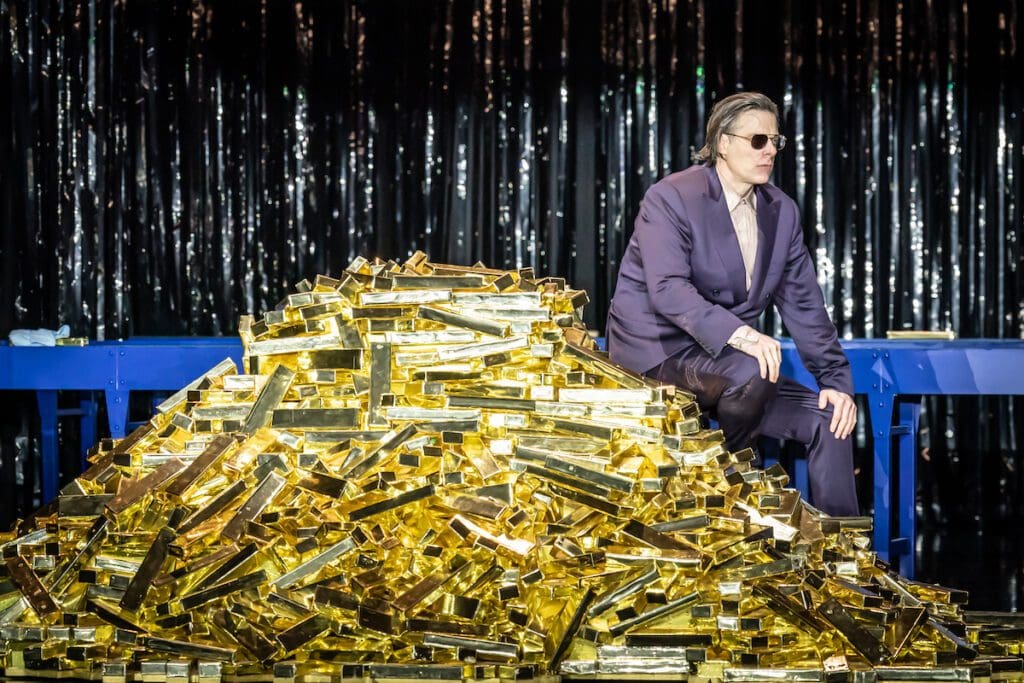
Canadian bass-baritone John Relyea in his ENO debut as Wotan, the supreme God of German mythology, brings us a nuanced and restrained reading of the conflicted deity’s persona. Wotan has to pay the giants, Fafner and Fasolt for the building of Valhalla, the fortress for the gods that looks rather like a series of marshmallows on chopstick legs. Wotan has promised his wife Fricka’s sister Freia to the gruesome twosome in return. Relyea uses the glorious grain of his voice rather than his undoubted vocal power to characterise the flawed Wotan, the capo di capo of the deities but one who embodies very human desires, ambitions and jealousies.

American bass James Creswell and British bass-baritone Simon Bailey are in turns thuggish and sensitive as Fafner and Fasolt.

Grammy-winning American tenor Frederick Ballentine gives a standout performance in his role debut as Loge, demi-god and Wotan’s wing-man and enabler. He is in turn insinuating and scornful of all around him and has a glorious lyric voice waiting for the right role.

British mezzo-soprano Madeleine Shaw is a striking and dramatic Fricka, wife of Wotan, and resplendent in a canary-yellow cloak. And in a pink sparkling pj-wearing cameo role as Erda the earth goddess, British mezzo Christine Rice MBE is sensational. The vibrancy of her voice is a thing of wonder.

Special mention must go to ENO Harewood Artist John Findon as Mime, Alberich’s put-upon younger brother. I have enjoyed his work as Spoletta in Tosca and Luke in The Handmaid’s Tale but here he gives a small and unappealing part some real substance. Major roles must surely beckon.
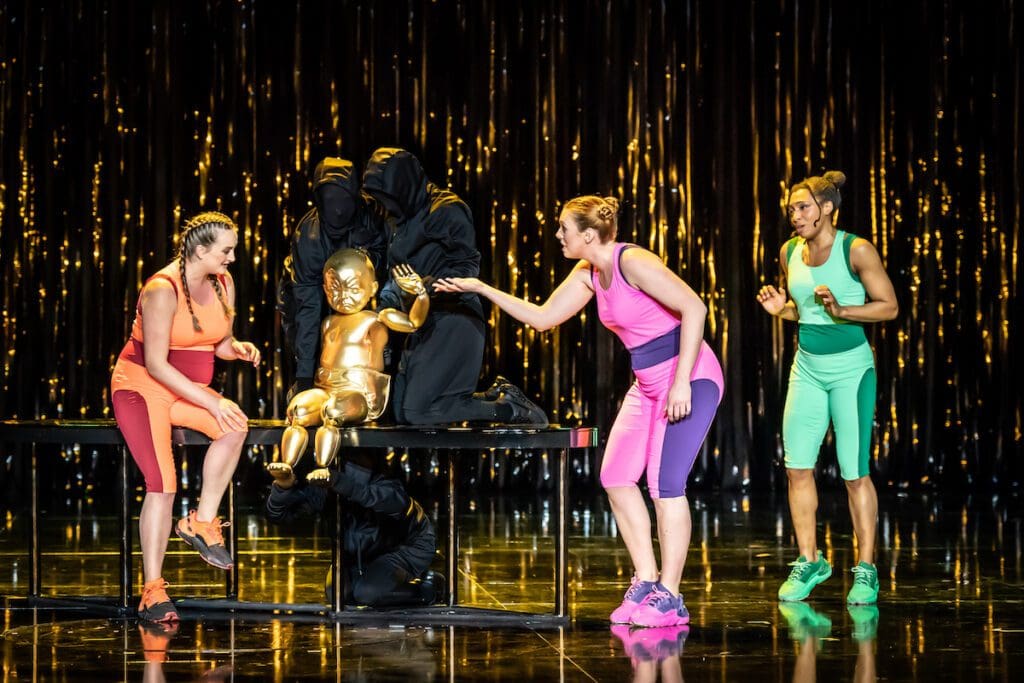
There were lots of enjoyable design and directorial moments in this production; the giants reversing a truck onto the stage to pick up the gold, the gold anthropomorphised into a highly realistic puppet baby, but the standout was near the end as the Gods traverse the Rainbow Bridge on their way to Valhalla. This was a psychedelic tour-de-force by designer Stuart Laing and lighting designer Adam Silverman set to Wagner’s euphoric score.

The Rhinegold is not a straightforward opera to produce but with a strong ensemble performance, this is a thrilling and dramatically engrossing production from Richard Jones. The thought of not seeing the final two parts of the cycle feels like a scandalous piece of cultural theft. If you haven’t booked, do so. We must support the ENO.
English National Opera,
London Coliseum,
St Martin’s Lane,
London WC2N 4ES
from 18 February – 10 March 2023

These modern productions of the WAGNERS ring leave me incandescent with rage .I know opera houses are strapped for cash but to dress every one in stuff from a charity shop sale is insulting to the audience who pay these high prices .I am sad to think that I will never see a sensible ring again. The only way is to ask Opera North to revive their concert performances.
You cant see how naff and silly this stuff is?
At the risk of stirring up a hornet’s nest, a similar argument could be made about traditional productions. What I see at the ENO is a young audience thrilled to experience Wagner and that;s a great thing.