Last Updated on February 15, 2026
This exhibition of Jewish Londoners and their role in shaping global style speaks to the moment.
At 59 Brick Lane, in the borough of Tower Hamlets, East London, stands the Jamme Masjid Mosque. Established by Bengali migrants in 1976, the mosque is today the place of worship for the largest concentration of Bangladeshi Muslims in the UK.
59 Brick Lane was not always a mosque. Until 1975, the building was home to the Chevra Machzike Hadath, or Spitalfields Great Synagogue. Consecrated by Orthodox Ashkenazi migrants in 1898, the synagogue was the place of worship for a large concentration of Eastern European Jews. And before the synagogue, 59 Brick Lane was La Neuve Église, a Protestant chapel. Founded by French Huguenots in 1743, the chapel was the place of worship for a community of French Christians.
Before that, who knows?
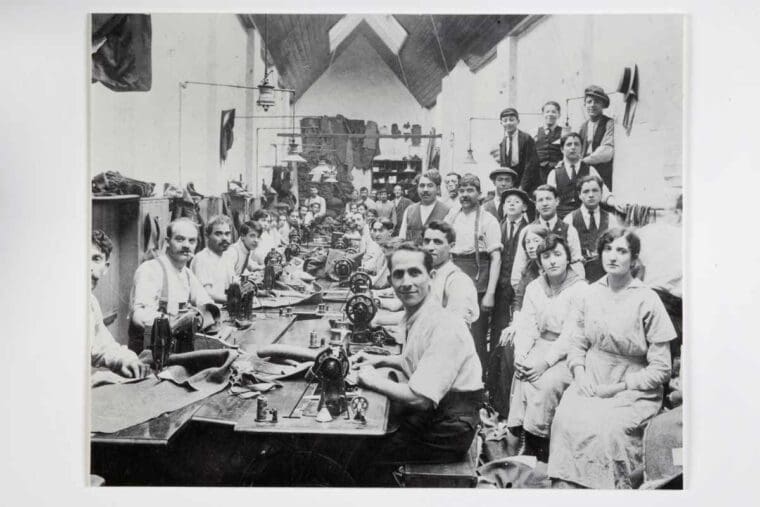
This information is only one display in a comprehensive new exhibition, Fashion City, at the Museum of London Docklands. It sits next to countless stunning items of clothing, shoes and bags produced by the Jewish fashion designers, milliners, jewellers, tailors, and dressmakers of London. It could easily be missed – it is merely a small photograph above a passage of text – and yet it demonstrates one of the key messages of the exhibition and the mission of the museum itself: London is a melting pot and always has been. It is built on the fruits of migration and the joining together of communities.
Plato described the statesman as a weaver, whose art is to intertwine the lives of different people to make ‘the most magnificent of all fabrics’: a society. Fashion City: How Jewish Londoners shaped global style showcases this art quite literally; it demonstrates how people come together to form a social fabric, by making actual fabrics.
It is right that the story starts with JFS, the Jews’ Free School. It is the school that produced Israel Zangwill, the man who popularised the term ‘melting pot’ in his 1908 play of the same name. From 1656, when Jews were allowed back into England after a nearly 400-year ban, London became a central hub for a small new community. Founded in 1732, when the population of British Jews numbered less than 6,000, JFS became the main centre of education for Jewish migrants in the East End of London. Astonishingly, by 1900, JFS was the biggest school in Europe, and possibly the world, with 4,000 students. The Jewish population of Britain had grown to a quarter of a million and would continue to rise until its peak in 1945 (450,000).
Like many of the schools of the time, JFS provided a highly practical curriculum, with an especially strong focus on apprenticeships. In particular, young Jews were prepared for a career in the garment trade. One exhibit shows an essay written by a JFS schoolboy, reflecting on a trip to visit a tailor’s workshop in London.
The story of JFS is the story of British Jewry. Established partly in response to Christian missionaries seeking to convert Jewish migrants, JFS had to strike a balance between preserving the Jewishness of its students, while encouraging assimilation into British life. Assimilation was a necessity of self-preservation in the face of xenophobia and antisemitism. Students, while educated amongst other Jews and with a rich sense of their heritage, were banned from speaking Yiddish and foreign accents were replaced by English ones.
The garment trade, too, trod a fine line between Jewish pride and the need for British approval. Eastern European names became Anglicised, and Jewishness was no longer worn on the sleeve. However, as the exhibition contends, in some way the Judaism of each maker is present on every sleeve of every suit and dress. Dr Lucie Whitmore, curator of the exhibition, told me: “[It’s a] really difficult tussle between established Jewish communities and new Jewish migrants maintaining their unique sense of their cultural heritage and their religion, versus the acceptance that they needed from British society in order to be able to live safely. Leading figures like the Montagus and the Rothschilds and organisations like the Jewish Board of Deputies were working very hard pressuring new Jewish Londoners to assimilate. Sometimes that feels uncomfortable to [think] about.”

It is especially uncomfortable when you look at the videos in the exhibition of the East End in the early 1900s and compare them to London today. Jewishness was extremely visible: Yiddish writing on buildings, synagogues in plain sight, and thriving Jewish markets. As Jews became more prominent and successful in British life, their cultural heritage became more hidden. By the 1960s, while over half of all the shops on Carnaby Street were owned or run by Jews, one might well not have known. “I think that’s a really important point,” Dr Whitmore says, “and I think a really poignant point in the current climate with what’s going on at the moment. The idea of hiding strategically is really quite an emotional thing to think about. I think it is really interesting that between the huge wave of migration that we get from 1881 and 1914 builds this incredibly vibrant cultural centre in the East End. […] It feels really alive, really vibrant, really culturally an interesting place and yes, there are a lot of public representations of Jewishness […] But I think that it is a combination of things. The two World Wars do a huge amount to stir anti – I’m going to say anti-foreign sentiment – within the larger British public. To be associated with anything Germanic between 1914 and 1945 was very difficult. I think a lot of the people in the exhibition, and Jewish people in London more generally, were hiding their national heritage as much as their Jewishness as an act of self-preservation. I think that also does a lot to decimate that public image.”
The irrationality of the anti-German sentiment is evident in the story of Otto Lucas near the end of the exhibition. Hat designer Otto Lucas, known as the ‘milliner millionaire’, established a business on New Bond Street in 1932. He was a German refugee whose parents were killed by the Nazis. Due to his German nationality, Lucas was classified as an ‘enemy alien’ in England in 1939 and was arrested in 1940. He was detained for three months, along with other Germans, in an internment camp on the Isle of Man. 29,000 people were detained in this way, the majority being Jewish refugees. It is easy to see why Jews were wise to hide their backgrounds.
Nettie Spiegel, whose brand Neymar specialised in high-end occasion wear, arrived in Britain on the Kindertransport. When she married her Polish husband, her official government records stated: “German woman married to a Polish subject. Alien loses German nationality, but it is not certain whether she attains her husband’s. She is therefore regarded as STATELESS.” Dr Whitmore tells me that she included Nettie’s story in the exhibition because an audience member came up to her after a talk to tell her that “I must tell you about my friend”. “Every single time I give a talk about this project,” Dr Whitmore continues, “there is always somebody who comes up and says, “my great aunt was a milliner” or “my grandfather was a tailor” and the way that we’ve told the stories in the exhibition has really been to honour the family members and the friends and the relatives. So, lots of the stories have come from those people, it’s their living family stories. […] That has always been an incredibly core part of this project.”

Fashion City is full of astonishing success stories of Jewish refugees and migrants from Europe becoming part of the fashion glitterati in London. Jewish designers dressed everyone from John Lennon to Mick Jagger, to Muhammad Ali and Princess Diana. They challenged gender stereotypes and set trends. The items on display are beautiful and significant in equal measure. Jewish brands that are now household names, from Marks and Spencer to Moss Bros., light up the glass cases of the show.
The exhibition starts in the East End and moves to the West End as we are taken into the swinging sixties. Visitors can be overheard sharing their own memories of fashion and British Jewry in the 20th century. There are countless stories both in the exhibition and in the memory book at the end that encourages visitors to recount their own tales.
What struck me about the show was both the richness of the Anglo-Jewish fashion boom and the specificity of that moment in time. Immigrants travelled from abroad, set up a thriving community of Jewish fashionistas, populated large portions of the high streets and did huge amounts of tailoring, dressmaking, and hat-making. And then, bar a small number of companies, that community mostly disappeared. JFS no longer teaches sewing and tailoring. Now, new immigrant communities have taken on the role of clothes-making. Dr Whitmore agrees that this is important to the message she wanted to convey: “That is an incredibly important part of the exhibition and it has always been a part of the story. I think the first time we talked about it was when that sewing machine – Anwara Begum’s sewing machine – came into the Museum of London’s collection. I was working with a colleague who was doing some community-based work with a group who were researching Bengali seamstresses in the East End. We put a workshop together for them, and we met Asma, who donated her mother’s machine, there. Asma being Bengali, myself having Jewish heritage and my colleague having Turkish heritage, all had the shared story – the same thing of our parents and grandparents working in the East End in the garment trade. Anecdotally, we’ve had so many similar experiences where people from very different cultural backgrounds have had the same sort of hook and connection to the East End. I think it is really important not to talk about migrants or descendants of migrants in groups, isolated from each other. London, that’s not how London works. That’s not how London exists.”
As a celebration of Jewish Londoners in the garment trade, this exhibition is a joy. As a celebration of the diversity of London and the strength we find in the heat of the melting pot, Fashion City speaks to the moment. Plato had it right: the most magnificent of fabrics is the fabric of society.
Fashion City is on until 14th April 2024, Mon-Sun, 10 am-5 pm (last entry 3.15 pm). Buy tickets here.
Museum of London Docklands
No 1, West India Quay
Hertsmere Rd
London
E14 4AL

Leave a Reply