Last Updated on May 14, 2026
Akhmetshina Seduces the Garden as Dalila
4.0 out of 5.0 starsLast night saw the first revival of Richard Jones’ resolutely non-realist production of Camille Saint-Saëns’ Samson et Dalila. Jones avoids the temptation of slipping into contemporary geopolitics and focuses on the conflict between the ascetic spirituality of the Jews and the much jollier, if crass, materialism of the Philistines with their God Dagon.
Composer Camille Saint-Saëns started work on Samson et Dalila in 1867, with the work originally intended to be an oratorio. Under the influence of his librettist Ferdinand Lemaire, the composition morphed into an opera that premiered in Weimar in 1877. At the heart of the piece lies a musical tension between static Handelian choral writing and some of the most sublimely erotic arias to be heard on the operatic stage. Saint-Saëns has created a hodgepodge of musical and dramatic styles that coalesce and, at best, make for a thrilling evening of opera.

The story was taken from John Milton’s poem Samson Agonistes and Chapter 16 of the Old Testament’s Book of Judges. Set in Gaza in 1150 BC, Samson, an inspirational leader, is driving his people (The Israelites) to resist an oppressor (The Philistines). Samson’s tragic flaw is his inability to resist being seduced by Delilah, a Philistine woman who uses emotional blackmail to wheedle out of her lover the secret of his superhuman strength. Samson is a Nazirite, a holy man blessed by an angel before birth, who abstains from alcohol or cutting his hair, and it is in his lengthy locks that his strength resides. Delilah traps him and cuts his hair off, and Samson is then blinded and taunted by his Philistine captors. Samson prays to God, who returns his strength, leading to a cataclysmic ending.
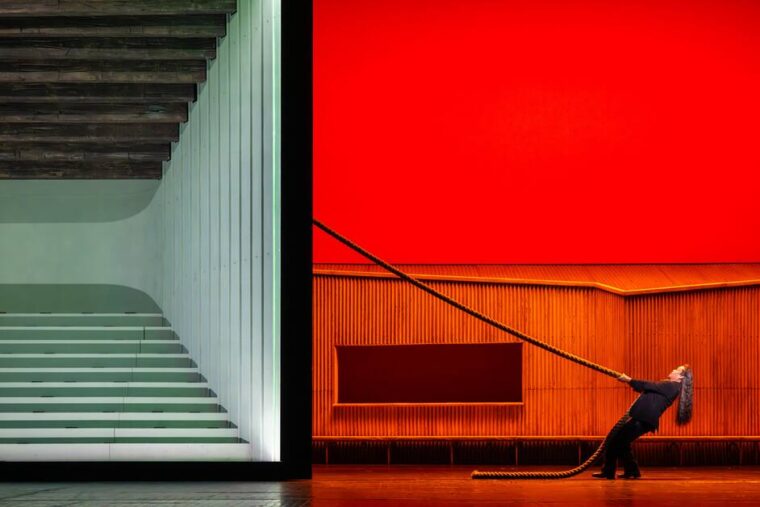
Korean designer Hyemi Shin’s pared-down modernist set for Samson et Dalila is initially framed by orange walls, orange being the colour of the Philistine soldiers’ shirts, which are matched with fetching white-striped teal-coloured trousers. Costume Designer Nicky Gillibrand dresses the Jews in ghetto-grey suits and skirts with white shirts to contrast with the glitz and colour of the Philistines. The temple is represented by a white box filled with raked steps, topped with ancient wooden beams and walls lit up with strips of lights in a subliminal nod to the aesthetic of Daniel Libeskind’s Jewish Museum in Berlin. The design succeeds in acting as an effective and unobtrusive supportive frame for the drama without adding much in the way of context.
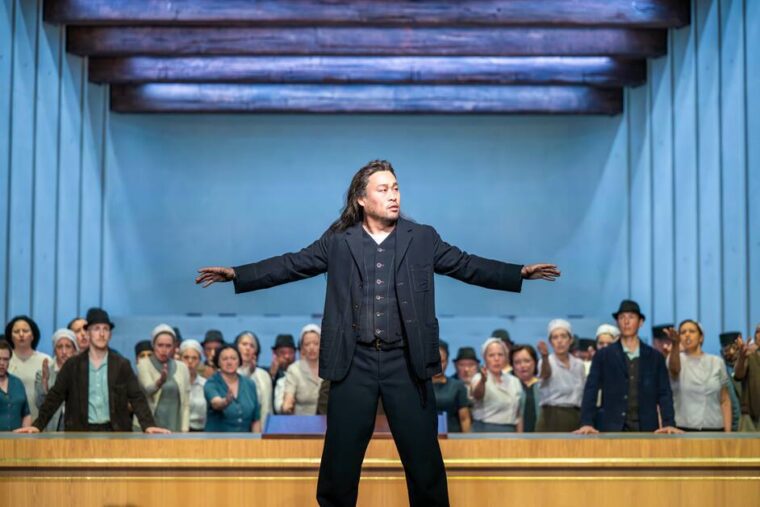
The role of Samson is sung by returning South Korean tenor SeokJong Baek. Last time out, Baek, making both his Covent Garden and role debut, was a last-minute replacement for the injured Nicky Spence. He gives a more mature reading of the role with powerful and dramatically convincing Samson, his roots as a baritone apparent in the warmth of his lower register. The part of Samson does not call for much in the way of nuanced acting, but SeokJong Baek delivers on all fronts, as inspiration to his people (“Arrêtez, ô mes frères”), struggling with his desire for the manipulative Dalila and most poignantly in the love duets.
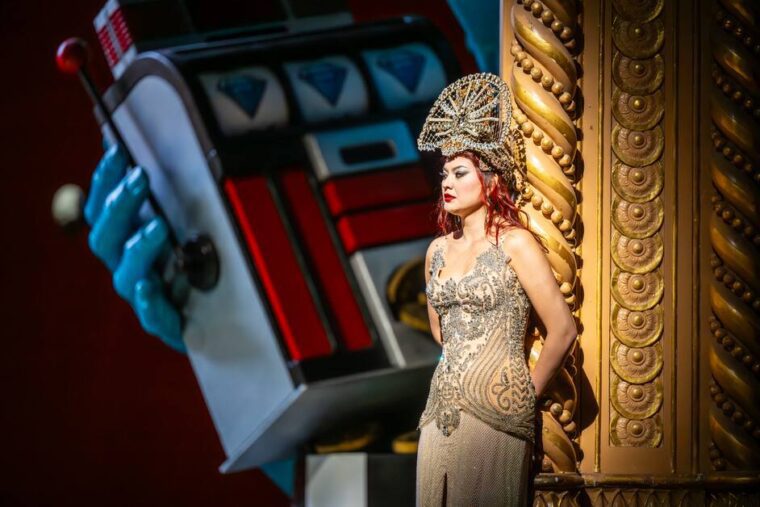
Russian mezzo-soprano Aigul Akhmetshina makes a much more convincing Dalila than Elina Garanca who took the role in 2022. Whilst Garanca has a beautifully limpid tone, Akhmetshina brings an earthy sensuality to the stage and a warm, velvety huskiness to her mezzo tone that allows Samson little chance of escaping her seductive wiles. Akhmetshina is very much the star of the show, and her casting has elevated this production considerably.
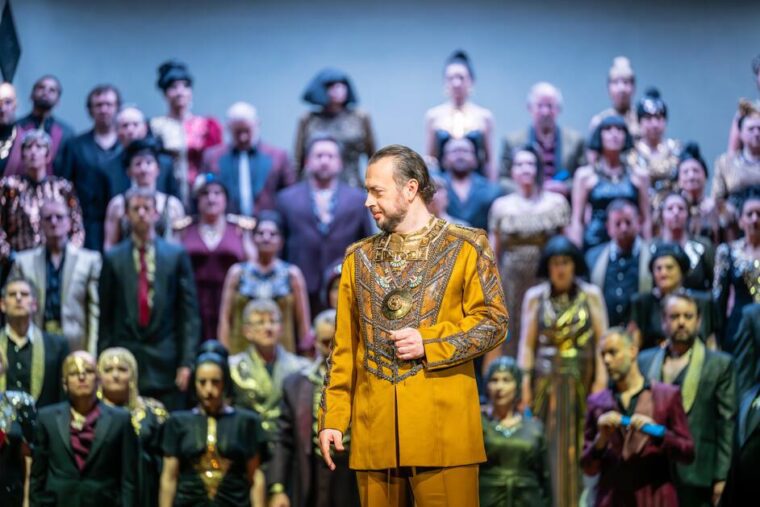
The minor male roles in Samson et Dalila have been well cast with a range of complementary lower-range voices that all impressed. Polish baritone Lukasz Golinski, resplendent in over-the-top gold epaulettes, is another returner from 2022. Golinski was again very strong with a dynamic and punchy performance as the Philistine High Priest (“Qu’enfin une compagne infâme trahisse son amour!“). But new this time around was British bass William Thomas as Samson’s Rabbi. Thomas, excellent as the assassin Sparafucile in the ENO’s Rigoletto, brought his powerful vocal resonance to this most stentorian of roles.
I’m a big fan of British bass-baritone Ossian Huskinson, terrific as the fugitive Cesare Angelotti in the Royal Opera’s Tosca, and convincing here as Abimélech, the Philistine governor.

From the opening descending string line of the overture with its sense of foreboding, conductor Alexander Soddy drove the narrative forward in a passionate reading of the score. The Royal Opera House’s orchestra responded brilliantly, especially in Saint-Saëns’ most lushly orchestrated moments, but there was a balancing issue at the opening with the offstage chorus, so powerful in the recent Peter Grimes revival, being drowned out. Chorus Director William Spaulding has done a fabulous job of marshalling the ROH’s vocal forces into a unit that here traverses the piety of plainchant to the contrapuntal fugal power of “Nous avons vu nos cités renversées” into a thrilling exhibition of dramatic ensemble singing. Movement Director Lucy Burge choreographed a wild Bacchanale to Saint-Saens’ North African-influenced score, with the Philistine priests cutting some pretty nifty contemporary dance shapes blending in the gussied-up chorus, with the less choreographically advanced placed strategically at the back.
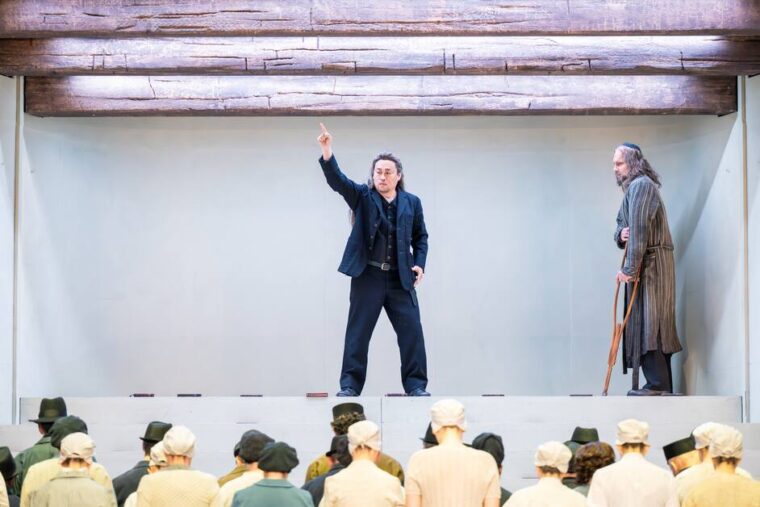
The ending of Samson et Dalila is undoubtedly a coup-de-theatre, eliciting gasps from the audience and genuinely bringing the house down on a production that is one of the best evenings of crowd-pleasing operatic entertainment I’ve seen for a long time.
13 May – 3 June
Royal Opera House
Bow Street
London
WC2E 9DD
Check out our London Opera Preview Winter/Spring/Summer 2026

Leave a Reply