Last Updated on October 22, 2025
Rare ballet and opera double bill sends shockwaves
This mythological double bill from Director Deborah Warner takes a while to reach the white-hot climes of Greek Tragedy, but when it does, it carries an undeniable power. Half opera, half ballet, this production, combining composer Benjamin Britten’s Phaedra and choreographer Kim Brandstrup’s Minotaur, ponders the un-knowability of attraction, and its often-disastrous consequences.
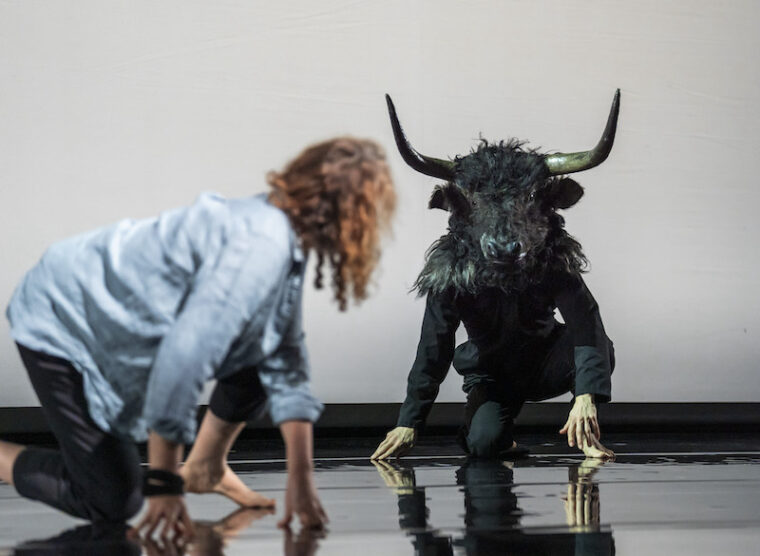
The connection between the stories of Phaedra and Minotaur, for those who wish to brush up on their Greek Myths, is King Minos of Crete. Although the myths vary, Minos marries Pasiphaë, and together they have a host of children, including Phaedra and Ariadne, the ill-fated heroines of Warner’s production.
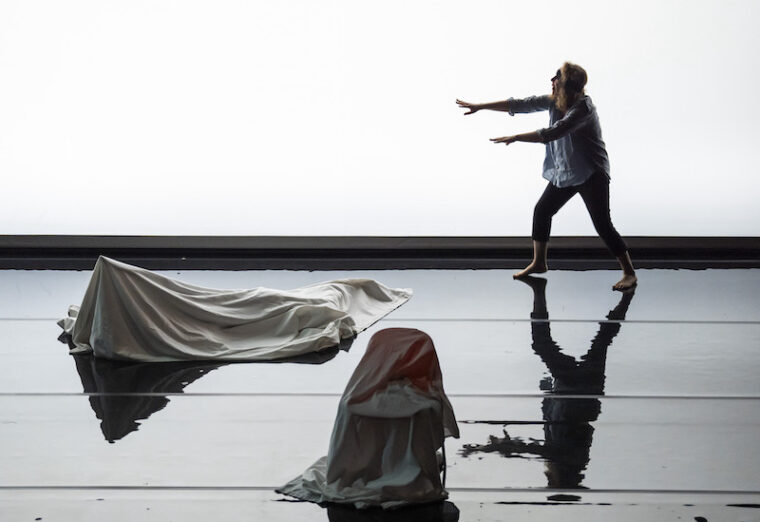
Starting with Britten’s Phaedra, a mere twenty-minute cantata, the production opens on a stark stage, littered only with objects covered in white sheets. The back wall is a strip of digital light, giving the space the feel of an empty house, aided by the presence of a grand piano on its left-hand side. This monochrome landscape is populated by two figures, the esteemed pianist Richard Hetherington, who plays a stripped-back version of Britten’s original score, and Christine Rice as the regretful Phaedra.
Phaedra’s tale is a difficult one, something that Britten’s score doesn’t let us forget, utilising a full range of violent highs and lows. Christine Rice’s powerful mezzo-soprano unfurls Phaedra’s disastrous infatuation for her stepson Hippolytus, whose rejection sends Phaedra into a downward spiral. In Rice’s hands, Phaedra invites sympathy, even though her deeds lead to Hippolytus’s death, and ultimately Phaedra’s decision to end her own life.
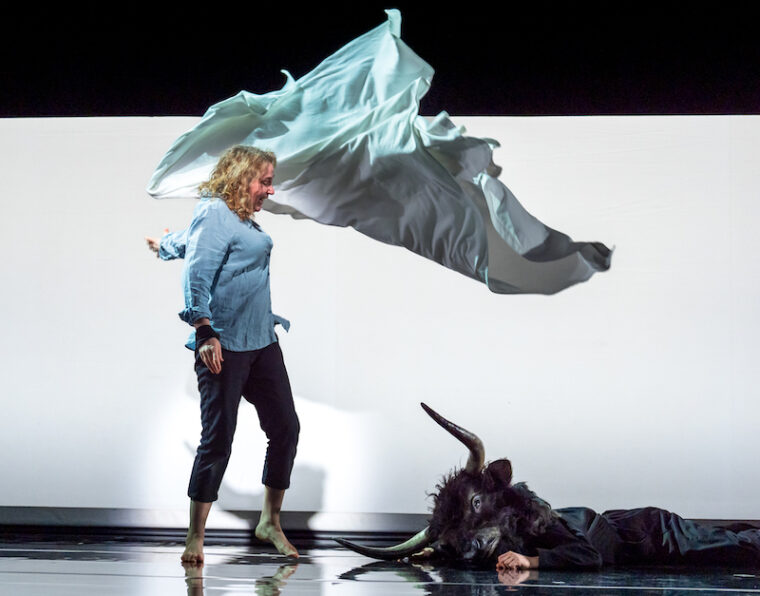
Throughout the performance, Phaedra sequentially unveils the sheets to reveal the dead bodies of Hippolytus and also a Minotaur, a (not so subtle) nod to the following tale. In the end, as the wall of light extends up to the heavens, Phaedra asphyxiates herself with the sheets. Oscillating perfectly between moments of quiet solemnity and full-blown fiery rage, Rice brings her all to this performance. However, it is in the second half of Phaedra’s twenty-minute run, where she truly shines.
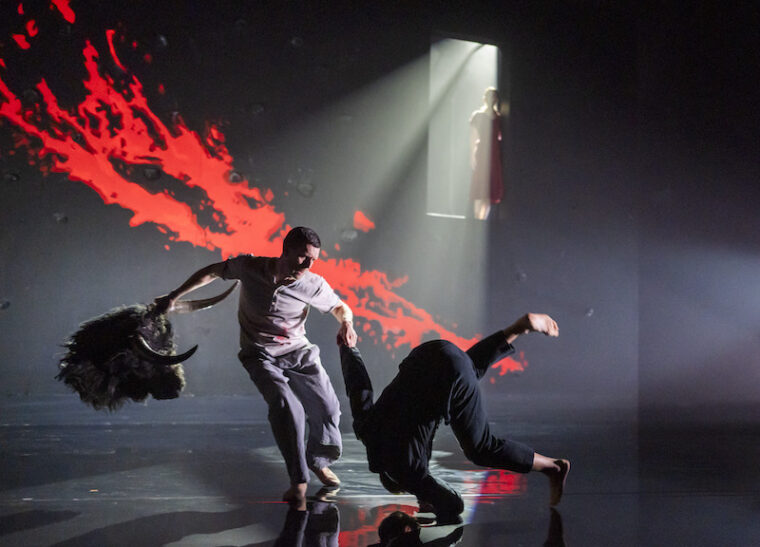
Much like Phaedra, Ariadne is also undone because of her love of a man. On the Isle of Naxos, Ariadne guards the labyrinth where her half-brother the Minotaur was interned. Half beast half man, the Minotaur was born after a curse incited Pasiphaë to sleep with a bull. Theseus, later Phaedra’s husband (and, lest we forget, the father of Hippolytus), is sent to kill the beast. Ariadne falls deeply in love with Theseus and agrees to help him, but once the beast is slain he abandons her, leaving her on Naxos.
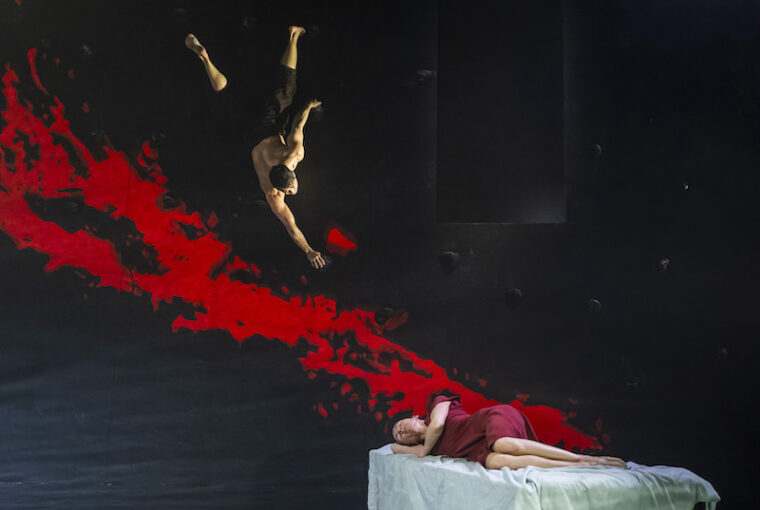
Although Phaedra offers a connection between the two productions with the figure of the Minotaur, there is little that ties the two together visually. Unlike the first act, which was superbly well-lit, Minotaur is characterised by darkness. The back wall is peppered in rock climbing holds, and a singular large streak of red blood, whilst Ariadne’s singular bed and a small stash of paint pots are the only visible scenery. Theseus’s eventual betrayal of Ariadne is beautifully played out on Antony McDonald’s close set.
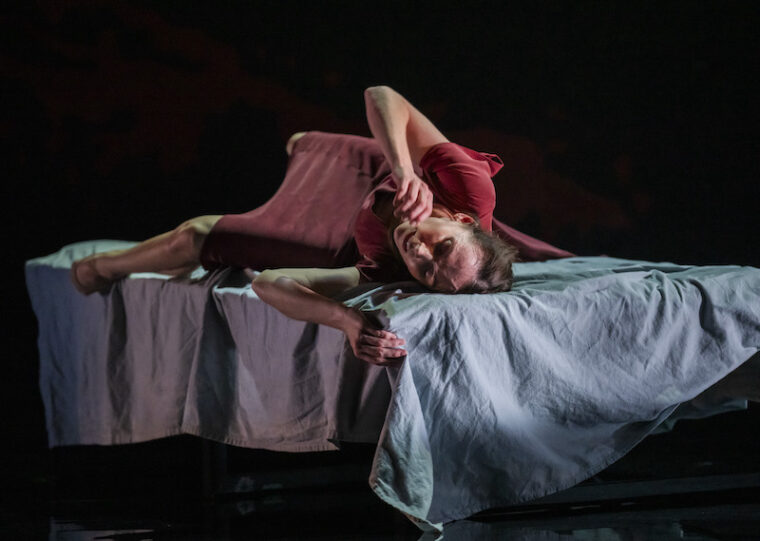
The wonderfully expressive Kristen McNally is Ariadne, whilst Jonathan Goddard is Theseus, with Tommy Franzen as the Minotaur. Together and apart, these dancers illustrate the tale beautifully, in no small part due to Kim Brandstrup’s precise chorographical storytelling. However, it is only at the end of Ariadne’s story that Brandstrup chooses to play the production’s trump card. After being abandoned by Theseus, the god Dionysus swings down from above, using the rock-climbing wall, and falls in love with Ariadne. Portrayed by Tommy Franzen, who descends and scales the climbing wall without effort, Dionysus convinces Ariadne to wed. The spectacle of Franzen’s acrobatics is mesmerising, serving as a reminder of love’s dreamlike wonderment- not to mention, of course, the timeless power of a deus ex machina. Unlike her sister, Ariadne receives a happy ending, even though it is not the one she had originally coveted.
The productions were first brought together (to much acclaim) under Warner’s artistic direction of the Ustinov Studio in Bath, before transferring to the Edinburgh International Festival. The two stories do work well in tandem, but the musical shift from a stripped-back Britten to a compilation of Schubert, Celtic folk music and Kurtag, was more than a little jarring. Still, it is worth seeing Minotaur for the dancing alone, and Christine Rice’s Phaedra is unmissable.
The flurry of four- and five-star reviews that poured from previous productions have resulted in Phaedra + Minotaur’s short stint at the Linbury being already sold out. Never fear, however, this feels like a production that will be revived once again.
Phaedra + Minotaur:
Linbury Theatre: 35-36 Bow St, London, WC2E 9DD
6 – 11 February 2025
Presented with Ustinov Studio, Theatre Royal Bath
For more Opera and Dance both at The Royal Opera House and elsewhere, check our previews for 2025 Dance and Opera in London

Leave a Reply