Last Updated on November 2, 2025
A Fishy Tale…
4.0 out of 5.0 starsI’ve had a ‘Benjamin Britten’ couple of days. Last night’s revival at Glyndebourne of Sir Peter Hall’s classic 1981 Festival production of Benjamin Britten’s ‘A Midsummer Night’s Dream’ was dreamlike and fantastical. Tonight I’m at the Coliseum for English National Opera’s new semi-staged ‘Albert Herring’, Britten’s lacerating chamber opera satirising English small-town mores. The ENO has had some success with their semi-staged productions, including ‘Gloriana’, ‘Duke Bluebeard’s Castle’, and ‘Suor Angelica’, and I’m fascinated to see if ‘Albert Herring’, directed and designed by multi–award–winning Antony McDonald, will suit this pared-back approach.

Britten began composing ‘Albert Herring’ in 1946, directly following the triumph of ‘The Rape of Lucretia’, his first post-war chamber opera. Unlike Lucretia, ‘Albert Herring’ is a spiky comedy in three acts, full of irreverence and irony, and inspired by Guy de Maupassant’s short story ‘Le Rosier de Madame Husson.’ Britten’s collaborator and librettist Eric Crozier transplanted Maupassant’s tale to the distinctly English setting of Loxford, Suffolk, infusing the tale with local references and small-town Anglo archetypes, all playing their roles in the provincial hierarchy.
Albert Herring premiered on 20 June 1947 at Glyndebourne’s smaller venue, as part of the inaugural tour of the English Opera Group. Peggy Ashcroft and Eric Crozier directed, with Britten conducting, and Peter Pears creating the role of Albert. The opera is now a staple in the Britten performance canon. Still, Glyndebourne’s founder, John Christie, was uncertain about programming it, commenting on the opening night, “This isn’t our kind of thing, you know.”
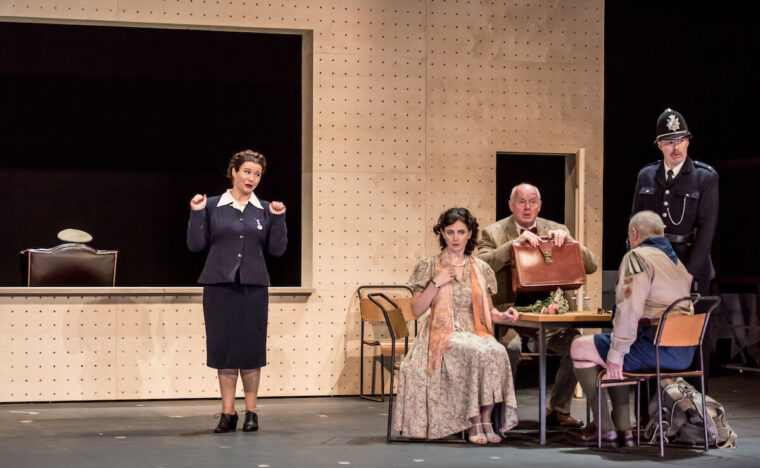
Set in Loxford, Suffolk, Albert Herring unfolds as a satirical portrait of small-town rectitude and rebellion. The village’s ruling class, led by the formidable Lady Billows and her housekeeper Florence Pike, seek a candidate for the annual May King or Queen—a local symbol of chastity (“I want a virgin – not a trollop”). Unable to find a virtuous girl, the committee instead chooses Albert Herring, the meek and model boy who works at his mother’s greengrocer shop, as May King.

Albert, initially cowed by authority and maternal control, is crowned amid much ceremony. His friends Sid and Nancy (sadly not portrayed as punk icons Sid Vicious and Nancy Spungen) spike his lemonade with rum at the banquet, triggering Albert’s night of liberation. Emboldened, Albert disappears from the celebration, causing panic in the village and sparking assumptions of misfortune. When Albert returns the following morning, unharmed and enlightened by his adventure, he throws off his timidity. He rejects the village’s prudish hypocrisy and asserts his independence—transforming from a figure of mockery into a symbol of self-determination.
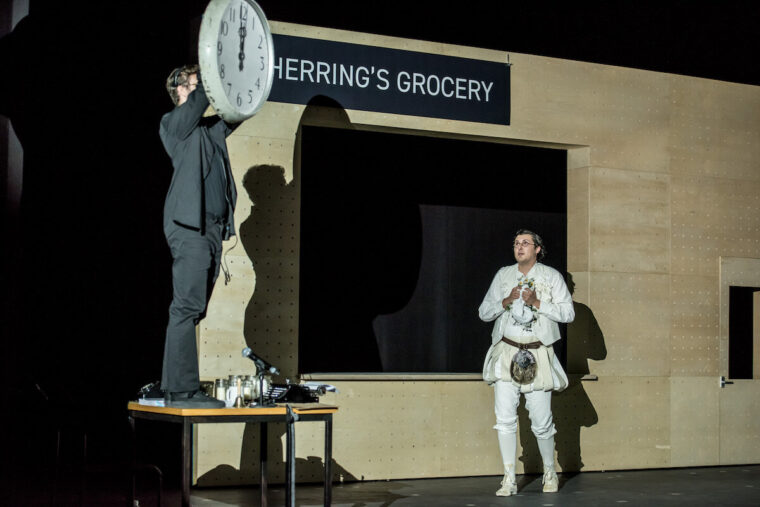
Director and designer Antony McDonald has created a barebones production. Two MDF fabrications serve as shop exteriors and interiors, featuring simple signage. Apart from that, there are some old-fashioned, utilitarian tables and chairs, as well as wooden crates. It works well enough, but why can’t a national institution such as the ENO afford a proper set to showcase one of the nation’s greatest composers? The Arts Council need to hang their heads in shame. Ashton Hall plays the stage manager sitting on the stage, manipulating a big clock and holding up a sign instructing the audience to applaud in the manner of a TV studio manager. It’s a deft comic touch that brings the audience into the performance.
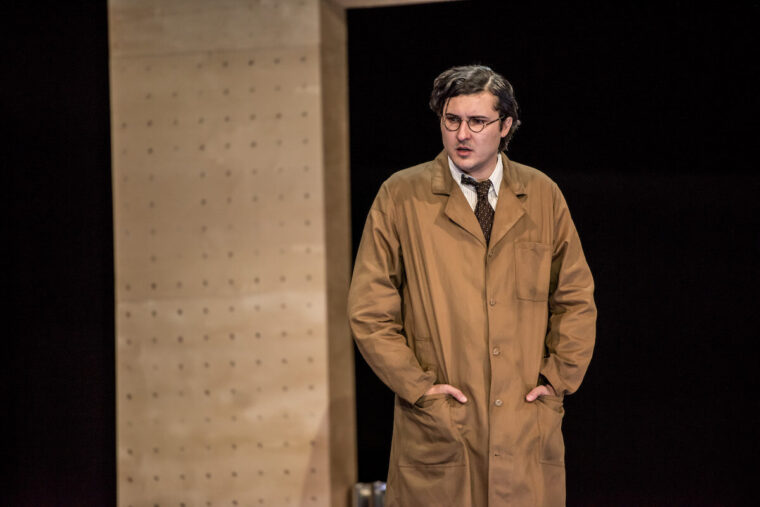
The cast is well-chosen for their roles, and they create a vibrant and distinctly delineated ensemble. Caspar Singh plays Albert, dressed up like a youthful Ronnie Barker from ‘Open All Hours,’ in a brown shop coat and tie, with metal-rimmed glasses. Singh, who impressed as the Young Sailor/Shepherd in Tristan und Isolde at Glyndebourne, has an affecting tenor voice, wringing the pathos out of his character’s lot. Singh owns his character’s discomfort, stiff and self-conscious, as he tries to shrink his tall frame into nothingness, and is mortified to be dressed as a swan in a virginal, white doublet and breeches to receive his prize.
Shopkeeper Mrs Herring, Albert’s overbearing mother, is sung by Welsh mezzo-soprano Leah-Marian Jones, making her role debut. Jones is a seething cauldron of maternal guilt in wellies and chintz housecoat with a characterful vocal delivery that had me apologising for my own many misdemeanours.
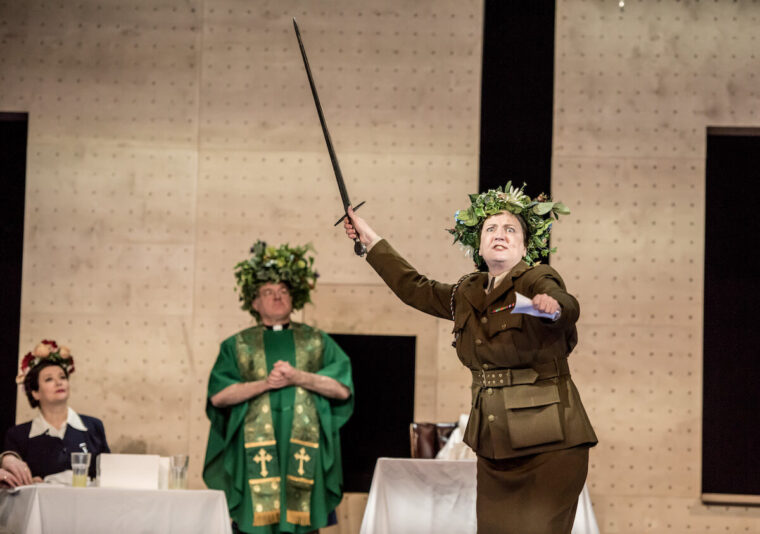
British soprano Emma Bell, brilliant as the Duchess in Rusalka at The Royal Opera House,
gives us Lady Billows, the entitled busybody micromanaging the town’s life. A privileged battle-axe decked out in military uniform, she swings a sword of virtue wildly around the stage to cut out the moral canker in the town. Bell brings her full dramatic soprano voice to the part, creating a posh amalgam of Hyacinth Bucket and Peggy Mount.
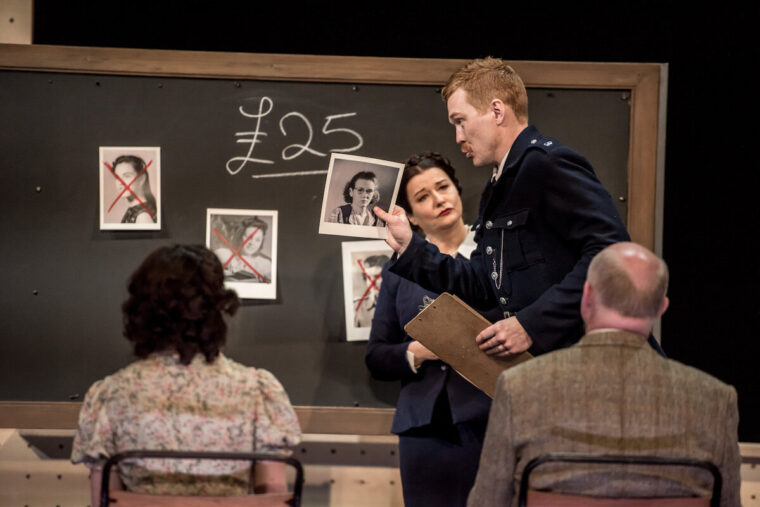
Billows is assisted in her crusade by her housekeeper and aide-de-camp, Florence Pike, Northern Irish mezzo-soprano Carolyn Dobbin, a squirming bundle of repressed sexuality, gleefully striking out the failed candidates for the role of May Queen by marking a red cross on their photos.

The minor roles in Albert Herring are no less convincingly played. Mr Upfold, the Mayor in a tweed suit and maroon bow tie, is played by tenor Mark Le Brocq, his punchy tenor exploding into outbursts of pomposity.

Bass-baritone and former ENO Harewood Artist Andri Björn Róbertsson is the bluff Superintendent Budd. A veritable PC Plod, Róbertsson’s portentious tone is well-suited to the role.

Baritone Eddie Wade as Mr Gedge, the vicar, creepily dressed as a scoutmaster in outsize shorts, leads his flock with hypocritical conviction.
Soprano Aoife Miskelly makes her debut with the ENO as the brittle, spinster schoolteacher Miss Wordsworth, her glistening soprano illuminating her moral conviction.
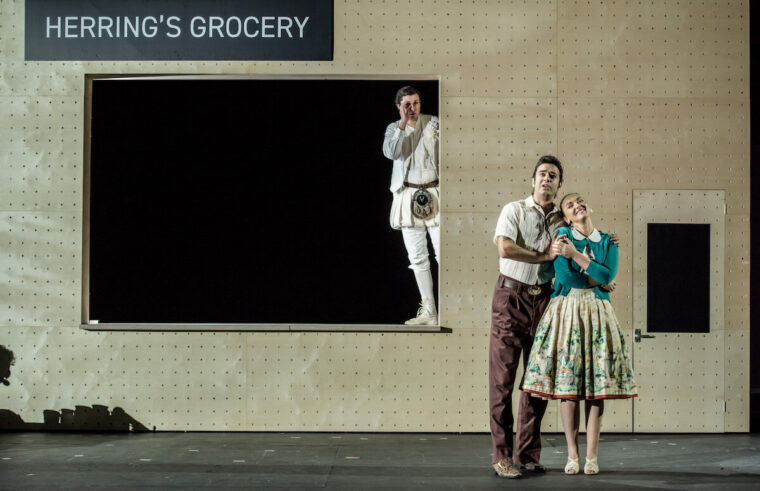
The character of Sid, baritone Dan D’Souza, as a small-town rebel in cowboy hat, and Western bolo tie, is pivotal in the opera. He functions as a sensible big brother to Albert, encouraging him to cut loose by spiking his drink at the party with rum (“How can he sow his wild oats tied to his mum?”) and reminds me of Woody, the amiable cowboy from the Toy Story films. ENO Harewood Artist mezzo soprano Anna Elizabeth Cooper is his girlfriend Nancy, torn between her more libidinous urges and the town’s moral strictures. Albert’s liberation is sealed when, at the end of the production, he kisses both Nancy and Sid, going off in a happy menage-à-trois, hinting, as is often the case in Britten’s work, at a queer subtext.

A special mention must go to Canadian soprano Abigail Sinclair, in her final year of the Opera Programme at the Royal Academy of Music, who sparkled in the child’s role of Emmie.
Conductor Daniel Cohen made a fine ENO debut with an energetic reading of this vibrant score, bringing out of the 13 instrumentalists and singers the multiple contrapuntal threads of Britten’s web of provincial deceit. The final words of Albert Herring – “Jolly good riddance!” left the packed Coliseum audience delighted and cheering the cast and production team to the rafters. The words might just as well have been directed at the Arts Council.
October 13 – 22
English National Opera
London Coliseum
St Martin’s Lane
London
WC2N 4ES
Looking for something different? Check our review of Carmen from ENO at the London Coliseum

Was there for the opening night. Saw lots of critics andi l important music glitterati but did not see you.. what a pity! I had my favourite box.
Your review was excellent, well presented with propoer details of cast and their values.
Unfortunately I did not enjoy it as much as others including my companion. I never laughed.! I did however smile a lot during the last act.
I am a great Brittan fan. Saw AH ony once whch was a fully staged production. My memory is more favorablle. It had moore colour and mirth. Still pleased to have had the experience.