Last Updated on September 20, 2025
Love it or hate it, but don’t miss Il Trovatore this summer.
3.8 out of 5.0 starsThe Royal Opera’s revival of Verdi’s Il Trovatore, directed by Adele Thomas and first unveiled in 2023, returned to the stage last night. This is a production that divides opinion: a theatrical ‘marmite’ that some hail for its dramatic aesthetic, while others contend that the staging detracts from the opera’s emotional heart. The work draws heavily on medieval and religious imagery, particularly inspired by 15th-century depictions of hell and damnation, most notably the Doom paintings found in medieval churches across Europe. As such, perhaps it was appropriate that the undoubted star of last night’s production was Clémentine Margaine as Azucena, who brought the house down with her ‘Stride la Vampa’.
Il Trovatore (The Troubadour) revolves around the themes of love and revenge among four key characters. The titular warbler, Manrico (Tenor Riccardo Massi), routinely serenades Leonora (Elena Stikhina), who is the love interest of Count di Luna (Baritone Étienne Dupuis). Manrico’s adoptive mother, the gypsy Azucena, is blamed for the death of Luna’s brother, and Luna is blamed for the death of Azucena’s mother. These cyclic relationships complicate and deepen the dramatic intrigue, building to an explosive release of tension between the warring factions.

My Colleague, Andrew Lohmann, when he saw the last staging of this production, wrote:
“Il Trovatore can seem at first like a parodistic collection of operatic tropes: Italian, numbers opera, tenor hero, soprano leading lady, bass villain etc., etc. In so many ways, it is an archetype which spawned a nauseating collection of stereotypes. As with so much of Verdi, though, those same cliches are apotheosised into an art form without equal.”
The famous tenor Enrico Caruso is often quoted as saying that “Il Trovatore requires “the four best singers in the world” to succeed” but while last night’s quartet were all great singers, both Stikhina and Margaine offered voices that worked well against the full force of the Royal Opera Orchestra with Carlo Rizzi conducting. Elena Stikhina’s ‘Tacea la notte placida‘ was a perfect, delicate and dreamlike love song, while her ‘D’amor sull’ali rosee‘ had all the dramatic power in the lower range and soared effortlessly to project the sustained and plaintive higher notes. Massi as Manrico cut a fine figure and sang beautifully in ‘Ah! si ben mio’ although ‘Di quella pira‘ seemed a little tired. Étienne Dupuis’ Count was characterised well, but at times was overwhelmed by the orchestra. Two of the Jette Parker artists took up minor roles. Veena Akama-Makia as Ines had a charming stage presence. We last saw Ryan Vaughan Davies as Remendo in Carmen. Here, playing as Ruiz, he was vocally impeccable and characterised the role brilliantly.
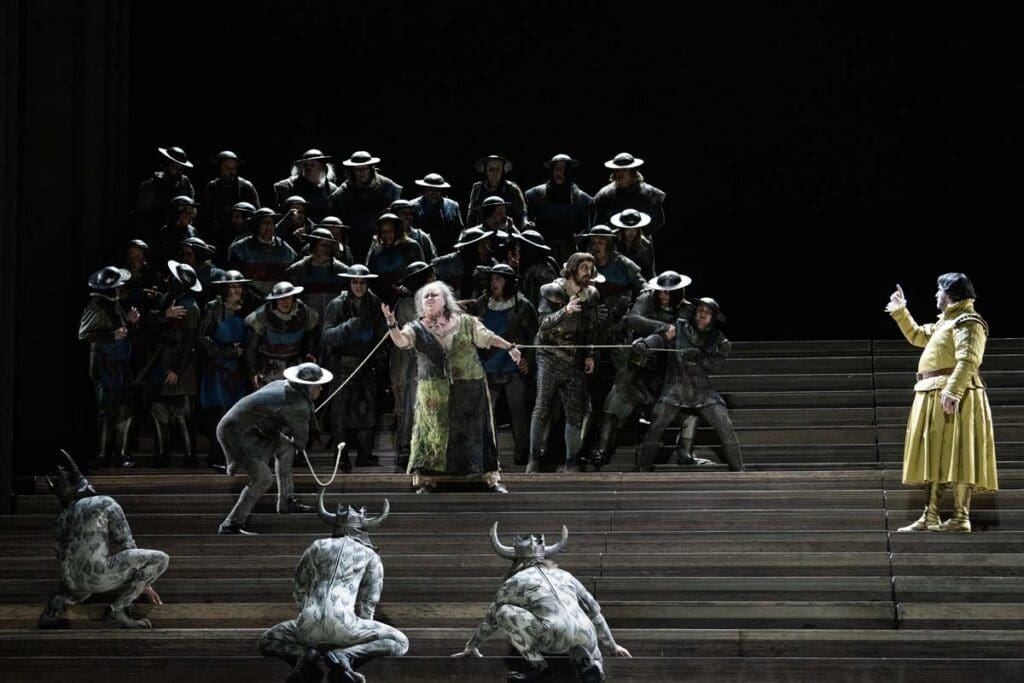
The chorus was on form, with a stunning Anvil chorus that had my neighbour almost singing along in very Un-Royal-Opera style. I approve. It’s too easy to forget that opera was intended as entertainment and, particularly Verdi’s works, had immense popular appeal despite often carrying important political messages. The orchestra, too, played brilliantly, if at times somewhat overwhelming, the singers.

Set against a minimalist grey staircase and inhabited by acrobatic, demon-like figures, for me, the production, with elements that complement rather than detract from Verdi’s brooding score and the opera’s deeply emotional, dramatic core, is a success. However, it’s my third visit to see this production (although I’ve attended dress rehearsals previously), and on each occasion, there has been much muttering in the intervals.
The set is largely bare, leaving the singers and their shocking story open to the audience. Designer Annemarie Wood’s Hieronymus Bosch-themed costumes provide some variety. Daemonic loping lackeys forever flank Luna’s lackey Ferrando, and the gypsy army in the anvil chorus is a riot of striped jerkins. Lighting designer Franck Evin has avoided stylish trickery and focused on the good old-fashioned spotlight on centre stage.

In 1851, at the time he composed Il Trovatore and riding high on the success of Rigoletto, Verdi was the most celebrated Italian composer in Europe. He was, however, far from being creatively sapped or bored to the point of churning out mediocrity.
Whether you leave the Royal Opera House a fan or a sceptic, Adele Thomas’s striking production of Il Trovatore is guaranteed to leave an impression. The bold staging, complete with eerie choreography and stark, symbolic design, continues to divide audiences. But one thing is indisputable: some of the vocal performances are exceptional.

Clémentine Margaine and Elena Stikhina deliver thrilling, emotionally charged interpretations, their voices soaring above Verdi’s dramatic score. The chorus, too, brings both vocal brilliance and theatrical energy to the stage, elevating the ensemble scenes to show-stopping heights.
While some, myself included, may find the ever-present dancers occasionally distracting, Thomas’s vision remains a captivating and audacious take on a classic. See it for yourself—and decide whether you’re a lover or a hater. Either way, you won’t leave unmoved.
8–19 July 2025
Royal Opera House
Bow Street
Covent Garden
London
WC2E 9DD
Looking for something different? We recommend Evita currently showing at the London Palladium

Leave a Reply