Last Updated on January 30, 2026
Inside, Before They Speak Exhibition
3.0 out of 5.0 starsWriters often use the term ‘visceral’ metaphorically, to signify raw, instinctive emotions: but as applied to the current exhibition at the Barbican Curve, Julia Phillips’s Inside, Before They Speak, the term is used quite literally. The exhibition focuses on the Chicago-based artist’s almost obsessive interest in the body, particularly its insides – or viscera – and human conception.
Take, for example, ‘Suspended Interior II’.
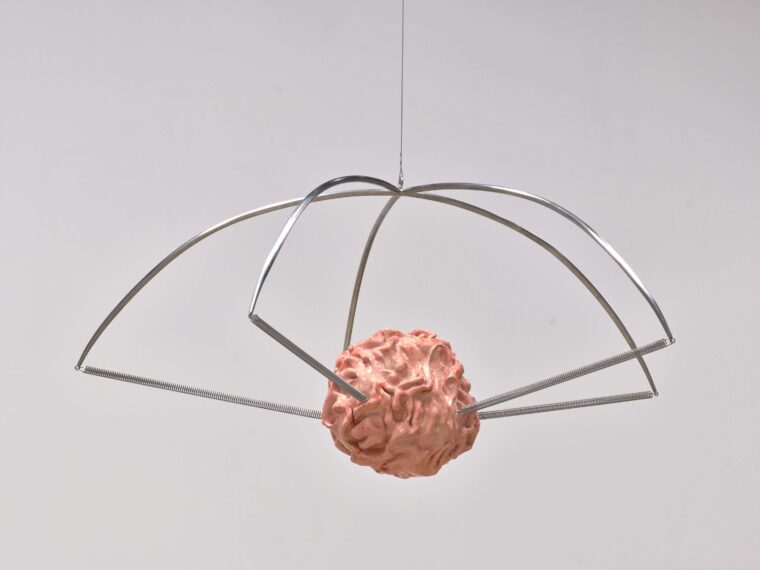
The central mass is immediately reminiscent of intestinal folds, not only for its shape but also because of Phillips’ choice of colour – the visceral pink that dominates most of the exhibition.
Inside, Before They Speak is the German/American Julia Phillips’s first UK institutional solo exhibition, especially commissioned by the Barbican on the 20th anniversary of its programme that asks artists to create or exhibit works particularly suited to The Curve. Phillips’s work sits nicely in The Curve’s specific space, which wraps itself gently around the Barbican Concert Hall, offering the visitor a gradual view of the pieces exhibited – 13 in total in this case.
Just inside the entrance to the Curve, there’s a stand with free booklets; it is advisable to take one as a companion to one’s visit, since this is not the kind of exhibition where the works speak for themselves regardless of context. On the contrary, the booklet provides much-needed context, particularly in its final pages, which offer detailed guidance on most pieces’ intention and what to look for.
A series of four ink drawings entitled ‘Assisted Conception Drawings (I-IV)’ was inspired, the booklet explains, “by the terminology she encountered over two years of dialogue with a friend undergoing donor-assisted fertilisation.” The first, entitled ‘(Un)viable Embryo’ is a sad depiction of a blurry, dissolving, dripping mass; the final one, ‘Cryopreserved Embryo’ shows a clutch of cells, not unlike the kind we often see in scientific drawings.
This sequence is bookended by two rather disturbing instruments, named ‘Inseminator’ and ‘Fertilizer’.
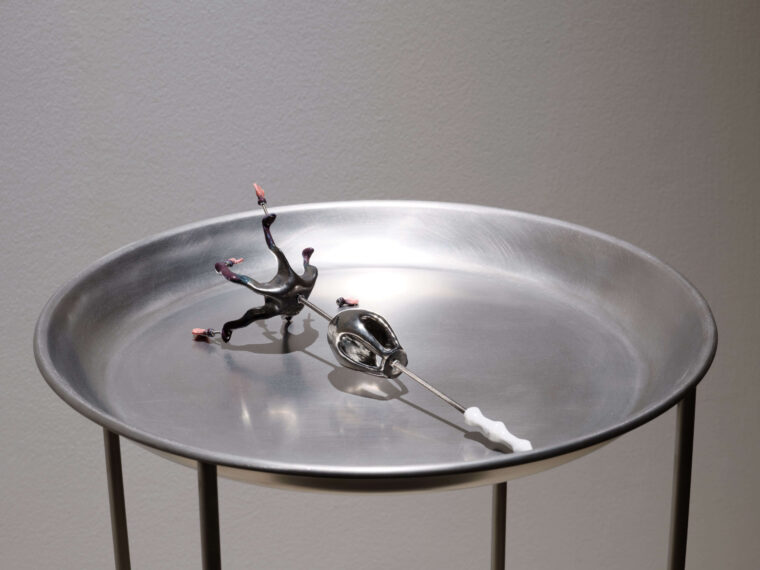
Julia Phillips’s method is very particular: for most of her pieces, she employs a casting process where she presses thin slabs of clay against her body before firing and glazing each ceramic fragment. This doesn’t mean that each piece is a faithful representation of a body part; but most, like ‘Mediator III’, a composite of ceramic and stainless steel, standing above a black granite circle, acquire their own identity, while reflecting the softness of bodily curves.
Not all pieces focus so tightly on the body, and not all use ceramic. Some incorporate industrial hardware, such as clasps or springs. One example is ‘Attachment V, Flexible with Quick Release’. At first sight, it suggests a pimped skipping rope. However, closer inspection, again with a little help from our guiding booklet, reveals a more complicated concept: up top it has two adult-sized grips, mirrored at the opposite end by a pair of child-sized grips. The ropes connecting them are equipped with quick-release clasps. The suggestion is of two interdependent figures, mother and child, perhaps connected, but allowed eventually to disconnect.
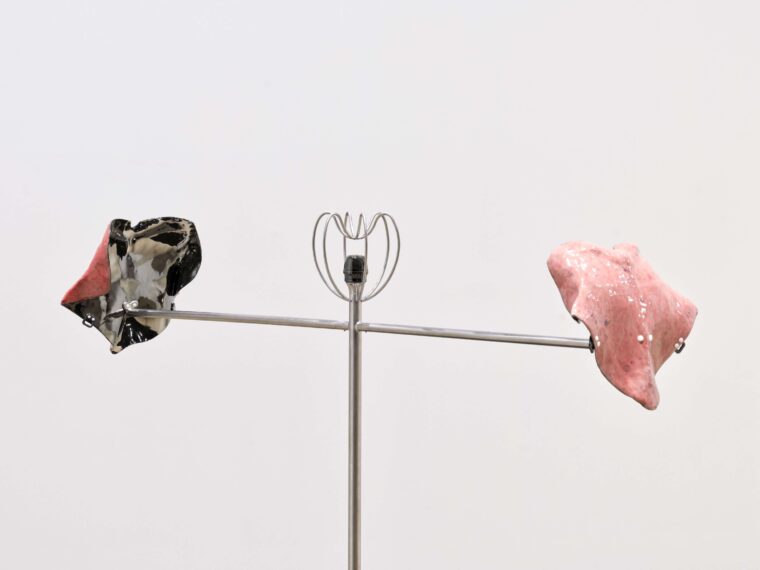
Stainless steel combines with ceramic in ‘Harmoniser’, a pair of partial facial moulds, for once inspired by the outside of the body, rather than its insides.

The booklet also includes an extract from a conversation between Julia Phillips and the British academic Dr Gail Lewis, which allows the reader to delve deeper into the artist’s intentions and broader philosophy. It’s not essential to viewing the exhibition, but it does provide further useful insights into works the full dimensions of which are not immediately apparent.
If you’re prone to queasiness, maybe this one is not for you. Otherwise, though, this is an interesting, unusual, small exhibition, worth a visit.
Julia Phillips, Inside Before They Speak is at the Barbican Curve from 30 January to 19 April. Free
Barbican Centre
Silk Street
London EC2Y 8DS
Looking for something different? Check out Hawai’i – A Kingdom Crossing Oceans at the British Museum

Leave a Reply