Last Updated on February 15, 2026
The New Exhibition at the British Museum presents a Dazzling Display of Hawaiian Culture
4.0 out of 5.0 starsVisitors to the British Museum’s latest exhibition – Hawai’i: a kingdom crossing oceans – shouldn’t be deterred by the sight that first greets them. A huge, snarling image of the god Ku stands ominously beside the entrance, ready for action and suggesting that he and his earthly underlings weren’t to be trifled with. Yet inside, all trepidation fades as you are treated to bursts of brilliant colour and a marvellous array of artfully crafted objects from a culture that celebrated its beliefs and traditions in exuberant style. Feathered cloaks, capes and headdresses once worn by Hawaiian chieftains, bracelets and necklaces, serving bowls, drums, images of gods, helmets, weapons, fans, and puppets are a revelation and enthralling evidence of the society that developed and thrived on the Hawaiian Islands.
Located in the central Pacific Ocean, the Hawaiian archipelago lies in splendid isolation about 4,000 miles from Japan and 2,000 miles from the mainland of the USA. Polynesian settlers arrived on the islands about AD1000. Statues depict the fearsome gods of raw power, who supposedly gave birth to the islands but were protectors too. Once ruled by a variety of chiefs, who were the gods’ earthly representatives, the islands were unified into a kingdom in 1810 by the dynamic chieftain Kamehameha.

![Gallery Image of Hawaiʻi a kingdom crossing oceans [4] © The Trustees of the British Museum, Photo by MKH](https://www.london-unattached.com/wp-content/uploads/2026/01/Gallery-Image-of-Hawai%CA%BBi-a-kingdom-crossing-oceans-4-%C2%A9-The-Trustees-of-the-British-Museum-Photo-by-MKH-760x507.jpeg)
Hawai’i: a kingdom crossing oceans is built around the strong, central story of the relationship between Hawai’i and the United Kingdom. Kamehameha began forging relationships with global powers whose incursions into the islands were having a dramatic and worrying impact, and soon saw Great Britain as a special ally. You can read the letter he wrote to King George III, asking for protection, and admire the stunning feathered cloak he sent as a gift for good measure. But the exhibition especially marks the 200th anniversary of the first royal Hawaiian visit to London. In 1824, Kamehameha’s son, the young King Liholiho, 26, and his wife, Queen Kamamalu, 22, arrived with a bevvy of chieftains and advisors to meet King George IV, hoping to bolster the alliance.
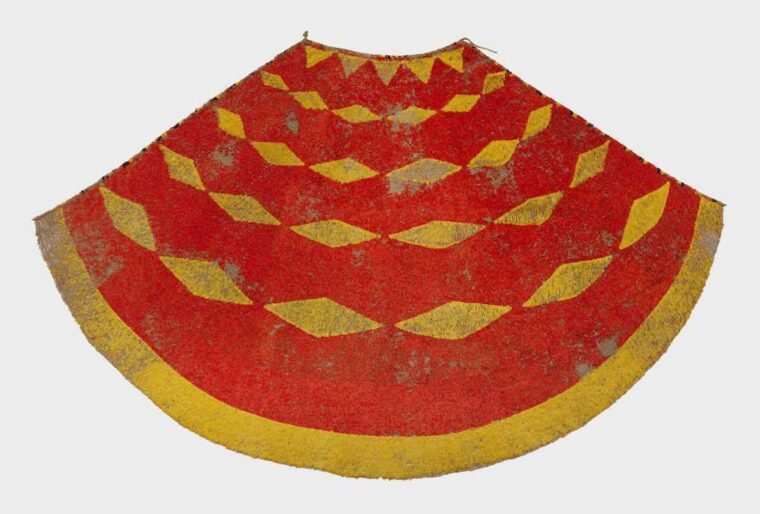
Many objects, including a group of gorgeous cloaks and capes, worn by chieftains to signify power and status, on show here were gifts bought by the delegation for their hosts, some of which are still displayed at times at Windsor Castle. King George IV’s coronation surcoat, in silk and velvet, also on display, looks positively lacklustre and fussy in comparison. Many other objects were acquired over time during the early visits of English ships to the islands. Quite a number were collected during the third voyage of Captain James Cook, who named the archipelago the Sandwich Islands – after the Earl of Sandwich – and was famously killed there in 1779.
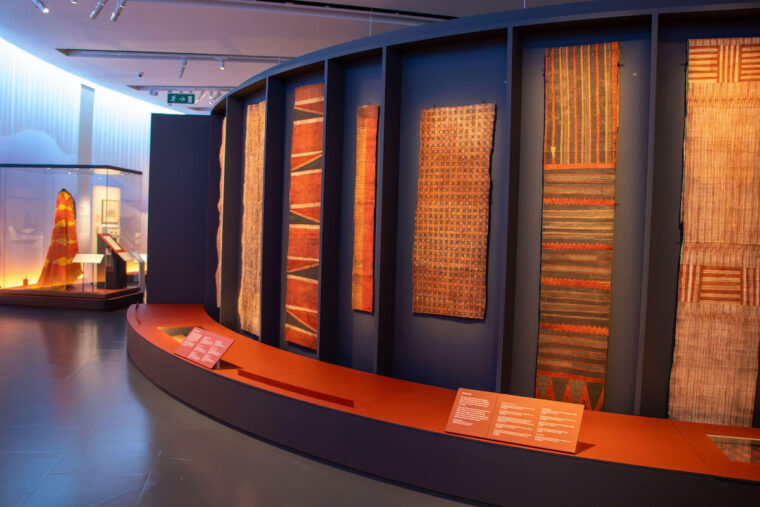
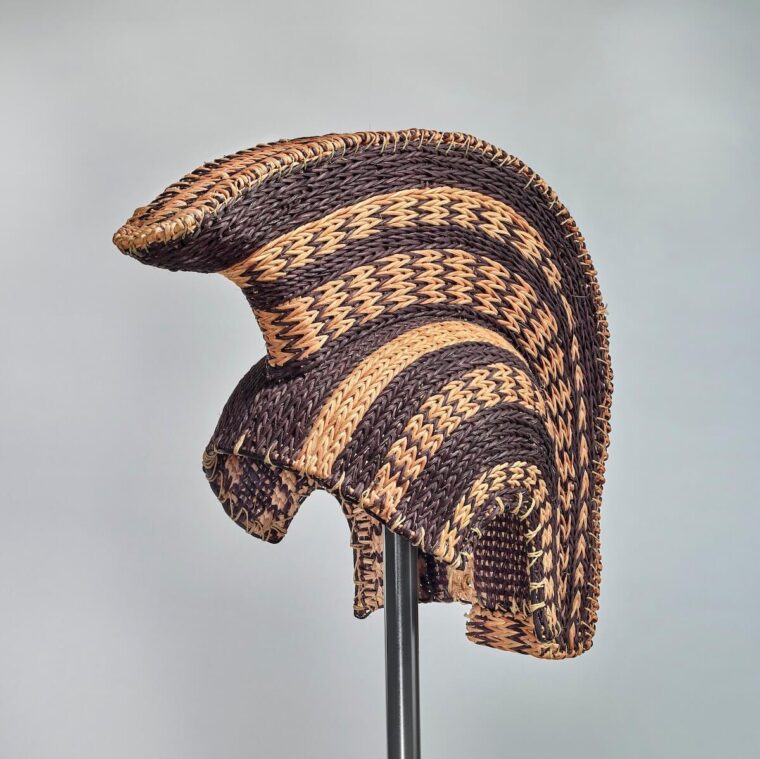
The allure of many objects lies in a marvellous combination of local materials and design: rich, dark-stained wood, brilliant bird feathers, shells, mammal bones and teeth, whale and walrus ivory, human hair, and plants – like barkcloth – were all pressed into service by artists to realise their visions. The elegance of the design of many objects is striking, and in time, you imagine that it must have been an inspiration here; cloaks and capes, made of plants and feathers, and decorated in bold, red-and-yellow geometric patterns, have simple, flowing lines and look completely contemporary. Hats made of coloured plants wouldn’t look out of place in the south of France, and you can imagine the chieftains’ helmets making an appearance on some Parisian designer runways.
The exhibition doesn’t shy away from the dark and sometimes troubling features of Hawaiian society or the turbulent chapters of its history, including its relationship with the United Kingdom. While the Hawaiian royal visitors were welcomed at court and in polite society in England, some ribald satirical prints show that racism was alive and well at the time. Tragedy soon struck, too, when the young royal couple contracted measles and died while they were waiting to meet the king. The arrival of Christianity and the missionaries on the Hawaiian Islands wasn’t a good moment either, and Liholiho’s cousin was killed trying to defend the old beliefs. While the local birds survived having some of their feathers harvested, many are now endangered or extinct after foreign diseases arrived on the islands.
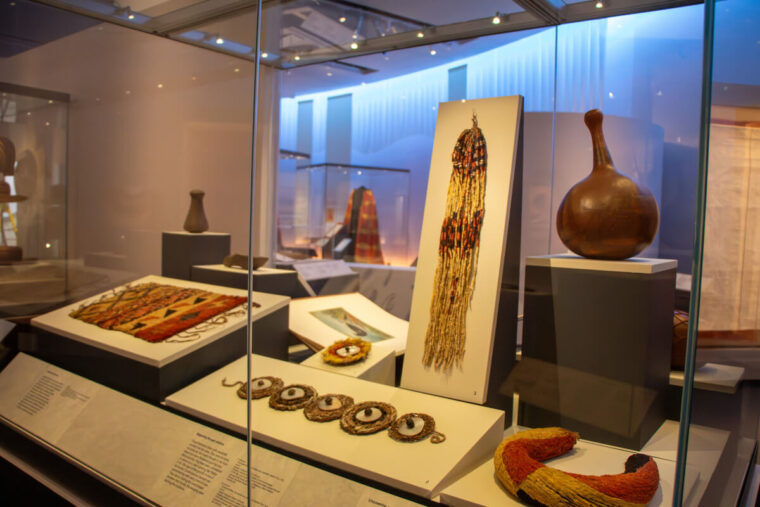
What is especially thrilling is that the exhibition not only includes objects that are centuries old, but those crafted today by Hawaiian artists who have mastered the considerable skills of their forebears. Just inside the entrance is a magnificent drum, hand-carved by contemporary artist Dennis Kana’e Keawe, with a base of interlocking figures, from Kamani wood, shark skin and coconut cord. It’s a replica of one you’ll see soon after. A display of helmets – worn by chieftains – and hats includes some ancient originals and copies made recently beside them.
![Gallery Image of Hawaiʻi a kingdom crossing oceans [5] © The Trustees of the British Museum, Photo by MKH](https://www.london-unattached.com/wp-content/uploads/2026/01/Gallery-Image-of-Hawai%CA%BBi-a-kingdom-crossing-oceans-5-%C2%A9-The-Trustees-of-the-British-Museum-Photo-by-MKH-760x507.jpeg)
There are videos here, too. One shows artist Hina Kneubuhl demonstrating how she makes Kapa – or barkcloth – which was put to all kinds of uses and nearby you can see some decorated pieces featuring bold, colourful designs. Another shows La’akea Perry, a master teacher of the kumu hula dance, which honoured the gods and chiefs, explaining the dance and showing how it’s taught today.
Sadly, the independence of these islands wasn’t to last. George IV promised his protection to the islands, and after a rocky period, the United Kingdom and France recognised the Hawaiian kingdom’s independence in 1843. But, eerily enough for us today, the Hawaiian kingdom was illegally overthrown by American businessmen in 1893 and a plea for help to the United Kingdom fell on deaf ears. In 1898, the islands were annexed by the United States and became its 50th state in 1959. Whatever the political upheavals of the past, however, the skills, artistry and distinct creativity of the people of the islands, so wonderfully displayed here, live on, preserved and honoured by Hawaiian artists today.
Hawai’i: a kingdom crossing oceans
British Museum, Great Russell Street, London, WC1B 3DG
15 January – 25 May, 2026 in the Joseph Hotung Exhibition Gallery
Saturday to Thursday 10.00 – 1700, Friday 10.00-20.30
Looking for somewhere to eat in the area? We recommend Bistro Bleu
Leave a Reply