Last Updated on March 3, 2026
1066 and all that – Elizabeth Wardle’s Arts and Crafts Bayeux Tapestry.
What must it have been like for the women of Canterbury who embroidered the authentic Bayeux Tapestry? Imagine your country has just been conquered, and you have to spend the next few months making a celebratory embroidery for the enemy. The 70-metre embroidery tells the story of the Battle of Hastings and of life in 11th-century England before and after the Conquest, all in remarkable detail, with images of castles, battles, feasts, and even potential fornication in the Ælfgyva mystery, Ubi unus clericus et Ælfgyva. The Bayeux Tapestry depicts the last time England was successfully invaded and marks the beginning of the modern monarchy.

Believed to have been commissioned by a Norman patron, it was probably based on manuscript drawings of the period. Most historians believe it was commissioned by Odo, Bishop of Bayeux, William the Conqueror’s half-brother, partly because there are numerous images of Odo himself. It was likely created to decorate the newly built Bayeux Cathedral, dedicated in 1077. Although it was nearly destroyed during the French Revolution and was taken to Paris by the Nazis during the Second World War, it always returned to Bayeux and today is housed in the Bayeux Museum in Normandy. Now, for the first time in nearly a thousand years, the Bayeux Tapestry is returning to England in September and will be on display at the British Museum.

For those who are impatient to gain a greater understanding of the tapestry, there is an easy solution, and one that is fascinating in its own right. ‘Britain’s Bayeux Tapestry’ was created much more recently, between 1885 and 1886, by the Leek Embroidery Society in Staffordshire, led by Elizabeth Wardle, who had visited the Bayeux Tapestry in France with her husband Thomas. He was a master silk dyer who worked closely with William Morris to revive traditional vegetable dyes. Elizabeth decided to produce a full-size replica of the embroidery, hand-stitched on a linen backing using woollen yarns just like the first version.
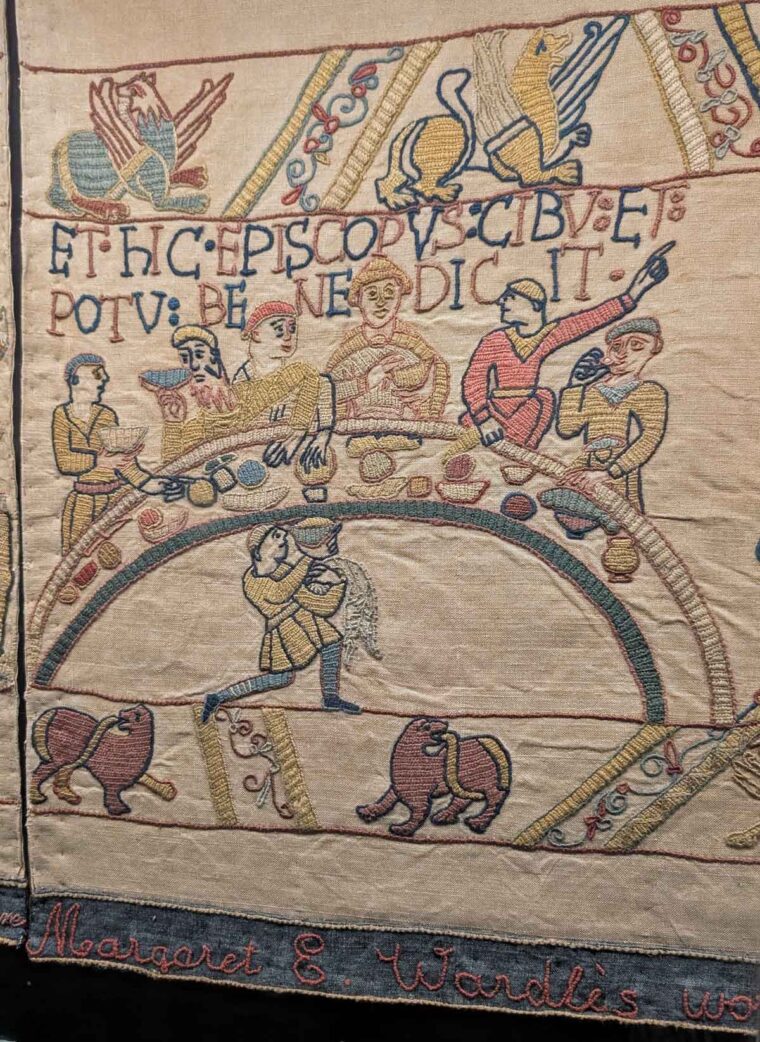
The husband-and-wife team were well placed to manage such a project, given their deep interest in medieval arts and crafts. Thomas researched and recreated historically appropriate colours using vegetable dyes to approximate the authentic medieval palette, and he ensured that traditional stitch techniques were used throughout. The couple were deeply involved in the Arts and Crafts movement, which sought to revive medieval craftsmanship, and the project is fascinating on many levels.
I travelled to Reading, just 20 minutes from Paddington by train to see for myself. Britain’s Bayeux Tapestry is slightly taller than the original because it includes an extra blue border at the bottom, where the 35 women who copied it recorded their names beneath the sections they embroidered. Based on tracings taken from full-sized hand-coloured photographs in the V&A Museum, there are a few differences from the original version, including the addition of underpants to one of the naked men, an alteration made by the museum itself to the photograph.

When the embroidery was completed, it was first exhibited in Leek in June 1886 and then displayed across Britain, Germany and America. The women were paid a percentage of the revenue from the exhibitions, based on how much each had embroidered. In 1895, the replica arrived for exhibition at Reading Town Hall. At that point, Alderman Arthur Hill, a local philanthropist and former Mayor, offered to buy it and presented it as a gift to the city of Reading.
In 1993, a permanent tapestry gallery was opened at Reading Museum, and that is the display we can see today. I have not seen the original, but apparently the replica is brighter and more vibrant, perhaps because it is considerably younger. It is truly fascinating and well worth seeing.

If you are determined to see the actual Bayeux tapestry when it arrives at the British Museum, you should register now for the museum’s newsletter in order to secure advance tickets. Whether or not you intend to see the original, it is certainly worth visiting Reading Museum to see Britain’s Bayeux Tapestry. It is an excellent way to avoid queues, get close to the embroidery, which you are very unlikely to be able to do at the British Museum, and spend time examining the elaborate detail.
Who knows, you may even solve the Ælfgyva mystery. Historians continue to debate that, with theories including a royal scandal involving Cnut the Great, who was linked to Ælfgifu of Northampton, a broken marriage alliance involving William the Conqueror and an English noblewoman, or just to misconduct by a member of the clergy, suggesting moral corruption in England before the Norman Conquest. Whatever the explanation, you will no doubt be relieved to discover that the naked man in the replica has been given trousers. Then, if you do make it to the British Museum, you can look out for the unadulterated version (no pun intended).
Reading Museum is open from Tuesdays to Fridays from 10 am to 4 pm and on Saturdays from 10 am to 5 pm. There are Bayeux Tapestry Tours on Saturday afternoons. The museum is free to visit, with a suggested donation of £5
Reading Museum
Blagrave Street
Reading
RB1 1QH

Responding to demand, Reading Museum now have 3 guided tours a week on Tuesday, Thursday and Saturday afternoons. https://www.readingmuseum.org.uk/whats-on/bayeux-tapestry-tours
Thanks Alex – I relly enjoyed my visit!