Last Updated on February 15, 2026
A message of unity in a fractured world
HUMANHOOD ∞ {Infinite} - Sadler's Wells East - Review

Part dance production, part meditation, HUMANHOOD’s ∞ {Infinite} is an unusual hybrid of contemporary dance, meditation and new age philosophy
Event Type: Event
Event Attendance Mode: OfflineEventAttendanceMode
Event Status: EventScheduled
Performer: Organization
Performer Name: HUMANHOOD
Start Date: 2025-02-12 14:23
Availability: InStock
Availability Starts: 2025-02-12T14:23:50
3.5
Billed as part dance production, part meditation, HUMANHOOD’s ∞ {Infinite} is an unusual hybrid of contemporary dance, meditation and new age philosophy where dancers and the audience “get so lost in the act that the act becomes art” (a quote from the show’s creators).
It’s not often that a brand new theatre opens its door in London, much less that I get to visit such theatre in its first week of operation – and yet that is exactly what I got to do this week. The brand new Sadler’s Wells East, a sister theatre to their much-loved premises in Islington, opened to the public on 6 February. Designed by Irish architects Odonnell + Tuomey, it occupies part of the 2012 Olympic Park and forms part of the Stratford East cultural quarter which also houses the BBC, UAL’s London College of Fashion, UCL and a branch of the V&A. It is hoped that the theatre will aid economic regeneration of the area and the plan is that at least 50% of jobs created by the venue will go to people from the four local boroughs of Hackney, Newham, Waltham Forest and Tower Hamlets.

The imposing brick building houses a beautiful modern auditorium with a stage of the same generous dimensions as Islington’s and 550 steeply raked seats redolent with the scent of freshly cut wood; a wraparound foyer with two bars and a space for community groups/artists performances; six dance studios; and two dance schools (the Academy Breakin’ Convention hip-hop youth theatre school and the Rose Choreographic School). The theatre will host all forms of dance, from classical ballet to contemporary to hip hop and beyond, but the clean modern setting lends itself particularly well to contemporary and experimental dance. My only niggle on the night I visited were the two long queues for bag searches which snaked through the entire length of the foyer, confusing patrons and making it hard to move around – surely the searches are better done at the entrance to the building as is the case in Islington?
∞ {Infinite} is the brainchild of dancer-choreographers Julia Robert and Rudi Cole, co-founders of HUMANHOOD. Rudi graduated from the Northern School of Contemporary Dance in Leeds and subsequently worked with several renowned choreographers and companies, including Akram Khan for the London 2012 Olympics Opening Ceremony. Julia trained at the Institut del Teatre in Barcelona where she honed her skills in both classical and contemporary dance and has also worked with several renowned choreographers including Akram Khan and Jasmin Vardimon. Their research into ancient traditions and practices including Chi Gong, yoga, African dance and meditation informs much of their work and infuses it with a spiritual character. As a choreographer, Julia’s work is characterized by its fluidity and the deep connection she creates between movement and the natural world – something very much in evidence on stage in ∞ {Infinite}.

As the auditorium lights go down, a “meditation guiding voice” over a soundtrack of jungle noises and distant rolling thunder tells us that we have arrived at this place in time and space to discover the infinity within ourselves. This will either delight you or induce a bout of eye-rolling – but it does pretty accurately set the tone for the rest of the mysticism-tinged, universal interconnectedness ethos of the performance. The lighting is atmospheric and excellent throughout, augmented by periodic clouds of “mist”. The curtain rises to reveal an atmospheric bare black stage punctuated only by rolling mist and seven dancers (with creator Rudi Cole among them) in loose-fitting non-gendered trousers and tunics, standing with their backs to the audience while a drumbeat as regular as a heartbeat reverberates hypnotically. Slowly, almost imperceptibly at first the dancers pivot to face the audience and transition from stillness to movement which continues impressively unabated for the remainder of the 75-minute, no-interval show. Almost all the dancers remain on stage for the full duration and Iain Armstrong’s varied soundtrack provides a clear delineation between segments.
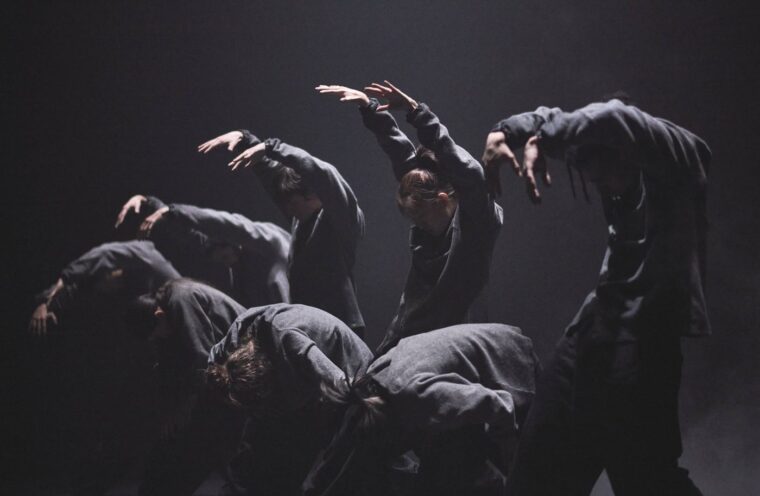
We are taken on a journey through the four elements of water, earth, wind and fire, each with its own soundtrack and movements. The soundtrack for the initial Water segment was my favourite and hovers somewhere between Peter Gabriel’s Ovo album and Depeche Mode’s industrial sounds on Black Celebration, before a segue into Sash’s Mysterious Times. From the outset the dancers move with a fluidity unconstrained by the rigid confines of classical dance, perfectly mimicking the fluidity of water and it is hard not to experience a feeling of calm watching their perpetual motion. Throughout the segment, the movements vividly evoke rolling waves crashing on a shore; swimmers moving through water; and the mesmerising sway of an underwater kelp forest, all of which have an almost hypnotic effect.
The Earth segment is introduced by a voiceover telling us that we are all connected – “When I breathe, you breathe, the universe breathes”, foreshadowing the collective movements of the section. Rather than straight wave-like lines of Water, the dancers move in a roiling mass rather like an octopus with tentacles which may extend but ultimately always pull back into a group as if by the planet’s gravitational pull. At other times, they form a circle and the rising and falling limbs call to mind a flower’s petals opening or a sea anemone’s tentacles opening and closing. There is a playfulness and joy to the movements, like watching children play unselfconsciously. Special mention must also go to the lighting in this segment which seamlessly follows the group of dancers around the stage and reinforces their group cohesion as nobody dances beyond the spotlight.
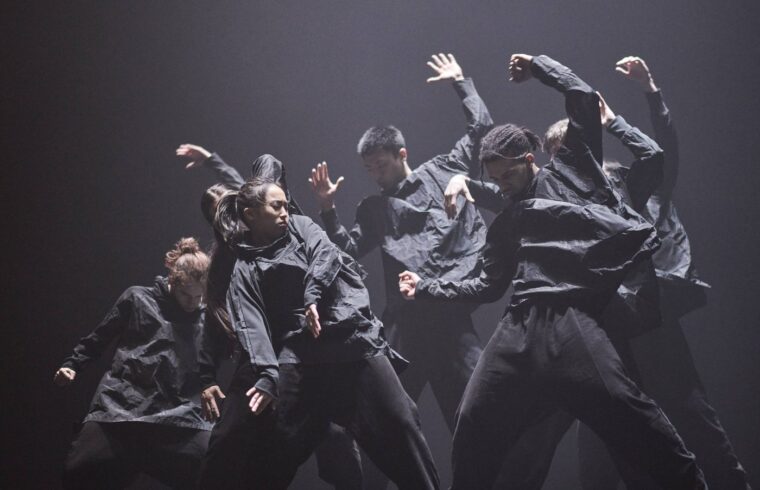
The Wind section opens with a single dancer in a spotlight wielding a wooden foil on the end of a cord. He sings the cord deftly around to create not only dynamic visual imagery but also mimics the wind as the foil spins through the air. Slowly the other dancers join him from the shadows before forming a wide circle around and. For the rest of the segment, they circle him and perform more powerfully defined movements that recall the martial arts moves of Shaolin monks. For the final Fire segment, dancers are bathed in red light and take to the stage jumping on the spot like Masai Warriors to Votiv by Dorisburg featuring a heartbeat-like rhythm. The jumping is hypnotic – atavistic and primal – while also evoking the joy of movement and shared community activity. It does not surprise me to read that while researching ∞ {Infinite} Julia and Rudi travelled to Papua New Guinea for field research with an indigenous tribe in the PNG highlands. Towards the end of the section, the dancers dance with hand globes which resemble fireflies in the dark before ultimately “disappearing” into the dark below glowing orange lights via a clever visual trick. The show ends with another breathy voiceover telling us to breathe, go forth and embrace the universe, which will either exasperate or exhilarate you.
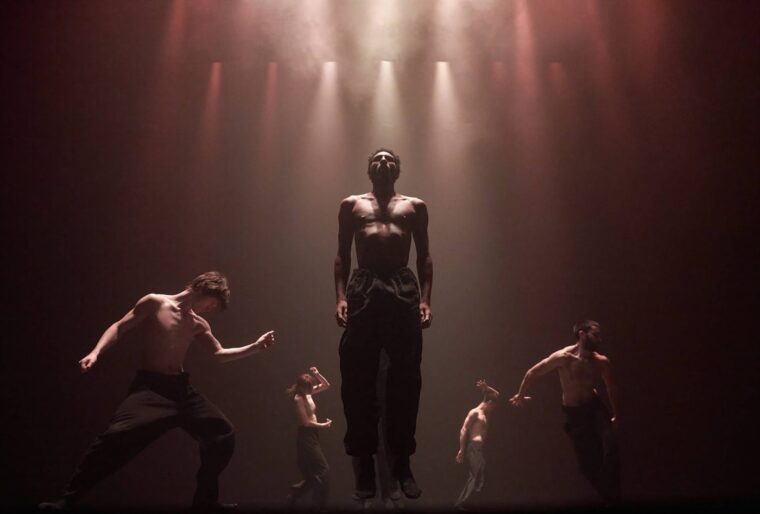
The dancing throughout the show is excellent and the choreography is to classical ballet as Birkenstocks are to Jimmy Choo stilettos – one constrains natural movement, the other positively celebrates it. The dancers are powerful and expressive, their movements strong, organic and expansive. At times they seem to be stretching as you would after a good nap and at other times, they call to mind the completely instinctive and unaffected movements of children at play, fully inhabiting the joy of their bodies.
“The dance itself is a formless and unseen flow; it is felt deep within, both in the dancer and the observer”, writes Julia, and this is very much the ethos of the piece. It aims to evoke feelings in the audience (as in the dancers) but does not trouble itself with a storyline as such, or even points of dramatic tension or conflict in the dance sequences. Much as the dancing is beautiful, fluid and impressive (and I think more accessible to young audiences than classical ballet), ultimately the piece suffers from a lack of narrative or emotional touchpoints. The slightly affected breathy voiceovers also make the whole thing feel a bit like an extended yoga class warm-down (which makes sense in the context of HUMANHOOD’s courses that use dance as “a catalyst for self-realisation”). But overall it is a well danced, beautifully lit contemporary piece of a kind that may well introduce and attract a new audience to the theatre.
Humanhood ends its sold-out run tonight, 15 February.
PEDESTRIAN ACCESS:
Stratford Walk
Queen Elizabeth Olympic Park
London
E20 2AR
VEHICLE ACCESS:
101 Carpenters Rd
London
E20 2AR
For more check our dance previews for 2025

Leave a Reply