Last Updated on March 1, 2026
Futuristic Dance Piece Narrated by Tilda Swinton
2.0 out of 5.0 starsFirst things first: the Coronet Theatre’s determination to present new, ground-breaking, often challenging international work, some of which would probably never be seen in this country otherwise, is admirable. A look at this historic Notting Hill venue’s programme for any given season will reveal a cornucopia of poetry, theatre, puppetry, dance, visual arts and multi-disciplionary shows by national and international artists. All find it easy to feel at home in the Coronet’s unique setting: a semi-circular stage set before a raked audience space, with immaculate sightlines, its distressed walls as quaint as its inviting bar.
No wonder it’s acquired a loyal audience; on any given evening you’re unlikely to find an empty space among its 195-seat capacity. Inevitably in such a daring, deliberately risk-taking venture some things are sure hits, others, sadly, misses.
Very slow and ponderous, Neon Dance’s Last and First Men slots into the latter category. An ambitious assembly of film, the spoken word, sound score and movement, it is a sci-fi tale set 2,000 million terrestrial years into the future, where a future race of humans finds itself on the verge of extinction.
The final film by the Icelandic composer Jóhann Jóhansson runs continuously on a large screen at the back over the piece’s 65 minutes’ duration, its monochrome images mostly of harsh, monumental carved rock masses, or geometric planes from vast stone buildings, flowing at a very sedate pace, accompanied by Jóhansson and Yair Elazar Glotman’s sound score, that relies on surging bursts of electronic sound and indistinct chanting. Nico De Rooji’s hazy lighting aims for an otherworldly effect.
Tilda Swinton narrates a text adapted from Olaf Stapledon’s 1930 sci-fi novel Last and First Men, from which the piece derives its name. She begins by urging us to “listen patiently” – little did we know at that point just how far our patience would be tested in the following hour or so.
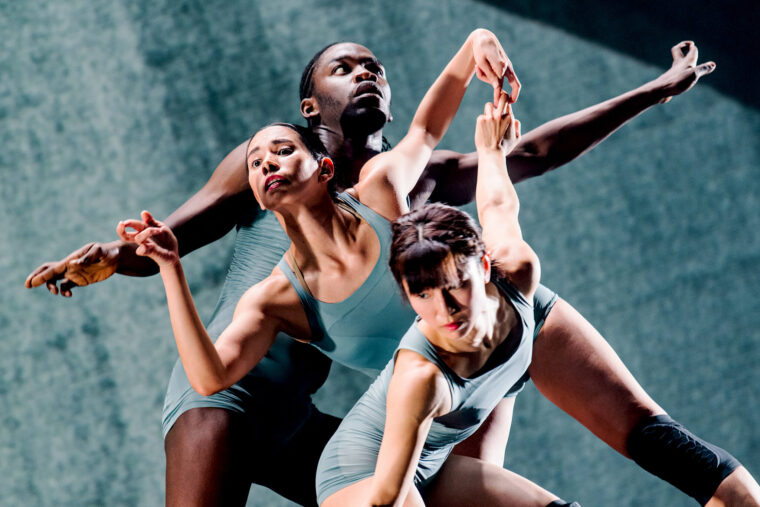
Three dancers – Fukiko Takase, Kevin Kilonzo and Aoi Nakamura – walk on very slowly. First the two women take centre stage and stand immobile facing each other. Enter the man moving at a crouch, two pointed white sticks rising either side of his calves. Those sticks will later be detached from his legs and instead become attached to the women’s hands. No, I don’t know what they symbolise.
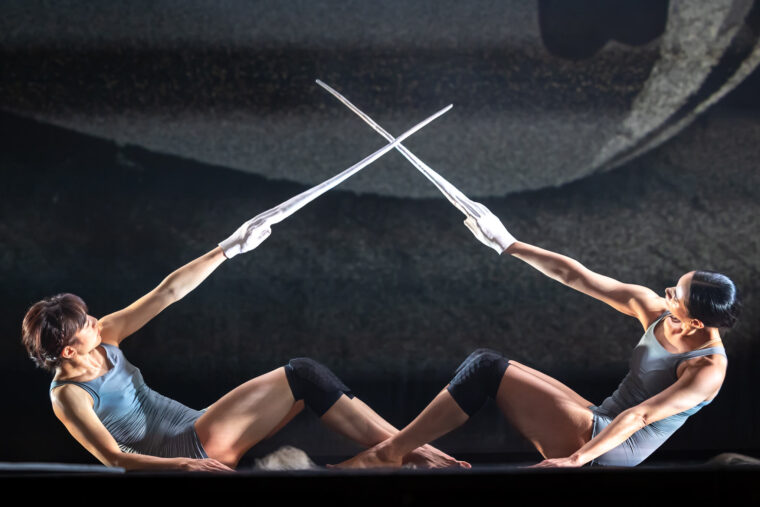
He circles the stage at a glacial pace. All three wear grotesque black ankle boots with very thick rubber soles, the meaning of which escaped me, unless it was to point out a difference between us and the humans of the future. In any case, it comes as great aesthetic relief when they take those boots off.
Neon Dance is an ad hoc company led by the British choreographer Adrienne Hart; and the three dancers it’s brought together for this show are clearly very good dancers – if only the piece gave them an opportunity actually to dance…. I get the sense that rather than set steps, Hart gave them “tasks” and left them to develop those, with the result that there’s little connection between the three in mostly individual sequences, which could perhaps be described as cavorting (bunny hops, anybody?), if only they’re weren’t always so painfully slow, lots of lying in the ground seemingly testing their abs, and walking on the tips of those ghastly boots.
The one positive throughout is Tilda Swinton’s clear, melodious voice telling a tale which I would happily listen to on an audiobook, dystopian and depressing as it is, brutally dispelling humanity’s notion of a steady progress towards utopia: “no such paradise ever existed.” The added components – film, sound score, movement (I really baulk at calling it dance) – appear to bear no relation to the spoken narrative, thus adding nothing to the text.
Nevertheless, in a worthy project, such as The Coronet Theatre’s, failure is allowed. Onwards to the next show.
Neon Dance First and Last Man is at the Coronet 26 to 28 February
Coronet
103 Notting Hill Gate
London W11 3LB
For more dance, check out our review of Ballet Icons Gala 2026

Leave a Reply