Last Updated on February 28, 2026
A visit to Ancient Egypt through 180 objects
4.5 out of 5.0 starsVisitors to London have a unique opportunity to see an exhibition of ancient Egyptian artefacts gathered from museums and sites across Egypt. On loan from Egypt’s Supreme Council of Antiquities, 180 priceless artefacts, many of which have never left Egypt, are on display in a beautifully curated exhibition, Ramses and the Pharaohs’ Gold, at the purpose-built NEON venue, Battersea Power Station. This is a multimedia show, an immersive experience that includes films, interviews, and specially composed music for each room. There is also an excellent audio guide narrated by historian and broadcaster Dan Snow, as well as a thrilling virtual reality experience that transports us into the Tomb of Queen Nefertari in the Valley of the Queens and the Temples of Abu Simbel. The NEON gallery has been transformed into a treasure trove in which viewers travel back three centuries to the reign of Ramses II, the pharaoh who ruled for 67 years. To put that in context, Tutankhamun ruled a mere nine years. Ramses II died at the age of 92, father to 100 children.
Ramses and the Pharaohs’ Gold is a good-looking exhibition, not only because of the stunning nature of the artefacts themselves, but also due to the design of the rooms that have low lighting in regal colours like purple, and highlighted glass display cases. The show opens with a large screening room with a film explaining who Ramses II was, his reign, battles, brokering the world’s first recorded peace treaty, and the consolidation of the borders of Egypt. He achieved everlasting fame not only because of the length of his reign, but also due to his extensive building projects across Egypt, on which he made sure to stamp his mark. Ramses II, also known as Ramses the Great, was closely associated with the sun god, Amun-Re and was worshipped like a god by his subjects. He was a prolific builder, a warrior, and a master of creating his own image. He might have enjoyed our social media age. The artefacts range from sculptures to royal masks and exquisite jewellery from a range of historical periods, treasures from Tanis and King Shoshenq II, and recent discoveries from Saqqara. Golden objects, mummies, statues, reliefs and a range of other artefacts make for a thrilling visit and a taste of ancient Egypt.
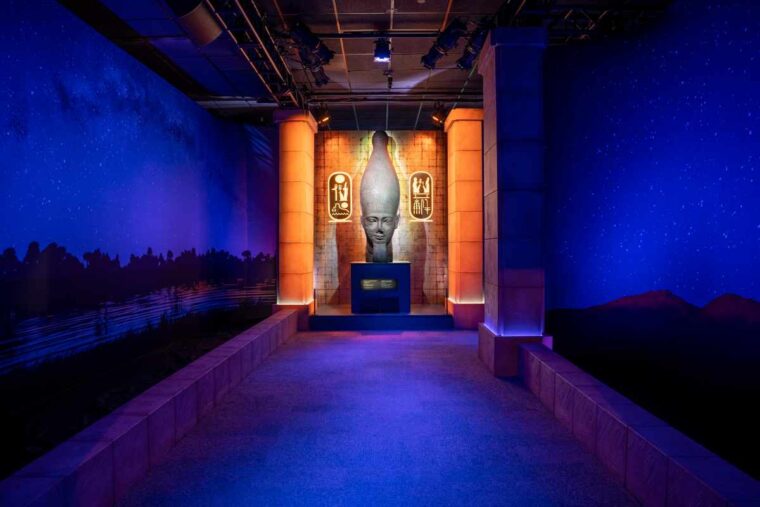
The first half of Ramses and the Pharaohs’ Gold focuses on the reign of Ramses II. Visitors can marvel at stone artefacts, including a huge Granodiorite statue head depicting Ramses II. He wears a crown with the uraeus – the sacred cobra that protects the king. A Sphinx depicts him as a human-headed lion. In some of the rooms, there are video screens with antiquities experts talking about specific pieces in the display cases. One room contains a virtual animation of the famous Battle of Kadesh, which was one of ancient history’s best-known battles. It ended with the earliest recorded peace treaty signed around 1259 BCE. A room designed to resemble a tomb is filled with mummified animals and animal sculptures. This enhances visitors’ understanding of funerary rites in the ancient Egyptian world.

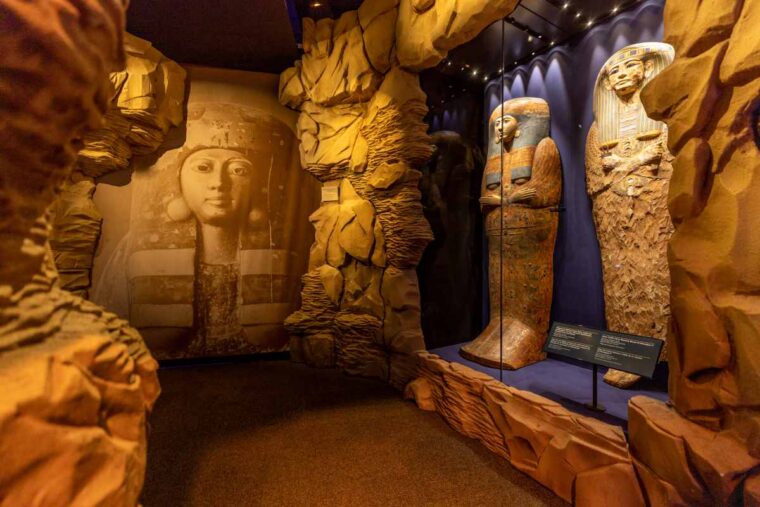
The death of Ramses II is the focus of the second half of the exhibition. He died at the age of 92, which was highly unusual at the time. Tutankhamun died at 19. He was buried in the Valley of the Kings, but sadly, his tomb was raided and damaged by floods. Visitors to Ramses and the Pharaohs’ Gold get an idea of what some of the contents of his tomb might have contained, and display cases contain artefacts found in other tombs of princesses and pharaohs. These rooms, some of which are designed to resemble tombs, include funerary masks, coffins, and jewellery.
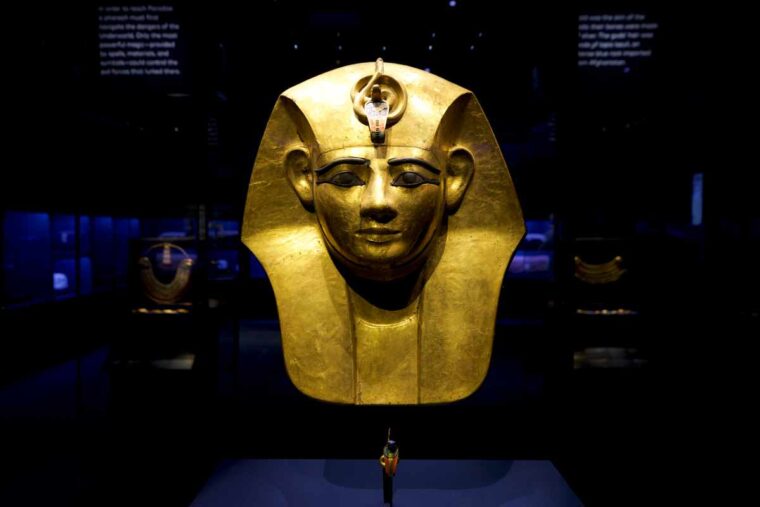
The funerary mask of King Amenemope is exemplary and composed of thick sheets of gold moulded with the king’s features. Another exquisite mask, striking in its opulent simplicity, is the mask of General Wendjebauendjed, who served with Psusennes I. Made of gold with his eyes highlighted with glass inlay, he looks out at us with a peaceful serenity, a gentle smile on his lips. It is extraordinary to imagine going back through the millennia to the time when this funerary mask was placed on the General’s mummy, enabling him to contemplate eternity.

Displays of jewellery are magnificent, and one can only marvel at the skill of the artisans who created these pieces. Some of the necklaces with shell pendants and stars that belonged to Princess Khnumit are very contemporary. There are intricate gold and beaded collars completed with carnelian, lapis lazuli, obsidian, turquoise stone, silver and chalcedony. The most spectacular piece of jewellery is the collar of Psusennes I, found in the pharaoh’s tomb at Tanis. It appears to be made of thousands of gold rings and tassels and inlaid with lapis lazuli (which was mined in Afghanistan), carnelian and feldspar.

A particularly striking display case contains the funerary mask of King Shoshenq II and the gold objects that were buried with the deceased. These include a pair of outstanding gold funerary sandals, finger and toe covers, gold collars, and bracelets with inlaid precious stones. The coffin of King Shoshenq II is also in the exhibition. It is a very fragile construction of cartonnage (linen or papyrus soaked in plaster) and adorned with gold leaf. The king has the face of a falcon, and the coffin is intricately decorated with images of goddesses and the sons of Horus, charged with safeguarding the king’s organs.
Cedarwood coffins are particularly moving, and it is astounding to think that 3000 years ago, Pharaohs were laid to rest in these. One of the highlights of the exhibition is the coffin of Ramses II. It is a huge piece of carved cedarwood and is mesmerising. It stands alone in its room where it radiates both power and beauty. Thinking about how this coffin held the remains of Ramses II, one has a sense of the passing of time and how the past reaches into the present. The coffin was discovered in 1881 along with other royal mummies that had been hidden from tomb robbers. This coffin was last seen outside of Egypt in 1976-77 when it was restored in France and exhibited at the Grand Palais.
The final room of Ramses and the Pharaohs’ Gold contains a last treat – the huge limestone colossus of Ramses II, which has been loaned by the Sharm el-Sheikh Museum. It stands alone in a large room. It is positioned on a high pedestal so that we peer up at it from below. This presumably replicates the height at which it once stood, and is exactly how Ramses II would have wanted us to view him – a godlike man, a ruler demanding and commanding respect and reverence.
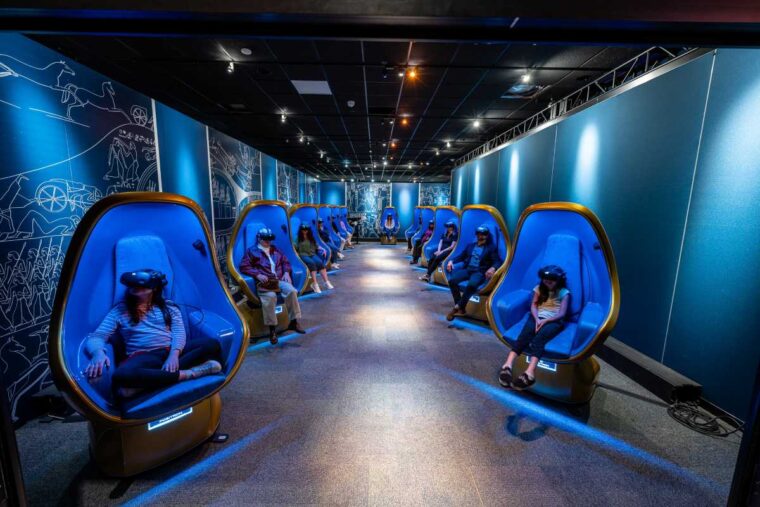
On leaving Ramses and the Pharaohs’ Gold, visitors can experience a is a thrilling VR experience to two of Rameses II’s most impressive monuments – Abu Simbel and his first wife, Nefertari’s, tomb. Seated in cinematic motion chairs, it feels as if one is flying through sandstorms, travelling into the tombs, and encountering Ramses II’s mummy. It is a thoroughly enjoyable and exhilarating 10-minute experience.
Ramses and the Pharaoh’s Gold invites us to imagine ourselves time-travelling 3000 years back in time. It was believed in ancient Egypt that people died twice – the first time when they stopped breathing, and the second when people stopped talking about them. Ramses II wanted to be remembered for eternity, and that wish has, at least for the past 3000 years, been granted.
Ticket prices start from £27.50 for adults (£32 at weekends), and there is a child and senior discount. There is an extra charge for the audio guide and again for the VR experience.
Ramses and the Pharaohs’ Gold runs from 28 February to 31 May 2026
NEON at Battersea Power Station, 2 Circus Road East, Battersea Power Station, London SW118DQ
For more culture, why not check out: South Bank and Bankside Theatre Previews 2026 (January–July)

Leave a Reply