Last Updated on January 30, 2025
The Rivals of Aida!
Aida - Royal Opera (RBO) - Review 4 stars - January 2025

The Royal Opera's Aida from Robert Carsen is a fresh take on the score’s perennial themes of love, power and war and is well worth a visit.
Event Type: Event
Event Attendance Mode: OfflineEventAttendanceMode
Event Status: EventScheduled
Performer: Organization
Performer Name: Royal Opera
Start Date: 2025-01-28 14:07
End Date: 2025-02-12 14:07
Availability: InStock
Availability Starts: 2025-01-28T14:07:25
4
Last night was the opening of the second revival of Robert Carsen’s production of Verdi’s four-act opera Aida for the Royal Opera. This grandest of grand operas is set in ancient Egypt and examines the love triangle at the centre of the country’s violent relationship with Ethiopia. Canadian director Carson locates the drama in a fantasy militaristic totalitarian state infused with religiosity, synthesising elements of America, Russia and China, with visual cues hinting at the 1960s. With a potent resonance for our world today, the opera examines the tensions and dualities of male and female, love and violence, honour and betrayal.

“Aida” was commissioned by Isma’il Pasha, the Khedive of Egypt, to celebrate the opening of the Khedivial Opera House in Cairo. The opera’s story was based on a scenario by French Egyptologist Auguste Mariette with the libretto being written by Antonio Ghislanzoni, with significant input from Verdi himself. The world premiere of “Aida” took place on December 24, 1871, at the Khedivial Opera House in Cairo. Auguste Mariette designed the sets and costumes, striving for historical authenticity based on his knowledge of ancient Egypt. This first production set the template for many future ones featuring pyramids, elephants and the iconography of this most ancient of civilisations. The opera has become a lightning rod for academics including Edward Said in the 1980s who used Aida as the central case study in his critique of cultural imperialism.
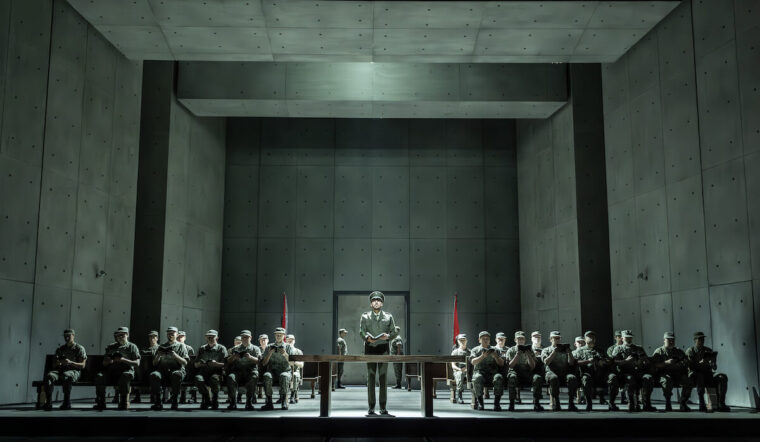
Set Designer Miriam Buether and Costume Designer AnneMarie Woods have created a visual world that effectively articulates the brute power of an all-powerful monolithic state. The set uses the verticality of the stage to great effect, framing the space with slabs of grey concrete, with characters dressed mostly in khaki, whether in military fatigues or a fancy dress, and greys. A red carpet, tie and dress stand out hinting at the blood sacrifice that the state demands to sustain its dominance over the individual and other competing national entities. The state functions as a character within the opera, all-powerful and pervasive, and expecting total dominance over its subjects. It is represented on stage not just by the visual symbols, but by the huge chorus that acts as it interlocutor, drilled to Soviet-style perfection by chorus master William Spaulding who took a well-deserved bow at the end. Video Designer Duncan McLean provides evocative black-and-white video projections featuring scenes of warfare, armaments and the devastation of conflict that act as a powerful counterpoint to the pious justifications of aggression by the state.

The narrative is built around the love affair between Radames, an ambitious young Egyptian soldier, and Aida, the daughter of the Ethiopian king Amonasro who has been captured by the Egyptians. Aida is torn between her romantic loyalty and that to her father and country. She has managed to hide her true identity whilst in captivity and at the start of the opera is working as a servant/companion for Princess Amneris, the daughter of the unnamed though very present Egyptian king. Amneris is also in love with Radames and the plot hinges around the intertwined dual conflicts, personal and political, as Amneris tries to assert her princess power to win Radames, and Egypt crushes repeated attempts at rebellion by the Ethiopians

Anna Pirozzi led this top-notch cast from the front in the role of Aida. Pirozzi is a classic ‘spinto’ soprano, able to dominate in moments of high drama but also with a lyrical luminosity to her voice that allows her to shift seamlessly to the more introspective emotional moments. Act III’s “O patria mia” was a stand-out aria with Pirozzi brilliantly navigating the technical challenges provided by the composer to provide moments of sublimity. Pirozzi can also act and was convincing as someone torn between her lover and her familial and patriotic loyalties.

Tenerife-born tenor Jorge De León, replacing an indisposed Riccardo Massi, made for a splendid Radames. De León has a fine heroic tenor voice but also one capable of finesse and delicacy as in Act 1’s “Celeste Aida” where he affirms his love for Aida. For the transcendent final scene where the lovers accept their upcoming death, set by Carsen in a silo in front of racks of what look like cruise missiles, there wasn’t a dry eye in the house as conductor Daniel Oren stretched the tempi to wring every last ounce of emotion out of the scene.
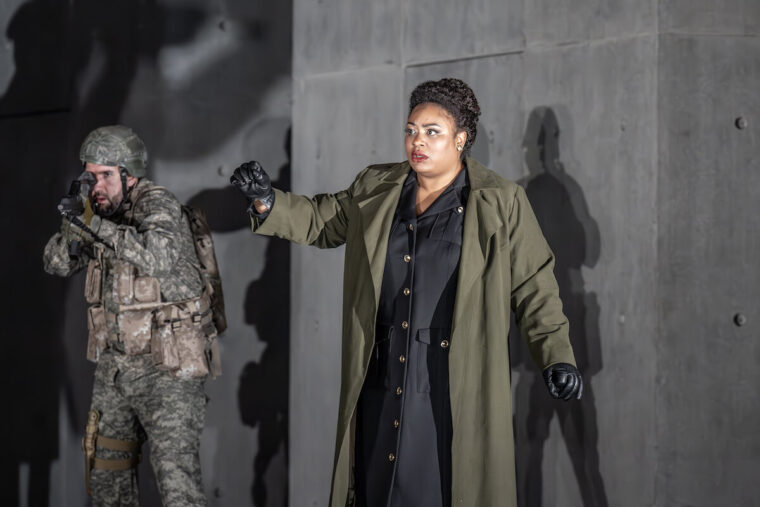
Amneris American mezzo-soprano Raehann Bryce-Davis, replacing Ekaterina Semenchuk as Aida’s entitled rival Amneris, brought touches of humour and an air of repressed sensuality into the first half of the opera which lifted the processional feel of the first two acts. She has a warm tone that easily inhabits the romantic numbers and manages the character’s arc with aplomb as she teeters between anger and love. The 3rd act is very much Amneris’ story and Bryce-Davis will have gained a lot of admirers with this performance and was in no way playing second fiddle to Pirozzi.
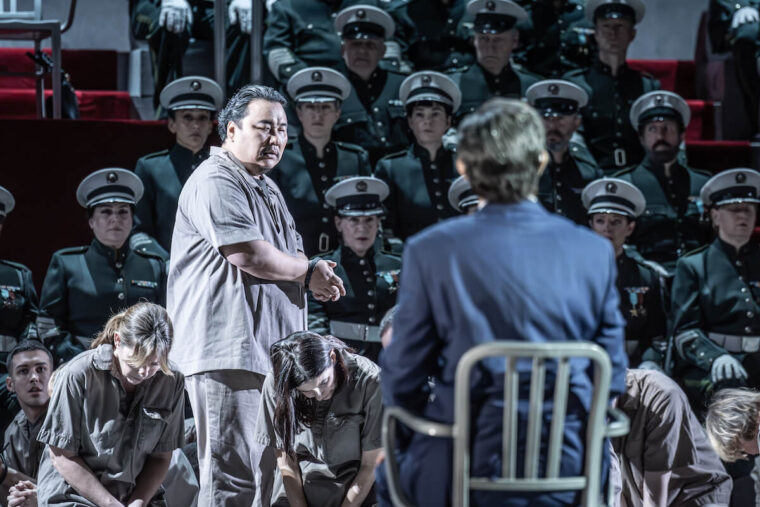
Mongolian baritone Amartuvshin Enkhbat exploded onto the stage in the role of Aida’s father Amonasro, bringing a disruptive energy and a powerful vocal performance that excited the audience. I was impressed by his Nabucco in 2021 and his Rigoletto in 2023 and with a voice that has an aggressively dark character Enkhbat has achieved star status in my book.

Hungarian-Romanian bass Alexander Köpeczi as Ramfis the priest and Georgian bass George Andguladze as the King of Egypt delivered very solid performances in what are not the most exciting of parts. Andguladze was sonorous and regal while Köpeczi had the necessary level of portentiousness. Uruguayan tenor Andrés Presno, an ex-Jette Parker Young Artist alumni, also impressed as the Messenger.

Carsen’s take on Aida feels more relevant than ever as the world reshapes itself around competing power blocks and aggression seems to be the new normal. With some stellar singing, this production is the Royal Opera at the top of its game. Go if you can.
Aida
Royal Ballet and Opera
Bow Street
Covent Garden
London
WC2E 9DD
28 January–12 February 2025
Read more about London Opera for 2025

Leave a Reply