Last Updated on October 16, 2026
Some play – Anne-Marie Duff triumphs as a woman of resistance
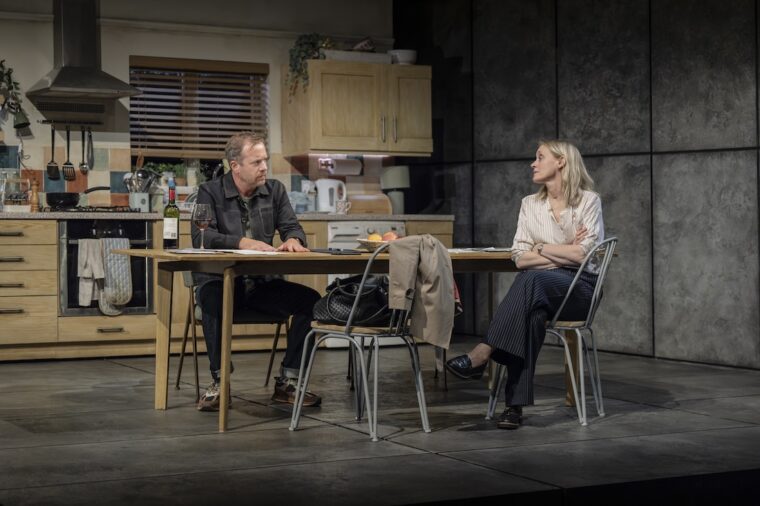
5.0 out of 5.0 starsSome Woman starts with Julie (Anne- Marie Duff) coming into a normal suburban kitchen. She leans against the table clearly in some pain, emotional pain but her reflex is still to clear away the morning’s dishes. Something has happened – an incident at the station on her way home from work, where a young boy has verbally abused her – she phones the local school to speak to the boy’s headteacher but he is not available. She asks to be called back, clarifying pointedly ‘my name’s Julie Robson… Ms… No, Ms. M-S…’.
A glance to Strindberg’s ‘Miss Julie’? The name, the kitchen are in common but she is not the youthful aristocratic Miss Julie, she is an ordinary woman in her 50’s suffering under the grind of life and the mundane responsibilities that inevitably fall to women. The psychological verity and emotional rawness she projects is a result of outstanding writing and acting. This is a brave play.

When Julie shares her story about the incident with her family, the scene shows her protective relationship with teenage daughter Ginny (Grace Doherty), who is mentally fragile and attends online school and a more fractious one with career focussed, adult daughter Kate (Hannah Onslow). Kate is closer emotionally to her father Richard (Geoffrey Streatfield), now divorced from Julie. Kate’s boyfriend is Nathan (Tobi King-Bakare) who is a salesman.
Everyone initially makes the right noises supporting Julie with the male characters dominating in terms of solutions and unhelpful suck it up advice. Nathan and Richard slide out to look at Nathan’s new expensive car. Richard returns and reveals the real reason for his visit – to discuss how they will split the equity in the house now that it is up for sale as Ginny is turning eighteen. In a deft piece of writing we see a beleaguered Julie and the family dynamics at play.
The headmaster, Mr Dunster (Daniel Miller) visits Julie and gives her the usual platitudes about taking incidents like this seriously and the importance of preserving the reputation of the school. Initially, Julie turns down the offer to meet the boy but changes her mind when she isn’t convinced that Dunster will communicate her main concern; that the boy did what he did because she was a woman and she decides that ‘…he needs to hear from me, a woman, that he can’t speak to women like that’. This is her first act of resistance; as Some Woman develops the pattern repeats itself, as adverse event engendering a growing self belief. This is never done in a linear way which makes it believable and emotionally relatable.
The meeting with the boy never takes place and Dunster informs her that in fact the police are considering charging her. Julie is interviewed by the police and as a result of probable influence by the father, Mr Blake (Stephen Wight) the boy’s account of what happened has now changed and contains a serious allegation. The growing burden of these developments sends Julie into turmoil. Kate in particular challenges her mother’s version of accounts and references times when Julie has lost her temper. Julie responds asking why everyone else is allowed to lose their temper and the one time she does she’s suddenly ‘this nasty…abusive woman…’
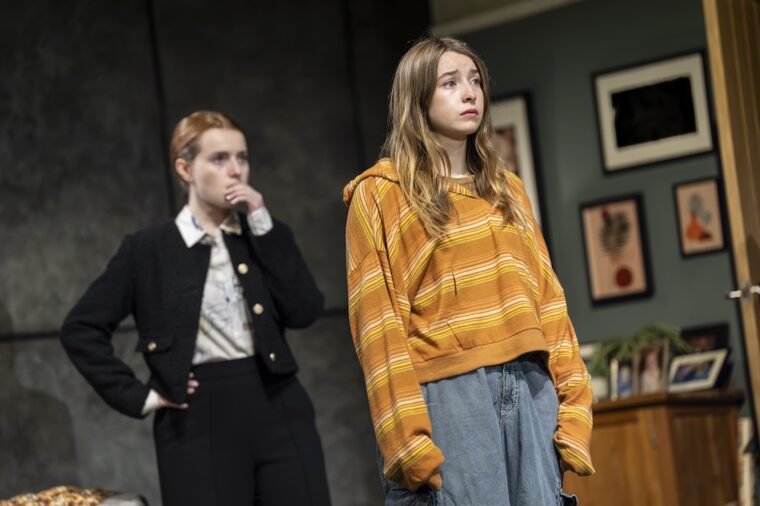
When Julie meets with her lawyer the discussion quickly move to mitigation and when prompted to reveal any previous sexual abuse, Julie recounts what she describes as ‘The usual. Over the years. Being groped. Touched. Chased through subways’. Julie is advised to do a deal with the prosecution and the question of whether she will or not hangs over the latter part of the play.
Her backstory is instantly relatable to women of her generation – career compromises, doing the domestic and emotional heavy lifting. We were told we could ‘have it all’ she says to Kate but the expectation of great home, great kids, great job was never fulfilled and what was left was an absence of joy and ‘shame at failing’.
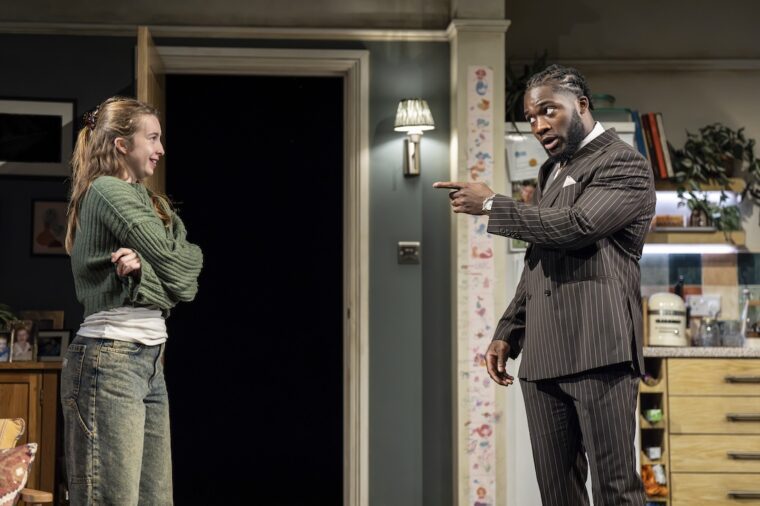
Julie’s resistance grows but in one terrifying late scene it could all be for nought. The play takes a big lurch tonally with this portrayal of vicious mysogynism. It is not an easy watch but doesn’t feel extraneous and powers the play to its conclusion.
The set moves seamlessly from kitchen to cavernous bunker like settings, where the action at the school or police station takes place. This is an appropriate visual metaphor for a domestic life enveloped by a foreboding external society for women like Julie. Robert Jones, responsible for set and costumes should be commended. The intimacy of the Dorfman auditorium where facial expressions can be easily seen helps the play. The wider cast are all excellent with particular mention for Grace Doherty in her portrayal of the sensitive Ginny.
Duff is often applauded at her ability to evoke great sadness and conjoined with Blanche McIntyre’s direction and Edmundson’s writing this results in an intensely moving emotional experience. It is never mawkish and the more overt political points about women’s position in a burgeoning patriarchy are woven in naturally. The trio are an absolute ‘A’ list of British theatre and Some Woman radiates their chemistry. This is Edmundson’s first original play for ten years (she has done many marvellous adaptations) but hopefully we can see more of her new writing for the theatre.

In terms of plot Some Woman is relatively simple but this helps show the accretive pressure of her circumstance. It skilfully shows how for women life is often a struggle and not necessarily because of their own personal mental health or the fact, for example, they are going through the menopause. It is more systemic and is the reality of the wider world we have built. The legal case was the tipping point but the scales have been weighed against Julie for most of her adult life.
Strindberg’s introduction to Miss Julie is a manifesto for naturalist theatre. It was also a deeply misogynist text aimed at the growing feminist movement of the 1880’s. Paradoxically, his Miss Julie is a psychologically complex character shown grappling with the restrictions of her time. She one of the great female heroes and in time the play would be heralded as an almost pro feminist work. Edmundson’s naturalistic play has also created a great hero for our era. It is a cathartic and chastening watch. A must see.
Dorfman Theatre
National Theatre
South Bank
London SE1 9PX
16th October – 21st November
Tickets from £10
Leave a Reply