Last Updated on September 25, 2025
Tour-de-force from Anne-Marie Duff in bitter family drama
4.0 out of 5.0 stars‘There are people who must finish what they start and not look back, and I am one of those people,’ declares Regina Giddens (Anne-Marie Duff) towards the end of The Little Foxes. While the play is set in America’s South in 1900, it felt like a line that could have been spoken by Lady Macbeth. Written by Lillian Hellman in 1939, the play opened on Broadway and was later made into a film starring the great Bette Davis. When it opened in the West End in 1982, it starred Elizabeth Taylor making her London stage debut. Now reprised at the Young Vic, it is directed by Lyndsey Turner (The Crucible, The Witches) and stars the never-to-be-missed, Anne-Marie Duff.
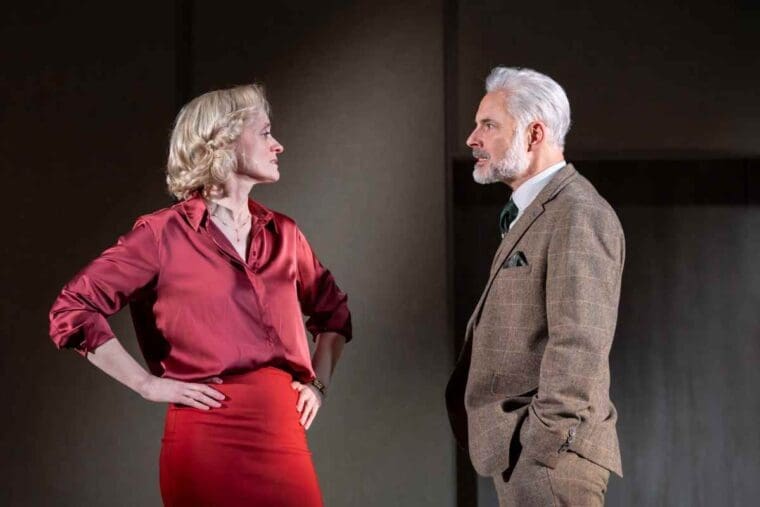
The theme of The Little Foxes is greed and treachery, with the title taken from a biblical reference about the little foxes spoiling the vines on which grow tender grapes. It explores the lengths that a family will go to in order to further line their already wealthy pockets, cheating and conniving both within and outside of the family relationships. Hellman’s script is tight and full of viscous interactions and brilliantly captures the level of cruelty that can take place within the supposed safety of family boundaries. In the directorial hands of Lyndsey Turner, this is a no holds barred production that is so visceral that some scenes will linger in the mind for some time to come. As if the drama unfolding on stage was not enough, one of the younger members of the cast, Stanley Morgan, collapsed early in the first act and managed, to his great credit, to resume the performance after medical attention. The show must go on and so it did.
Not all reprised plays hold their relevance for contemporary audiences but the themes explored in The Little Foxes certainly do. Race, class and gender relationships are all woven into the script. The cruelty of the three siblings – Regina and her two brothers, Oscar (Steffan Rhodri) and Benjamin (Mark Bonnar) – has its own emotional backstory that underlies their dysfunctional relationships. They are loathsome characters with major chips on their shoulders and while none of that excuses their behaviour, it makes for complex, three dimensional characters.
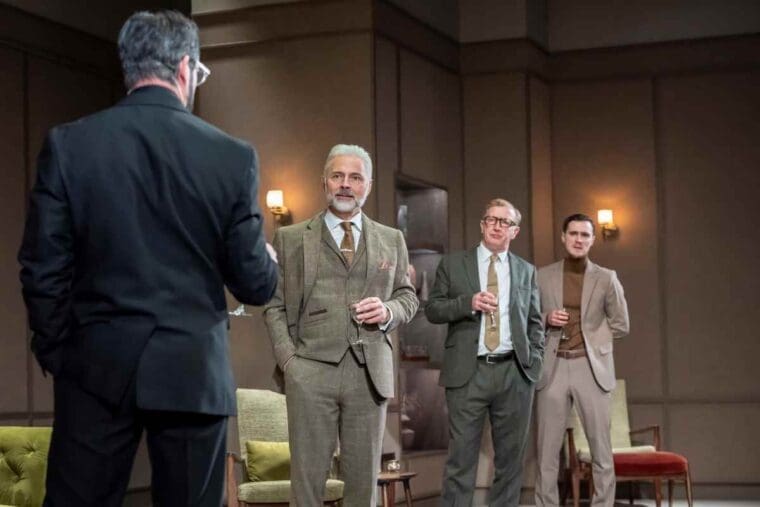
Everyone in The Little Foxes is part of a strictly delineated social hierarchy from the aristocracy (from which they are excluded), to the brothers, the overlooked sister, the abused wife and finally to the servants whom they employ. Unlike the Southern aristocracy – landowners who owned the cotton plantations – the Hubbard brothers and their sister, Regina who is married to the local bank manager, Horace Gibbens – come from ‘trade’ stock. They have made a fortune buying up estates that lost value after the Civil War and from loaning money to people of colour whom they have cheated. Having connived their way up the economic ladder through loveless marriages to wealthy partners and cheating and lying in business, they now find that enormous wealth lies almost within reach. A business partnership is about to be sealed with a suave businessman from Chicago, William Marshall (John Light), that will bring a cotton mill to their town and untold riches to their pockets. There is just the matter of some money left to be raised. Regina’s terminally ill husband, Horace (also played by John Light) refuses to stump up the remaining cash which finally blows the lid on their marriage and results in the brothers plotting against Regina to steal it all for themselves.
Regina was overlooked in her father’s will – he left his money to her brothers – and is also considered dispensable by her brothers who are only too happy to exclude her from having a piece of the pie. While Regina reacts with shocking cruelty to the thwarting of her desire ‘to have the world’, the question of how disempowered women are to attain power through their own efforts is explored in the play. At the same time, women’s propensity for cruelty and ambition is revealed to be as powerful as those of their male counterparts. Much like Lady Macbeth who could only gain power through her husband seizing the crown, Regina uses her strategic plotting to manipulate her husband and her brothers in order to have the life she dreams of. Regina’s mother prepares her for a life of compliance and persuading men with a smile, but she steps out of this traditional role and displays as much cold-hearted cruelty as her brothers. Violence, however, can still be, and is used as a deterrent against her and her sister-in-law.
Anne-Marie Duff is perfectly cast in the complex role of Regina, bringing to the part a broad range of emotions and conveying so much nonverbally with a twitch of the lip or her cold stare. In an unforgettable scene, as her dying husband staggers up a staircase, she stares into the audience, her body frozen, as if daring us to defy her as she refuses to intervene. It is utterly compelling theatre and uncomfortable to sit through. Once her goal is realised – she has her hands on the millions she has fantasised about and which will buy her freedom – she is left to face the empty shell of her inner life. For Regina, the loneliness she has always endured in her childhood and in a sterile marriage finally threatens to overwhelm her. No amount of riches can ever fill that void.
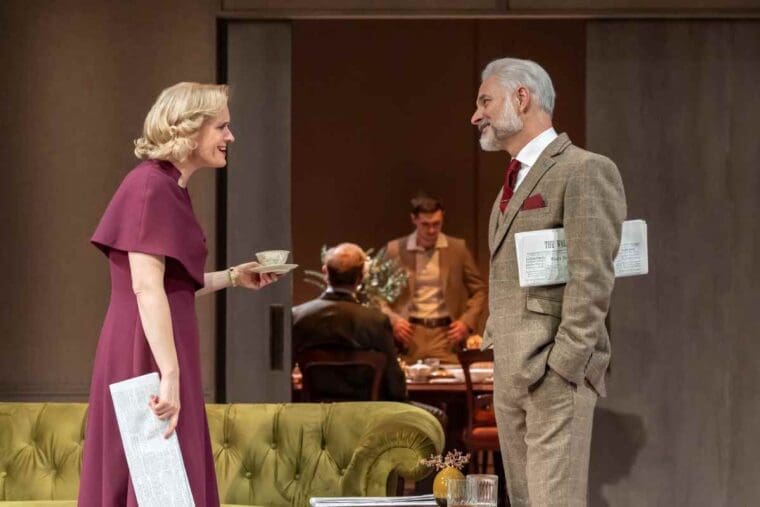
This is a play with dialogue so cruel it put me in mind of Edward Albee’s Who’s Afraid of Virginia Woolf. The cast of The Little Foxes is all strong with special mention to John Light who was unrecognisable in his second iteration as Regina’s husband who returns home from a 5-month convalescence and limps onto the stage looking every bit like a dead man walking but goes to his grave fighting. He has had time to reflect on how he has stood by and watched the ‘people who eat the earth and eat all the people on it’ and he no longer wants to stand around and watch. His redemption is to pay for his daughter and housekeeper to escape their fate. Once again, women are at the behest of men as they have no monetary value of their own. Little brings great power to his role as a dying man, while his body is frail he is impassioned. His body visibly absorbs the emotional blows during the showdown between him and Regina when she tells him how she despises him and wants him dead. It is riveting.

Anna Madeley as Regina’s sister-in-law, Birdie Hubbard, gives an energetic performance, displaying the poignancy of a woman who realised too late that she has been married for her family’s cotton fields the brothers wanted – she was part of the bargain – and has ‘not had one full day of happiness in 22 years’. She anaesthetises some of her pain by drinking alone in her bedroom. Unlike Regina, who defies the expectations of her role as a docile woman, Bertie’s spirit has almost entirely been crushed by the abusive control of her husband, Oscar, an odious man who treats her with cold disgust, humiliation and violence.
Sound designer, Tingying Dong, keeps the sound of menace alive throughout the performance with pulsating music that is purposefully disturbing. The set for The Little Foxes (Lizzie Clachan) is as cold as the drama enacted on it – it is stylish and minimal, with no soft surfaces here. Shades of grey, taupe and a pop of chartreuse provide the backdrop against which Regina’s red and plum-coloured outfits shine.
The fortunes and self-inflicted misfortunes of families is an enduring theme which continues to capture audience attention. When Hellman wrote the play, as in our modern day, the lives of the wealthy continue to play out in public glare like soap operas. Only this week we have the latest season of the Murdoch family with brothers and sisters pitted against one another. Life imitates art. In The Little Foxes, we have art imitating life and this is a play not to be missed.
The Little Foxes runs at the Young Vic until 8 February 2025.
The Little Foxes
The Young Vic,
66 The Cut,
London SE1 8LZ
Looking for something different? We also loved Bette and Joan, currently showing at Park theatre

Leave a Reply