Last Updated on September 7, 2025
A masterful women-led take on climate change
The Barbican have brought together almost fifty female and non-conforming artists for their new show Re/Sisters: A Lens on Gender and Ecology, opening today at the Barbican Art Gallery. Combining better-known feminist artists such as Barbara Kruger, Judy Chicago and Ana Mendieta with lots of international names that viewers may be unfamiliar with, this largely photographic exhibition draws on more than forty years of women, indigenous and non-binary peoples fighting on behalf of the planet.

This is by all means a big show: a large number of artists, and a huge number of items on display, but it feels refined, visually and thematically. Artists present familiar topics such as the 2014 Flint water crisis in an up-close-and-personal manner, not as spectators, but from within. Perhaps lesser-known events (to a UK audience) such as mining disasters in Brazil are foregrounded in a thoughtful, powerful manner.
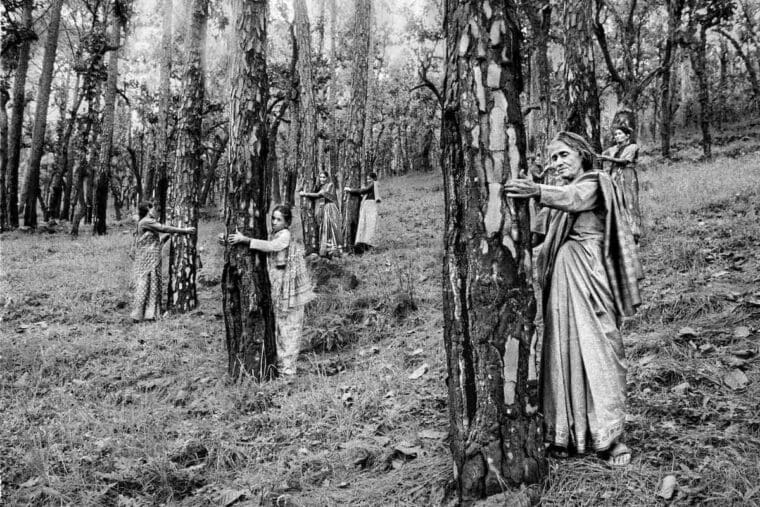
© Pamela Singh
Courtesy of sepiaEYE
The standout works do not shout. Pamela Singh’s black and white images Chipko Tree Huggers of the Himalayas series (1994) are poignant and beautiful. Fern Shaffer’s Nine Year Ritual – April 9, 1998 is a series of dance-like rituals that take place in different locations to express concern over different ecological issues. The documentary imagery is captivating.
Agnes Denes’s seminal Wheatfield – A Confrontation (1982) steps into the limelight again after being shown at the Hayward Gallery’s Dear Earth earlier this year. Denes planted, maintained and harvested a wheatfield in Manhattan, just a stone’s throw away from the World Trade Centre.

The artists included in Re/Sisters share a certain self-awareness: of how the female body is seen by society, of how women artists are seen in the context of the art world, of traditionally female labour that all too often goes unseen. Knowing art history references are alluded to: Fina Miralles’s body being slowly covered in straw evokes Keith Arnatt’s Self Burial (1969), only in reverse. Francesca Woodman plays a naked Ophelia (Millais 1852) transported to the waters of Colorado and Massachusetts. The exhibition undoubtedly refutes the idea that land art is a male-dominated arena.

Artists discuss water in many of the works: crises of clean drinking water, coral reef degradation, floods and rising water levels, and the idea that we too are water. This watery tributary running through the exhibition raises the idea of oneness, questioning a ‘man versus nature’ mentality.

The exhibition architects have made a series of subtle interventions in the gallery space by curving walls, eradicating some corners and softening the space. The curves create flow, a continuum and lead the viewer around corners from one section to another. This makes a big difference, especially in a largely photography-based show. It creates a sculptural element, hugging the viewer in places and makes for a very enjoyable experience. The walls are white apart from installations, which feel warm and womb-like.

Scale and layout are used to great effect, ensuring that the viewer pauses to take a second look. The gallery’s usual amazing vistas across the exhibition allow the viewer to catch a glimpse of artworks already encountered and ones yet to see. Careful curation ensures that these private glimpses open up new dialogues between artworks.

This is a thrilling and thoughtful show that is a joy to experience. What could be dry and analytical is brought to life. There’s even plushy shrimp pillows to nestle into while watching a film. Just make sure to leave enough time to get stuck into all of the artwork: this is not a show for a cursory glance.
RE/SISTERS: A Lens on Gender and Ecology
5 Oct 2023 – 14 Jan 2024
Barbican Art Gallery
Barbican Centre
Silk Street, London
EC2Y 8DS
Leave a Reply