Last Updated on June 14, 2026
From Orfeo to Ulisse: The Second Chapter of a Monteverdi Journey
4.7 out of 5.0 starsVisiting Garsington for the second time this season (check our review of Rosenkavalier for more of what is on), the production of Il ritorno d’Ulisse from The English Concert seems particularly apposite. I’m moving away from London, and much as I love summer excursions to Garsington at the Wormsley Estate, going next year may be something more of a challenge. This Monteverdi opera is the second in a trio of works that the English Concert have planned, and Orfeo, staged at Garsington in 2022, marked my first visit for a truly memorable production. Conducted by Laurence Cummings and directed by John Caird, with sets and costumes by Robert Jones, with lighting by Paul Pyant and choreography by Arielle Smith, the original creative team for Orfeo was reunited. Ulisse sits between Orfeo (1607) and L’incoronazione di Poppea (1643), which the English Concert will bring to Garsington in 2028, offering a fascinating insight into the development of Monteverdi’s style and the evolution of opera from courtly entertainment to the humane world of Ulisse and then to the complexity of Poppea.
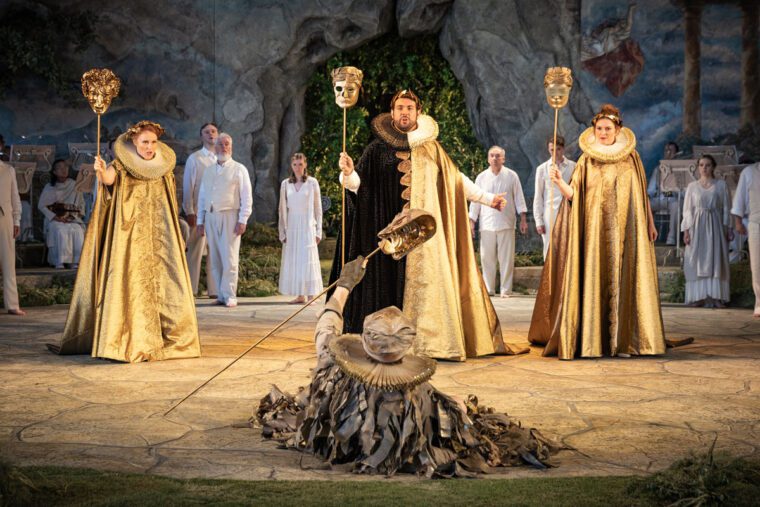
Unlike Orfeo, which centred on youthful love, Ulisse was written when Monteverdi was in his early seventies and was one of the most celebrated composers in Europe. And, unlike Orfeo, written for the royal court in Mantua, Ulisse was written for one of Venice’s new commercial opera houses, the Teatro Santi Giovanni e Paolo, during the 1640-41 carnival season. As such, it’s a work which is less concerned with heroic adventure than with endurance, fidelity and the wisdom of experience. Opera was still a relatively new art form, and writing for a commercial opera house, Monteverdi’s work needed to appeal to a broader audience, mixing mythology with comedy and theatrical spectacle. Ulisse, with the protagonist disguising himself as a beggar, with the central spectacle of the bow challenge and with recognition of servants as friends and advisors.
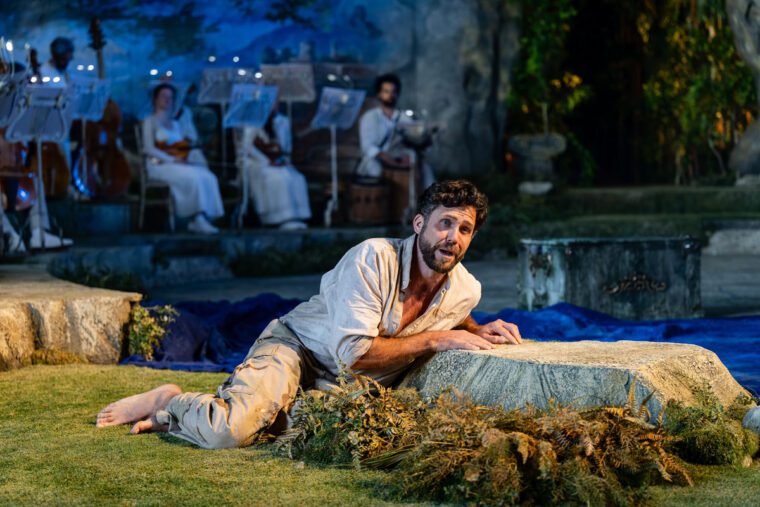
Ed Lyon, who performed Monteverdi’s first great hero, Orfeo, in the 2022 production, returned as Ulisse, alongside other members of the 2022 cast, including Claire Lees and Benjamin Hulett. And, Il ritorno d’Ulisse was just as memorable a production as Orfeo.
Lyon, a lyrical tenor with an expressive and subtle voice, was in his element as the returning, battle-weary hero, oscillating between his lowly disguise as a beggar and his innate nobility. When partnered with Minerva, a bright-toned, agile and incisive Claire Lees, we are reminded that he chose a mortal human life over immortality in order to return to Penelope. When he meets his old servant Eumete (James Gilchrist), he is humble and sensitive; when he confronts Penelope’s suitors, he displays the authority and strength of a king reclaiming his kingdom. The vocal nuances in his solo recitatives, driven by Monteverdi’s wonderful score, were beautifully realised.
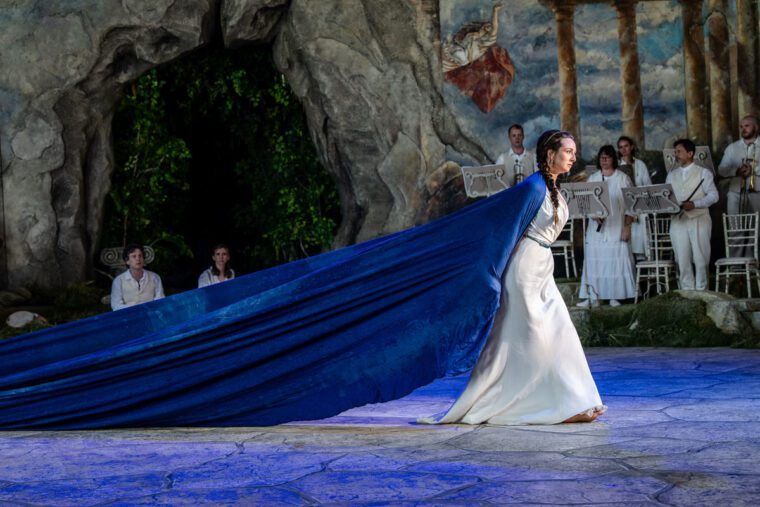
By contrast, Cecelia Hall’s Penelope was defined by constancy. Possessing a gloriously rounded mezzo-soprano, she conveyed the character’s dignity and steadfastness, though there were moments when a little more emotional intensity might have lifted the music into the sublime. While Monteverdi’s writing in the opening lament is austere and restrained, the delivery could perhaps have benefited from greater expressive variety. It is a delicate balance: Penelope’s dignity needs to rest upon the love and emotional connection with Ulisse that has sustained her fidelity over two decades. Similarly, in the final recognition duet, the chemistry between the pair seemed somewhat elusive.
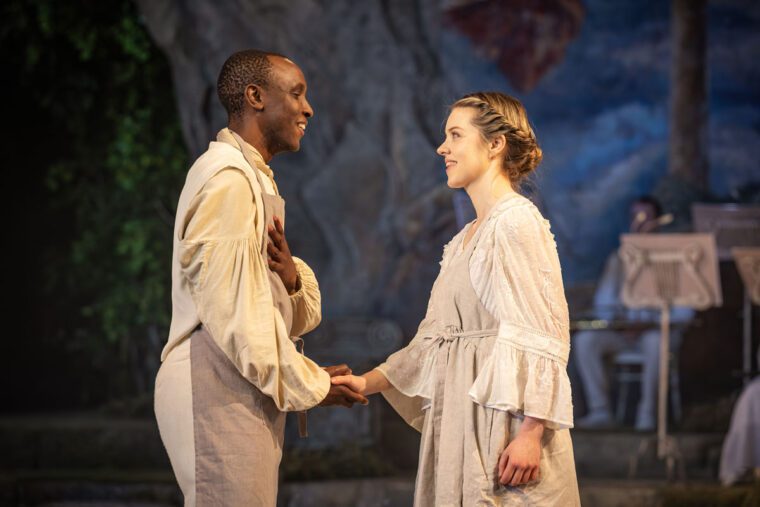
Innocent Masuku as Eurimaco and Rowan Pierce as Melanto in Il ritorno d’Ulisse at Garsington Opera © Craig Fuller
The vibrant Melanto (Rowan Pierce) and Eurimaco (Innocent Masuku) were a delight, with Masuku in particular offering a bell-like vocal tone and wonderful lyricism. Both were charming on stage, with Pierce trying her best (and failing) to lead Penelope astray.
For me, the female vocalist of the night, though, was Claire Lees, with a bright, silvery soprano and irrepressible energy. Her singing combined clarity with warmth. A sparkling stage presence and impeccable diction made each divine intervention count.
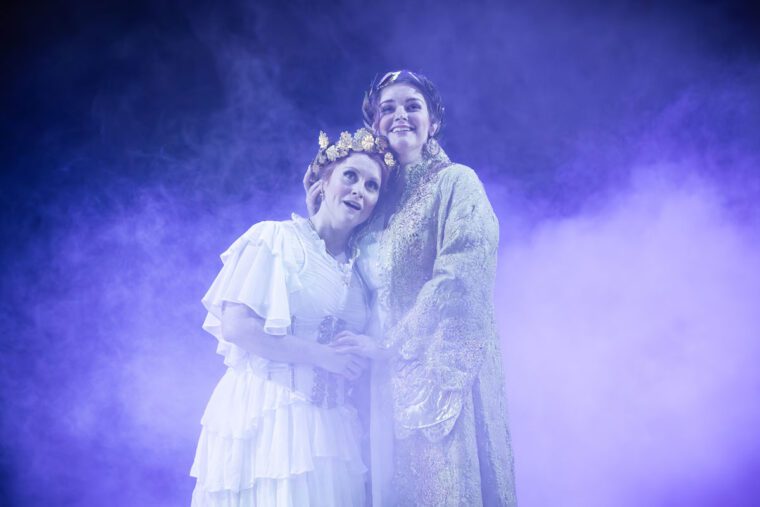
What makes an opera, though, should not be one great singer, but the entirety of the production. There are too many great performances to mention in this Ulisse, from Lyon himself through to the wonderfully sonorous James Cresswell as Nettuno and Anfinomo, the honeyed lyricism of Dafyyd Jones as Telemanco and the comedic yet vocally brilliant Stuart Jackson as Ino. The staging, with a similar pastoral setting to parts of Orfeo, the brilliant costumes and designs, including Penelope’s stunning blue cloak that doubled as ‘the sea’ and some truly adorable ‘sheep’ with lace-topped gloves and black legs providing a cohesive setting for this fabulous work. And, of course, the splendid English Concert who played impeccably throughout (and before the show). It’s rare for me to want to see it all again – but I would be happy to do so. This is a pivotal work at the crossroads of Renaissance and Baroque music – and yet it’s the perfect entertainment for a glorious summer’s evening in the country today.
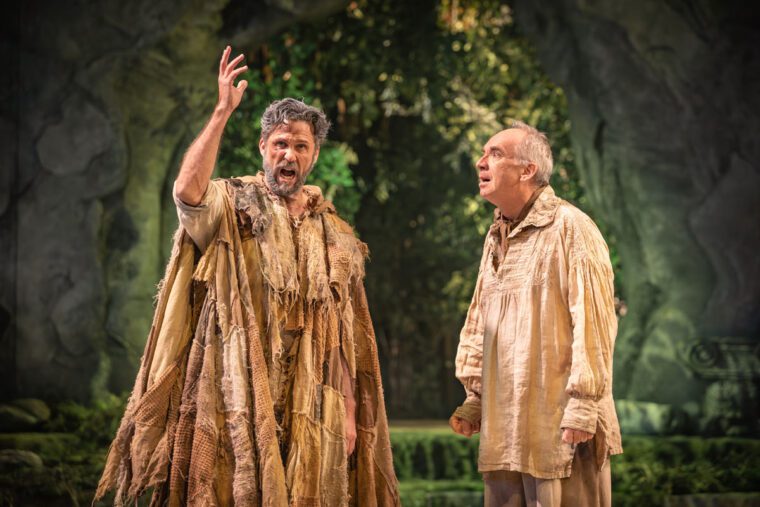
Il Ritorno d’Ulisse runs from 12th to 25th June 2026 with tickets from £185, including an £80 donation.
Wormsley Estate,
Stokenchurch,
High Wycombe
HP14 3YE
Check our Summer Opera Previews

Leave a Reply