Last Updated on September 11, 2025
Isherwood’s Emblematic Gay Novel Becomes a Ballet
4.0 out of 5.0 stars
Grief fractures you. And if it’s grief you can’t share with those around you, it becomes even more corrosive. Such is the grief afflicting George, the central character of Christopher Isherwood’s 1964 gay novel, A Single Man, now turned into an affecting ballet, which has opened the new season at the Linbury Theatre, RBO, following its world premiere at the Manchester International Festival in July.
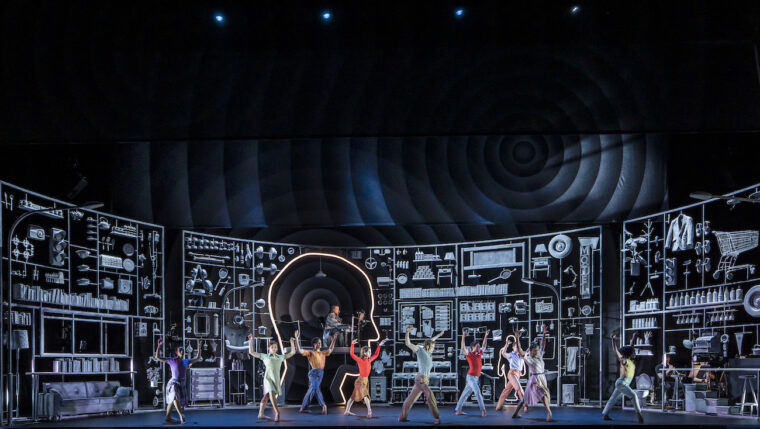
George, a British middle-aged professor at a Los Angeles university in the early 1960s, is grieving for his long-term partner, Jim, who was killed in a car crash a few months prior, at a time when, in the words of Jonathan Watkins, choreographer of the new ballet, “people didn’t even believe that two men could love each other, let alone feel this level of grief.”
So A Single Man is very much a ballet about grief; gay grief, all the more poignant for being forbidden, but ultimately universal grief – if you’ve experienced loss, this ballet will at times cut straight to your heart, regardless of who you are or who you love.
That it does so is due to a remarkable combination of creatives, led by two of the most charismatic dancers of their generation, the former Royal Ballet principal Ed Watson and the versatile dancer and actor Jonathan Goddard. The two alternate in the lead role of George, with Goddard also playing Jim to Watson’s George in the first cast.

I attended the Manchester premiere, led by Ed Watson, and the second performance at the Linbury led by Jonathan Goddard, and found both fascinating: both very much Isherwood’s George, yet quite individual. As Goddard told me when we spoke in the run-up to the Manchester premiere, “There’s me, Jonathan [Watkins] and Ed [Watson], and I think there’s three ideas of what George could be in that pot. The steps are the same, but even if I tried, I could never be what Ed Watson is, and he’d never be what I am; we have different qualities.”
More about the two Georges, and indeed Jim, who haunts George’s memory, in a moment; but first a word or two about the other remarkable creatives who have brought Isherwood’s novel to the stage.
The dancer represents George’s body, and his inner monologue – his head – is communicated by the songs of the Icelandic singer-songwriter John Grant. So, as George goes about his day through Chiara Stephenson’s detailed set with sections representing his home, classroom, the home of his friend Charley, the beach bar where he first met Jim, every setting skillfully pointed up by Simisola Majekodunmi’s lighting, watching him from a raised platform within the neon outlines of a head is Grant.

Grant’s songs, in the style of 60s rock ballads, are framed by Jasmine Kent Rodgman’s original score, jazzy at times, occasionally riffing on the minimalist, sometimes just an atmospherically sustained note, performed by five musicians from the Manchester Collective, who sit downstage left behind a translucent curtain.
A 10-strong ensemble costumed by Oscar-winning Holly Waddington and Eleanor Bull, work hard as the various characters in George’s day – his students, a pair of tennis players whose well-toned bodies catch George’s eye, a group of gym bunnies and, kitted out in white unitards stained with splodges of soft colour, as manifestations of George’s inner turmoil. In a particularly effective sequence, they become the waves that surround and lift George when he goes for an impulsive midnight swim in the ocean.
Both the Royal Ballet’s principal character artist, Kristen McNally, and the dancer and choreographer, Laura Careless, dance Charley, respectively, in the first and second casts, a brittle, loving friend, whose drunken antics provide a moment of levity in George’s day.

And the role of Kenny, the student whose insistent presence goes a long way towards helping George recover his balance, is danced with flair by the Royal Ballet’s James Hay in the first cast and Chester Hayes in the second.
Jonathan Watkins’s choreography has the ensemble moving in an effective, though not particularly exciting way; but it comes into its own in the duets between George and Jim, at once loving and tender, playful and deeply erotic, the two bodies intertwining in George’s eagerness to hold on to the past.
I felt the George/Jim partnership worked a little better in the first cast, not only because physically Watson and Goddard are perfectly matched, but also because there’s intense chemistry between the two.
In the second cast, Jim is danced by the very expressive Harry Alexander, who sees Jim as a flimsier, ghost-like presence. Their duets are still compelling, but lack the Watson/Goddard chemistry, partly because the physical match, with Alexander towering over Goddard, is not ideal.

Formerly a Royal Ballet principal, Ed Watson is a gripping dancer, his wiry body capable of conveying all manner of emotions, from the pathological jealousy of Leontes in The Winter’s Tale to the expressionistic oversized bug of Kafka’s The Metamorphosis, to mention but two of his unforgettable interpretations. He gives the grieving George an interiority that somehow isolates him from everything around him.
Goddard’s George is as technically accomplished, but he is a little more human, a little more relatable. He doesn’t push you away from his grief; rather, he draws you in, so that when at the end of the first half he breaks down, curls in on himself and cries, you’re bound to feel quite choked. Or I was.

Having now seen A Single Man twice in different venues, I think the intimacy of the Linbury serves the ballet better than the much larger Aviva Studios in Manchester.
I still feel, though, that at two hours, including one interval, it is a little uneven, and would perhaps work better at 90 minutes straight through. Still, I found the production stylish, its ideas interesting, and its love duets truly powerful.
A Single Man is a co-production between The Royal Ballet and Factory International. It’s in repertoire at the RBO Linbury Theatre 8 – 20 September 2025
Jonathan Goddard dances George on 9, 10, 13, 17, 19 September, and Jim on all other dates.
Ed Watson dances George on 8, 11, 12, 15, 16, 18, 20 September
Royal Ballet and Opera
Bow Street
Covent Garden
London EC2E 9DD
Check the link for more ballet and contemporary dance previews

Leave a Reply