Last Updated on June 16, 2026
5.0 out of 5.0 starsA triumphant return
Superlatives sometimes feel hyperbolic, but in the case of the recently opened Anish Kapoor exhibition at the Hayward Gallery, words like superb and stunning seem appropriate. Kapoor is one of only a few artists who have had a second exhibition at the Hayward Gallery. In1998, the Hayward was the first public gallery to have hosted a major survey of his work. This exhibition spans both seminal and new works, including sculpture and paintings.

The work is deeply emotive – both moving and disturbing in equal measure. It is certainly the first time I have entered the vast opening room of the Hayward and felt claustrophobic. Here, the viewer is confronted with an enormous red form (All of Nothing, 2026) that fills the 6-meter-high space and forces us towards the one free wall. Is it a giant balloon? According to the curator, Ralph Rugoff, the PVC membrane took several days to inflate. Is it a giant red bean that escaped from a Roald Dahl children’s book? Is it still growing, and might we be squashed like insects against the concrete wall? Only on entering the room on the next floor do we realise that this monumental form cannot be contained and has oozed its way through the concrete pillars that are usually open spaces between the two floors. Here it forms bulbous shapes, which I found viscerally disturbing.

This installation is a brilliant response to creating a site-specific installation in what is a challenging space. Red is a familiar colour for Kapoor who has written about its significance for him both in representing emotions and ceremony. A further monumental red installation is an enormous jagged form suspended from the ceiling. Entitled Mount Moriah at the Gate of the Ghetto (2022), it represents an inverted mountain with the peak almost touching the floor of the gallery. Walking around this vast shape, I had the sense that it might collapse onto the viewers, and once again, Kapoor, who interrogates ‘the space of the object’, disturbs our sense of where we and objects belong in a space.
The work, which has streaks of black and white, looks as if the artist has taken vast quantities of oil paint and created a sculptural form. On a far wall hangs a large oil painting (The Dark, 2021), red with a large black gash, and it seems as if the suspended sculpture might have somehow erupted from the wall. On a side wall, hang three huge sculptures wrapped in thick plastic. Plastic Sacrifice I, II, III (2026) resemble, at first glance, a giant helping of raspberry ripple ice cream and another of cassis sorbet. But these are not memories of happy days at the seaside. The work in this room is about sacrifice – specifically, evoking Abraham’s sacrifice of his son Isaac, which, according to the Old Testament, was demanded by the Creator, a ram being substituted as Abraham raised his knife. Here, Kapoor is the creator and stops us in our tracks to consider the implications of ritual sacrifice, its place in our culture and our unconscious fears arising from it.

Another room is filled with a deeply saturated ruby red installation inspired by Kapoor’s visit to Uluru in Australia. Kapoor has named this installation Ha Makom (2026), which means ‘the place’ in Hebrew, and says that his visit there was the ‘most religious place’ he has ever been to. Through this work, he aims to evoke the presence of the divine across space and time. It creates a sense of the mythical and monumental. It looks like a rocky hill at the top of which is a mysterious rectangular aperture – similar to one in another room, Untitled (1992), created from sandstone. Here, it appears to be the entrance to a chamber or perhaps another dimension. Could this be where the Oracle lives?
There is something about the sheer scale of the work and the saturation of colour that is psychologically disturbing. I feel a sense of foreboding and dread which burst forth in the final room, where all the works are titled Ritual Expiation (1 – VIII, 2025). Here is a scene as gory as any Tarantino film. On the floor were three immense sculptures that looked like a nightmare scene in an abattoir. In three large metal trays, silicone, resin and pigment combined to resemble rivulets of blood, guts, gore, and clots. Possibly a pile of aborted fetuses. Tracy Emin’s work came to mind. Who has been mutilated here, and is this a homage to Francis Bacon? Certainly, the painted canvases on the wall seemed to scream despite their jewel-like colours. The work was both repulsive and compelling. In a speech to the press, the curator commented on how, when covering conflict, the media censors images of mutilated bodies, which are judged too disturbing for viewers. Kapoor has employed no censuring here and encourages us to confront living in a culture saturated with violent images. For Kapoor, the bloody red represents both life and violence.
Kapoor occupies the intersection between art, architecture and psychoanalysis, which is perhaps why his work is both often beautiful to look at yet subverts our sense of safety and evokes unconscious anxieties. The world seems to tilt, emotions arise to disturb us as we walk through the gallery. This is not a soothing show; it is anxiety-provoking in parts while inspiring a sense of wonder. Kapoor is not dishing up platitudes in his search for meaning and answers to deeply philosophical questions. He speaks of his ongoing questions about where we were before our birth and where we are going after death. The scale of the installations makes it impossible to view entire works at once. We have to walk around the room to view the work from different angles. It is precisely this need to see things from different perspectives that Kapoor sets out to encourage. He addresses the relativity of our knowledge – what can we really know if things look so different from another point of view? This doubt and uncertainty taps into our unconscious anxieties, which often, in our conscious minds, result in us clinging to binary opinions.

On the two outdoor terraces, Kapoor’s signature mirrored steel forms are displayed. Here, we are literally turned upside down. In Japanese garden design, there is a concept called shakkei, which translates as ‘borrowed scenery’, and I was reminded of this while gazing at the sky and clouds reflected in the sculptures, as if Kapoor himself had painted vast landscapes onto his mirrored sculptures. Tsunami (2025) and Cloak (2026) are architectural artworks, not only in relation to their form, but in the way in which they converse with the Brutalist architecture of the Southbank – not only the Hayward but also the Royal Festival Hall and the National Theatre are reflected here. From time to time, a red bus trundled across the top of the sculpture, reflected from the street alongside the gallery. Humans are inverted and reduced to tiny figures by the curves of the sculptures. We are literally dwarfed by the buildings that surround us and the endless universe above.
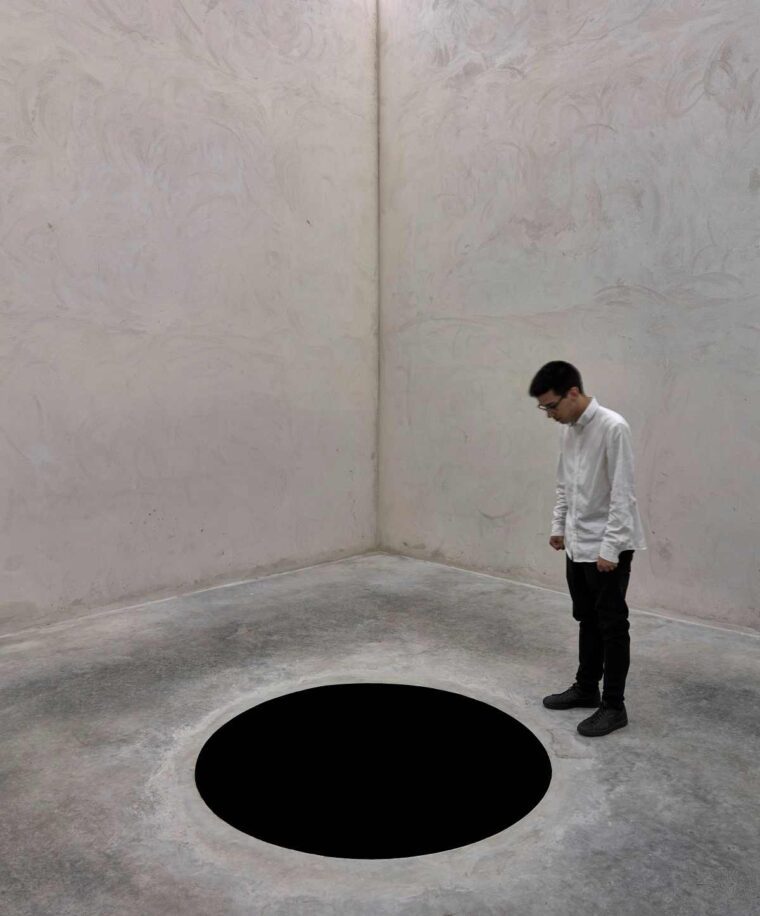
Those familiar with the work of Kapoor will be pleased to find a few older pieces – especially in the ‘black’ room full of optical illusions, although here, too, there are many works from 2026. Here, there are works which occupy threshold states. Descent Into Limbo (1992) looks like a black circle painted on the floor. Yet it has a safety boundary erected around it. Is this to prevent us from falling into the abyss? Is there, in fact, a hole in the floor? It depends on how you look at it. Other works are coated with Vantablack, a nanotechnology which absorbs 99% of visible light and makes three-dimensional forms seem completely flat when viewed head-on. As we move around these pieces, forms appear that were previously invisible. It is as if the laws of physics have been suspended, and certainly our own sense of wonder is evoked. Kapoor is commenting on the outer and inner spaces that we occupy – our bodies and our minds, our conscious and unconscious selves. As Kapoor has said, ‘perhaps the darkest black is the black we carry within ourselves’.
This is a superb exhibition, as if anyone needed reminding of what a giant of an artist Kapoor is. I left with my head spinning, my emotions churning, my thoughts challenged. Kapoor is concerned with how precarious our existence is while exploring the possibilities of transformation. Some of it may appear religious, and it seems that this is Kapoor’s intent. We are encouraged to think about the presence of the divine, the place of ritual sacrifice in our culture, which evokes our innate fear of death. Much of the work is deeply spiritual, challenging the way we think, see and feel.
Anish Kapoor runs at Hayward Gallery from 16 Jun – 18 Oct 2026.
Hayward Gallery,
Southbank Centre,
Belvedere Road,
London, SE1 8XX
Check our theatre previews for more on the South Bank and Bankside

Leave a Reply