Last Updated on June 8, 2026
4.0 out of 5.0 starsA musical adaptation of a slice of London’s history
Following two sellout runs in 2024 at Southwark Playhouse, Cable Street has now opened in north London at Marylebone Theatre. The musical tells the story of remarkable resistance to the march of Oswald Mosley’s British Union of Fascists (funded by the Nazi Party in Germany) in the East End of London on Sunday 4 October 1936. Cable Street was a multicultural area populated at the time predominantly by Jewish and Irish families. Refusing to be intimidated by the rise of fascism in the UK and the threat to their communities, one hundred thousand Jews, Irish workers and communists united to blockade the street from the fascist group known as the Blackshirts. Mosely was due to give a speech at Shoreditch Town Hall to garner more support for his cause. This event remains an important part of British history.

While such historical events have been researched and written about extensively, the resistance of Cable Street might not seem a natural choice of subject matter for a musical, it succeeds in the hands of writers Tim Gilvin and Alex Kanefsky and Director Adam Lenson. Similar themes were explored in Tracey-Anne Oberman’s production of The Merchant of Venice 1936. Focusing on three characters – Polish Jew, Sammy (Isaac Gryn), Irish Catholic, Mairead (Lizzie-Rose Esin Keely), and Lancashire working class man, Ron (Barney Wilkinson) – the musical explores family relationships and some romance while depicting the events which became a symbol of how communities can join together to resist fascism.
The structure of Cable Street The Musical works well. It begins and ends with a tour guide leading his visitors around the East End. Amusingly, they weave in and out of the production as the drama unfolds. The tour guide reads at points from a notebook written by his uncle, Sammy, that records the events of the Cable Street resistance, while later realising why an American participant is saddened to discover that the building in which her mother once lived is no longer there. The tour bookends the narrative with the events of the Cable Street resistance unfolding within its parentheses.
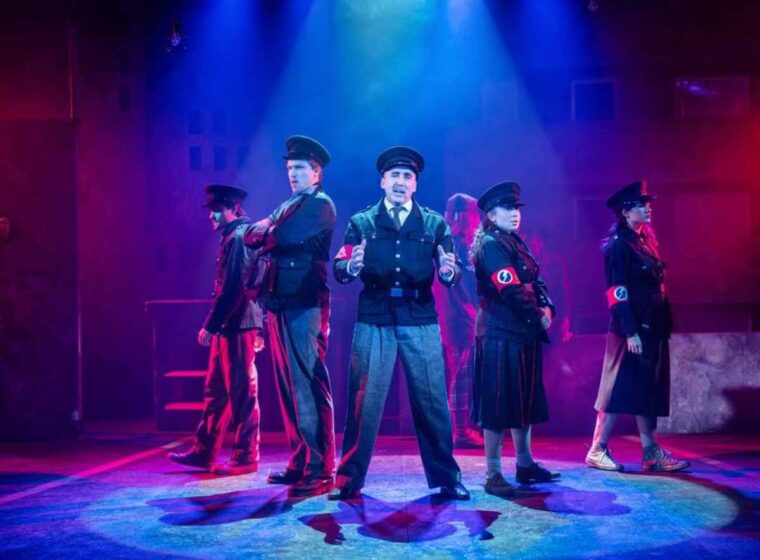
The story of Cable Street is told through the interaction of three East End families – one Jewish, one Irish, and a mother and son who have moved to London from Lancashire in search of work. They are all neighbours in Camelot Mansions – the name suggesting something rather grander than the straightened circumstances in which they live. Each parent has a young adult child wanting to change the world, whereas the parents are desperate to protect their offspring from harm. As the Blackshirt threat grows, each of the three young people decides what side to support. Amongst those resisting the fascist threat, divisions are evident but eventually put aside when the Communists, Jews and Irish dockworkers organise a brave and coordinated resistance to Oswald Mosley’s planned march through the East End.
The first half of Cable Street introduces the families and sets the political scene, culminating in an emotional rendition of the show’s anthem, No Pasarán. The second half depicts the events of 4 October 1936 and the violence that ensued, the resistance being victorious but not without serious consequences for those who suffered life-changing injury. Once the experience of a united front has been established, the community come together once again to fight evictions due to rent increases they cannot afford.
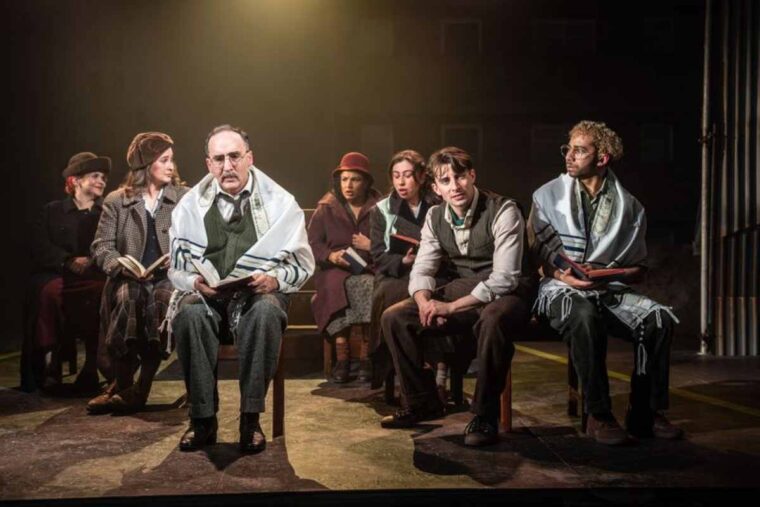
Does Cable Street work as musical theatre? Most definitely. The telling of history through songs helps to educate while simultaneously entertaining the audience, and the juxtaposition of the songs enables the pace and the emotional tone to move up and down a key where required. There is much fine ensemble work and powerful singing with good lyrics, albeit that at times I wished there were surtitles, as I could not hear all the words. The stage is small, so choreography is limited, and the production might benefit from a larger space, as at times there was too much going on and too many characters in a restricted area. The live band provided excellent musical accompaniment to the cast with the bass guitarist (Robyn Brown) and violinist (Elizabeth Boyce) on stage throughout, while the keyboardist (Dan Glover) and percussionist (Joel Mulley) appeared only for the curtain call. The cast not only sang passionately, but there were also some fine acting performances. Stand-out performers included the three protagonists, Sammy, Mairead, and Ron. They all convincingly portrayed character development as the consequences of their political choices play out. Ethan Pascal Peters played a range of diverse parts with force and humour, whether playing the religiously devout son or a rather camp newspaper reporter. Jez Unwin was wonderful as the seen-it-all tourguide, Steve, who forms a bond with his American participant, Una (Debbie Chazen). He also played a despairing Jewish father and segued equally convincingly as the chilling leader of the British Union of Fascists.
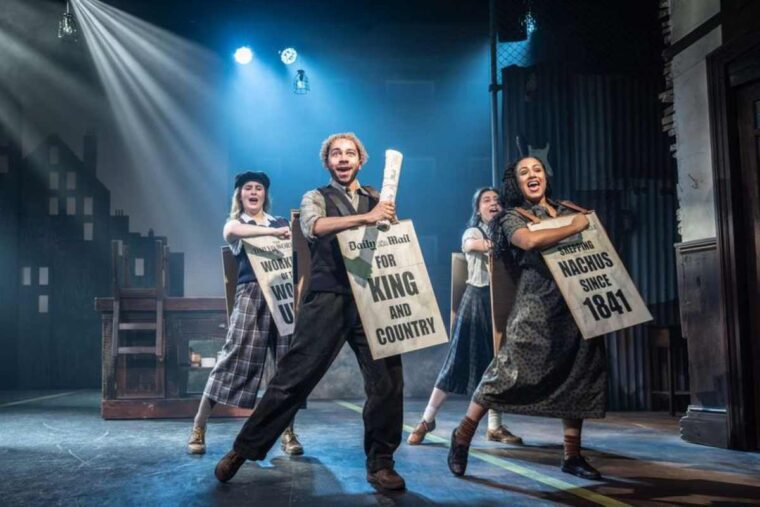
Many songs were poignant – Only Words being a moving ballad and one of the finest in the show, others were angry and defiant. At points, the emotion rendered some of the songs a bit shrill, and the drama lapsed occasionally into sentimentality. Yet the songs were powerfully delivered either as solos or as ensemble pieces, which had some lovely harmonies. There was a mix of musical genres from folk to rock and rap. The musical’s anthem, No Pasarán, was particularly strong with Preeya Kalidas in the lead, belting out a fabulous performance with her richly resonant voice.
While Cable Street relates a piece of British history that deserves to be better known, it is also rather chilling to watch in 2026. While 90 years have passed since the events unfolded, once again on the streets of Britain, there is an upsurge in hate speech and antisemitism, and far-right forces are on the rise across the world, where the rallying cry yet again blames the ills of society on immigrants. It is impossible to enjoy Cable Street without feeling the dangers of history repeating itself. This makes this production particularly important, and the Director has spoken in the press about his desire for school children to see it. This production is the third iteration of Cable Street on a London stage, and the production travels to New York as part of the Brits Off Broadway festival in April. Hopefully, at some future point, it might make its way back to London, where it deserves to play on a bigger stage; it certainly packs sufficient punch to do so.
Cable Street runs from 16 January to 28 February 2026.
Marylebone Theatre,
Rudolf Steiner House,
35 Park Road,
London NW1 6XT
Check our previews for more Off West End Theatre in 2026

Leave a Reply