Last Updated on September 11, 2026
A Punchy Don Giovanni to Open the Royal Opera Season
4.0 out of 5.0 starsThe new season at the Royal Opera House kicked off last night with a strong revival of Kasper Holten’s 2014 production of Don Giovanni. Holten casts us deep into the amoral, guiltless world of the eponymous arch seducer. A man whose power and self-belief catalyses the weakness and hypocrisy of others and for whom amorous conquests and the subsequent adventures that emerge are the only game in town, even if they involve rape and murder.
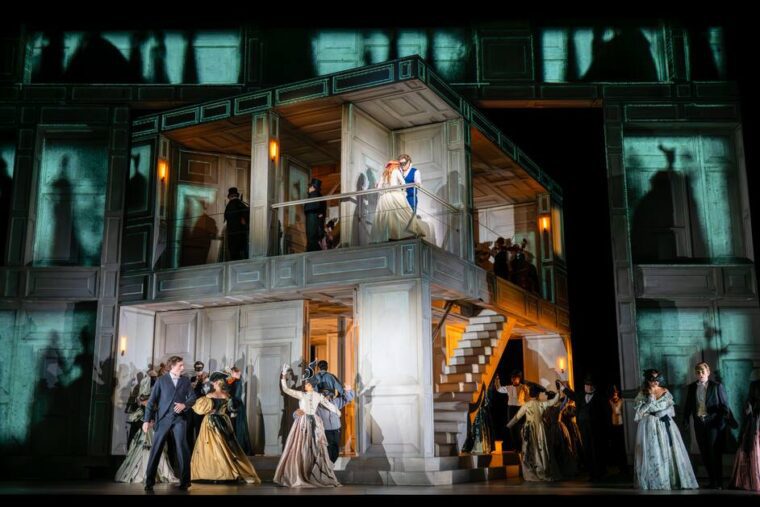
Mozart’s masterpiece with its libretto by Da Ponte was first staged at the Prague Italian opera in October 1787, and since that time each generation has reinvented their own version of Don Juan in literature, theatre, opera and film, trying to grapple with the tension between Christian morality and the realities of human behaviour and the balance between comedy and drama that the character affords us. Kasper Holten takes us on a deep dive inside Don Giovanni’s psyche. The narrative and characters are framed within Es Devlin’s imposing and cleverly designed set, a building that spins around on its axis, revealing a frontage and then its inner skeleton. The building represents Don Giovanni’s world and allows the various couples and couplings to be presented in a way that retains narrative clarity in what is often a tangled web of amorous intrigue. The Don and his manservant Leporello slip through hidden doorways and back staircases as they navigate the treacherous terrain of jilted lovers and their revengeful partners.

Overlaid on the building are spectacular and symbolic video projections by Luke Halls. These are mapped using advanced projection techniques to great effect. The opening scene shows the names of Don Giovanni’s thousands of conquests from his manservant Leporello’s journal scrawled across the building. There are splodges of spattered ink that are repeated on the dresses of the Don’s victims to remind us that each of them is just a footnote in his ledger of short-term love. As the drama progresses, we see blood and other viscous bodily fluids dripping and spreading like a virus over the building as the Don’s obsessional lust infects all in his path. There are line drawings of twisted naked bodies, the all-seeing Masonic Eye and colours that range from dusky pink to blood red, illuminating and giving texture to the unwinding of his fate.
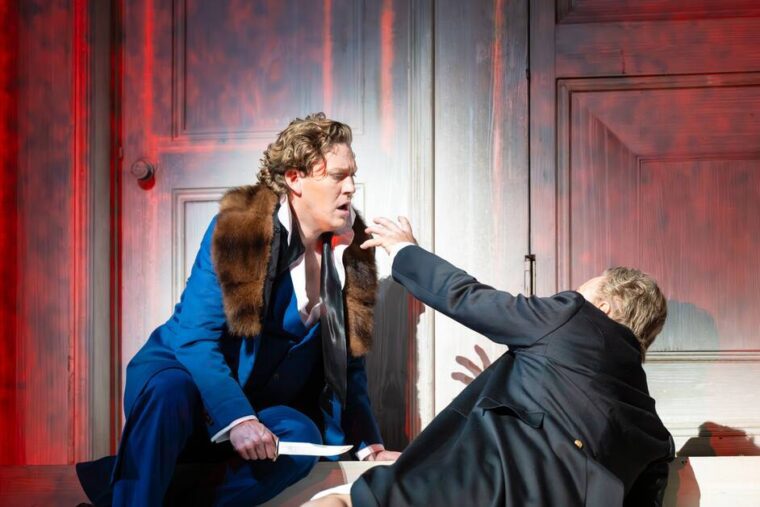
Canadian bass-baritone Gordon Bintner as Don Giovanni was resplendent in a fur-collared blue frock coat and is dramatically convincing in the part of this galactico of Lotharios. The story centres on his attempts to seduce or re-seduce three women, two of whom are on the cusp of marriage. In the signature Champagne Aria ‘Fin ch’han dal vino calda la testa’, Don Giovanni sets out his hedonistic stall whilst positioned at the centre of a whirling kaleidoscope of images. He artfully plays off the men and women against each other, revelling as the pawns in his game fail to take him – ‘None of them is a match for me’. Bintner impressed with his acting at the end of the truncated opera (the final scene is cut for good dramatic reasons) with his final desperate utterances, ‘Don Giovanni! A cenar teco m’invitasti – Don Giovanni! You invited me to dine with you’, but doesn’t quite have the vocal presence to own the part.

The Don’s primary and only long-term relationship is with his servant Leporello, a more comedic creation who shambles across the stage in a misshapen grey felt hat. Always wanting to leave the Don’s service but seduced by his money, Leporello wants the Don to give up women – but this is a mission impossible. As the Don says, ‘I need them more than I need bread’. Italian bass Roberto Tagliavini was a less vocally dominant Leporello than Christopher Maltman in the production’s previous outing but was an excellent vocal fit for this strong ensemble cast.
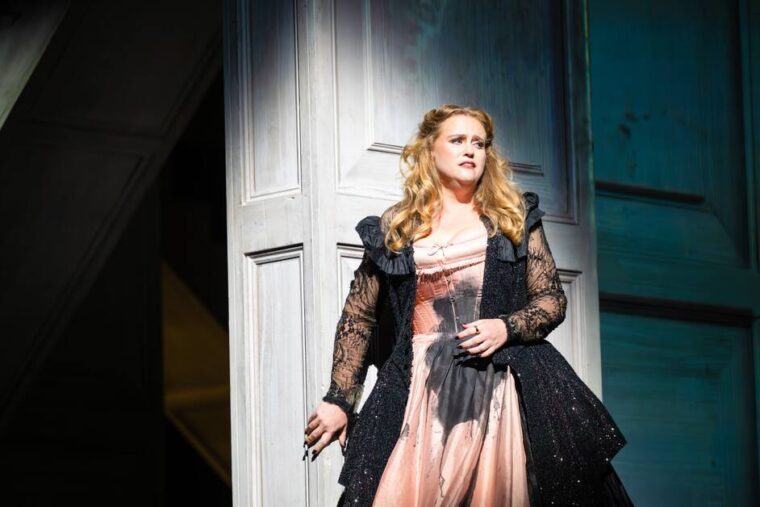
The singing of American soprano Rachel Willis-Sørensen was the night’s female vocal highlight, gaining a spontaneous ovation after her first aria. Willis-Sørensen was playing Donna Anna, whom Don Giovanni attempts to rape at the start of the opera, killing her father, the Commendatore, in the process. She has a powerful upper register, impressing both with the drama of ‘Ma qual mai s’offre oh Dei – What is this I behold?’ and in the sublime duet ‘Ah, vendicar, se il puoi, giura quel sangue ognor! – Ah, swear to avenge that blood if you can!’ with her fiancée Don Ottavio.
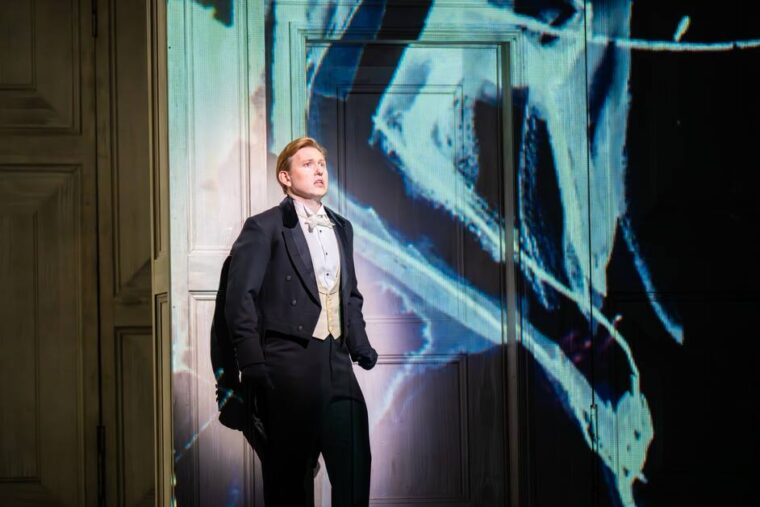
Ukrainian tenor Bogdan Volkov, as Ottavio, stole the show vocally with his aria ‘Dalla sua pace ’, displaying a beguiling romanticism showcasing his gorgeous lyric tone.

Anna’s father, stentorian German bass Andreas Bauer Kanabas, dies with a backdrop of dripping blood, having been told casually by Don Giovanni, ‘Stay if you want to die’. But on his return from the dead, the tables are turned as he sings ‘Don Giovanni! A cenar teco m’invitasti – Don Giovanni! You invited me to dine with you’.
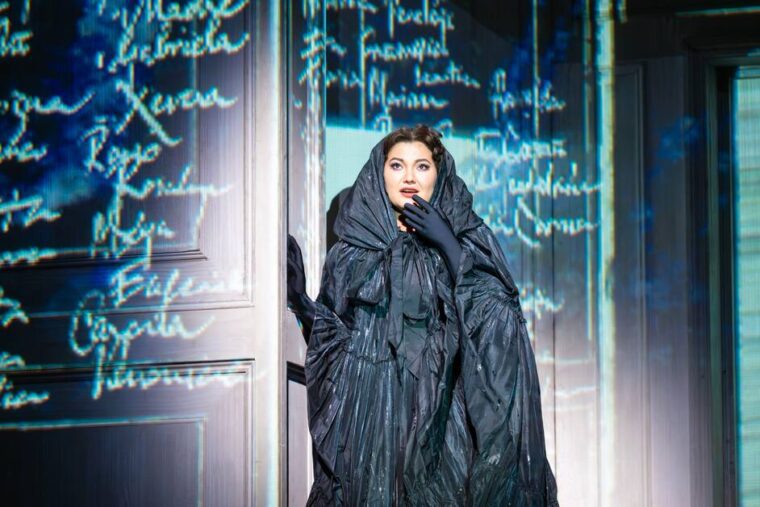
Russian mezzo-soprano Aigul Akhmetshina as Donna Elvira tried and failed to escape from the Don’s hold on her, wanting him to reform: ‘Ah, chi mi dice mai – Ah, who could ever tell me’, but finally accepting her lot. Akhmetshina wasn’t on top form, with her voice sounding a little tired, but she is always a formidable presence.
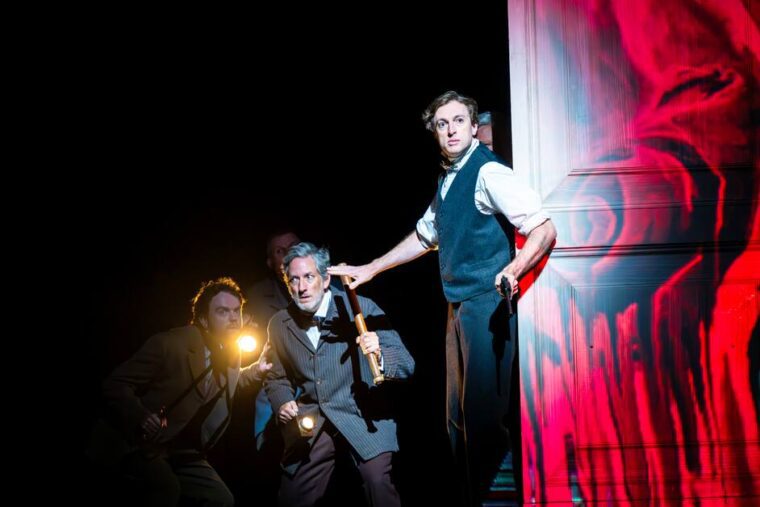
Italian soprano Giulia Semenzato as the peasant bride Zerlina displayed a lovely Mozartian clarity in her singing and is a real vocal find. It was terrific to see British bass-baritone Dingle Yandell making his Royal Opera debut playing Zerlina’s dim-witted, gawky husband Masetto. He was excellent as Captain Zuniga in Carmen at Glyndebourne and brought his characterful vocal tone to the part.
Conducted by Stefano Montanari, the orchestra played with a confidence and energy that comes with familiarity. The sombre first orchestral hits of the overture presaged Don Giovanni’s fate before morphing into the more playful Allegro in D major taken at full pelt. However, Montanari never let the drama sag or feel rushed, and the vocal balancing was much better managed than in the previous production. The orchestra sounded splendid throughout, with props going to the basso continuo for keeping the singers on their toes.
Special mention must go to Costume Designer Anja Vang Kragh, who created the fabulous fin de siècle costumes that, with the help of Lighting Designer Bruno Poet, created such gorgeous silhouettes.
This revival of Kasper Holten’s Don Giovanni is a production with some very fine singing alongside terrific dramatic moments. Don Giovanni becomes an existential hero, owning his fate and taking responsibility, if not seeking penance for his sins. It seems like a good way to go.
10 September -15 October 2026
Royal Opera House
Bow Street
London
WC2E 9DD
Looking for more opera? Check our previews of London Opera for Autumn/Winter 2026

The Royal Opera House’s Don Giovanni looks good, but I found some aspects of it disturbing. The choice of set and bright video projections is eccentric and flashy, perfectly mirroring Don Giovanni’s chaotic, attention-seeking personality. However, the production forces us to see everything through his eyes.
The show hints that Donna Anna is secretly attracted to Giovanni, completely undermining the reality of her assault and grief. Making all the women hopelessly fall for a toxic abuser, while framing the decent men as boring, feels totally out of touch with real-world issues which I personally found somehow disturbing.
I loved these singers & would happily listen to them again. To me the orchestra sounded strangely weightless and uncertain, and the heavily metaphorical set jarred. This was noticeable in the murder and the supper scenes, where the stage direction bore no relation to the libretto. . So I wouldn’t revisit this version, though one departure was quite comical – at Gia la mensa e preparata, you were aware of 1800 people thinking, “Uh, what table?”
I can see how beguiling a task it must be to create a new look, perhaps to the point where understanding the plot seems almost secondary. But the monochrome set could have allowed for more colour differentiation in costumes, and that might have helped in those wait-who’s-that moments.
The singers were beyond wonderful. Thank you.
Yes, I agree! I was looking forward to the supper scene but where was the table? Not much opportunity to show off the barbaro appetito! He’s just sitting on the threshold having a snack.. Leporello theft of the food was not accentuated. The drama around the table was lacking.