Last Updated on November 1, 2026
Tosca-Art as Resistance
3.0 out of 5.0 starsENO brings Tosca, this titan of the opera canon to a contemporary, vaguely ’80s Eastern European, setting. In its most successful moments, it is rousing and infused with urgency, but the dramatic punch of Act Two doesn’t land, and the cast is uneven.
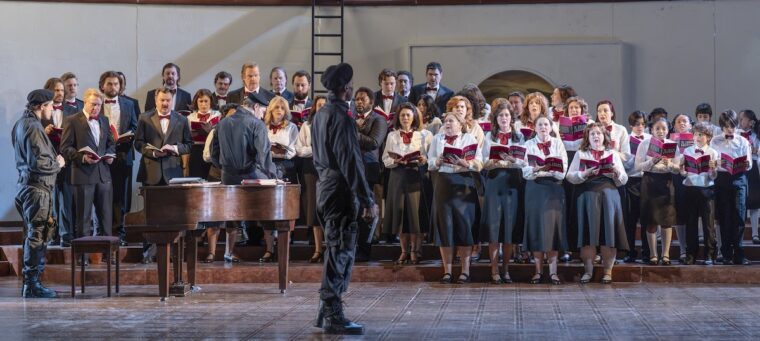
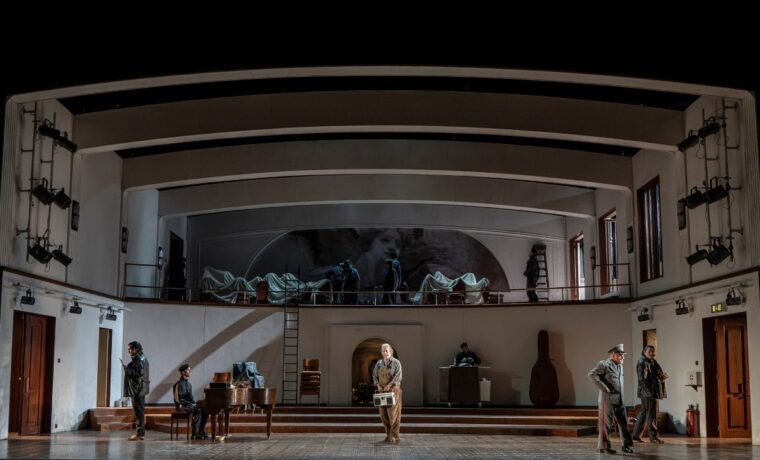
The entire drama is set in a concert hall. At the outset, it is an easy going space, full of innocuous comings and goings. In spite of the appearance of Angelotti, an escaped political prisoner, the atmosphere is not a tense one, and the political turmoil feels remote. From here, Act One is one slow crescendo towards a reckoning with the dark political landscape. For the finale, the choir assemble as bombs explode in the distance, and thuggish guards beat up civilians. The choir sing on. It is a moving portrait of everyday life struggling on in the face of terror and conflict. With Puccini’s monumental score, it is stirring stuff. Act Two really does need a change of scene though. The dogged (or cash strapped) insistence on staying in the concert hall starts to battle the libretto, and common sense. Cavaradossi is arrested, tortured and waits for his death sentence. It takes substantial suspension of disbelief to accept that this would remain within the concert hall and not move to a jail or police station. It is also too innocent a space to really feel the jeopardy of Cavaradossi’s situation, the torture scene was quite unmoving.
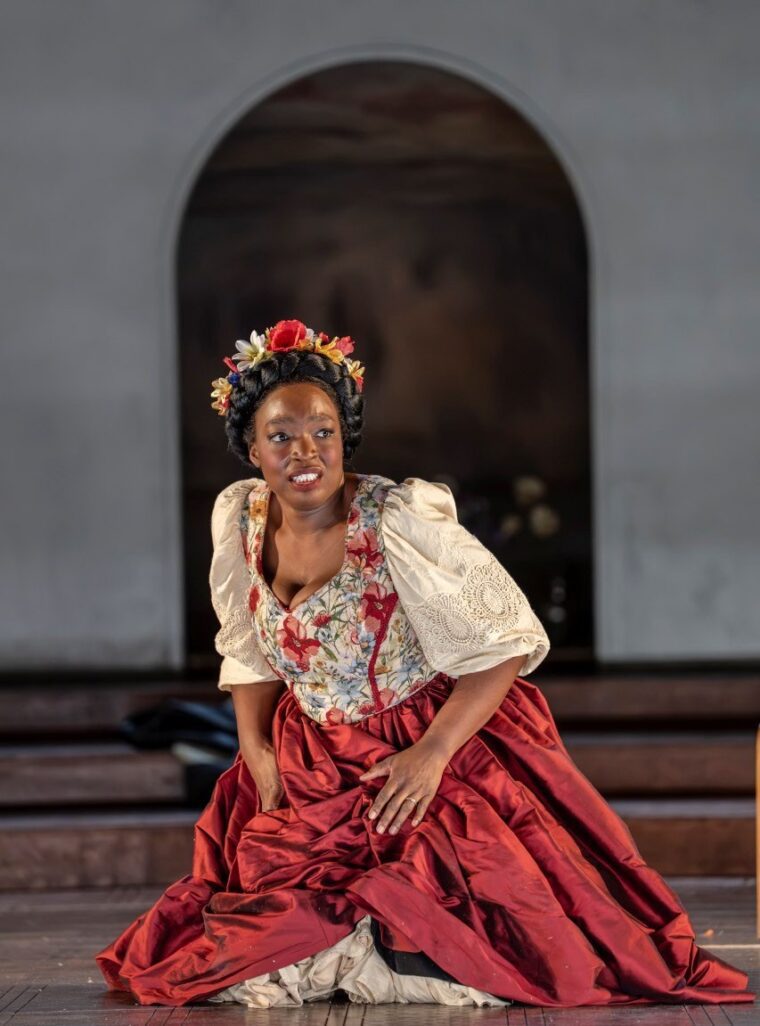
Our Tosca, Axelle Fanyo, brings a captivating stage presence as the iconic diva. A true singing actor, she grasps the complexities of the role with utter conviction, presenting her initial jealous mood swings with warmth and humour, and negotiating the later horrors with great sensitivity. Vocally she is at her best when unleashing her full, soaring upper register and in some coy, giggly diminuendos. The iconic Vissi d’arte (in English) is very moving, not especially beautiful, but raw and desperately anguished. There is, however, a distracting problem throughout, and that is the text, or rather lack thereof. It is very indistinct. The problem is not so much underpowered consonants, but the way Fanyo chews on the text, with warped and wandering vowels.
Indeed, the evening speaks volumes on the relationship between singing and text. While Fanyo struggles, Christopher Purves (Scarpia) and Alaric Green (Angelotti) deliver a masterclass in flawless diction. Surtitles are quite redundant with these two. What a shame they’re both dead by Act Three. The fact that the production is in the vernacular, and with a particularly good translation, means that there is the opportunity for real emotional immediacy. Poor diction squanders this. Furthermore, the colour of the vowels is a part of the music. Pure, stable vowels give a clean contour to the sound, when they wander the waters are muddied.
Diction aside, Alaric Green’s gloriously resonant, powerful voice is quite something to behold and Christopher Purves is a skin-crawingly nasty Scarpia. This Scarpia is understated in his evil, which is coldly institutional rather than flashily psychopathic. His crisp, direct voice carries effortlessly over the orchestra. He could be speaking right in your ear, and what a horrible thought that is.
Chaz’men Williams-Ali delivers a passionate Cavaradossi. Initially swallowed up the orchestra, he soon warmed into it. Despite some signs of flagging stamina, his Act Three aria was stunning, particularly with the heartbreakingly plangent clarinet solo. He brings authenticity and pathos to the role, and his chemistry with Fanyo is one of the highlights of the evening. They find passion and tenderness, and bring an endearing humour to their bickering.
The chorus are on fine form, and it is fantastic to see that the children’s chorus is drawn from a state primary (Marlborough Primary School). They are perfectly drilled but more importantly exude unbridled, electric enthusiasm. It is heart warming to see these kids, many of whom had never encountered opera before, experience its exhilarating power from within.
The standout performance comes from the ENO orchestra under Ben Glassberg, who embody every ounce of the majesty of Puccini’s score. Glassberg carves out broad phrases full of swooning, swelling passion. The sound is unfalteringly lush and warm, but also bombastic and red-blooded for the martial motifs, and thunderingly dramatic for each jaw-dropping plot twist.
On the strength of this, and a grand finale that will make your eyes pop out of your skull, it is worth seeing, but not an unmitigated success.
5th November – 11th December
English National Opera
London Coliseum, St Martin’s Lane, London, WC2N 4ES
All photos © Ellie Kurttz
Leave a Reply