Last Updated on February 7, 2026
The Story of Faustus Reimagined for Modern Day Africa
3.0 out of 5.0 starsI have a thing about puppets. That is to say, I love them. Not the simplistic Punch and Judy type, but rather the more sophisticated variety, detailed and realistic effigies skilfully manipulated to tell a complex story in ways that enraptures both children and adults.
So my ears pricked up when I heard that the Coronet Theatre would be hosting a show intriguingly entitled Faustus in Africa! combining the talents of the Handspring Puppet Company and the South African artist, film director and animator William Kentridge.
British audiences will certainly remember Handspring at the very least for the extraordinarily life-like horses that brought so much heart and emotion to the hit show War Horse; but its prolific output since its foundation in 1980s South Africa extends well beyond that; William Kentridge’s has been regularly featured in the UK, most recently in a powerful 2022 Royal Academy exhibition of his multi-disciplinary work, which I remember as if it was yesterday.
So, to Faustus in Africa! then.

The centuries-old cautionary tale of the man who strikes a pact with the devil, selling his soul in exchange for youth, power and knowledge, most famously told by the German poet Goethe, forms the basis of Faustus in Africa! It is, however, modified to speak of Africa today, and the moral compromises that define its politics and choices.
The set is a dusty old office with wooden desks, an old-fashioned manual typewriter and a telephone exchange, with glass-fronted cabinets full of files and bulging dossiers. Above and behind all this, there’s a large screen, on which a succession of charcoal animations by William Kentridge provide the constantly changing locations for the action, as well as pictorial commentary on some of the key moments of the tale.
Enter Faustus, a gaunt puppet manipulated by two men.

Enter, also, Mephistopheles, the only character played not by a puppet, but by a real-life actor, Wessel Pretorius, his forceful characterisation of the devil a very effective combination of sassy and sinister. He speaks in rhyming couplets, Robert David Macdonald’s translation of the original combined with additional text by the poet Lesego Rampolokeng.
The pact between man and devil leads Faustus on a dizzying trip across Africa, denoted in monochrome maps from old colonial days that succeed each other on the screen. Landmarks of the past – Abyssinia, the famous Hotel Polana in Mozambique’s capital, here under its colonial name of Lourenço Marques, the Belgian Congo, to mention but a few – transport the tale to the days when Africa was seen as the white man’s playground to use and abuse at his pleasure.
So, armed with a gun, Faustus goes on safari, shooting everything that moves, but missing a hyena, which then materialises from image to three-dimensional puppet and joins the action.
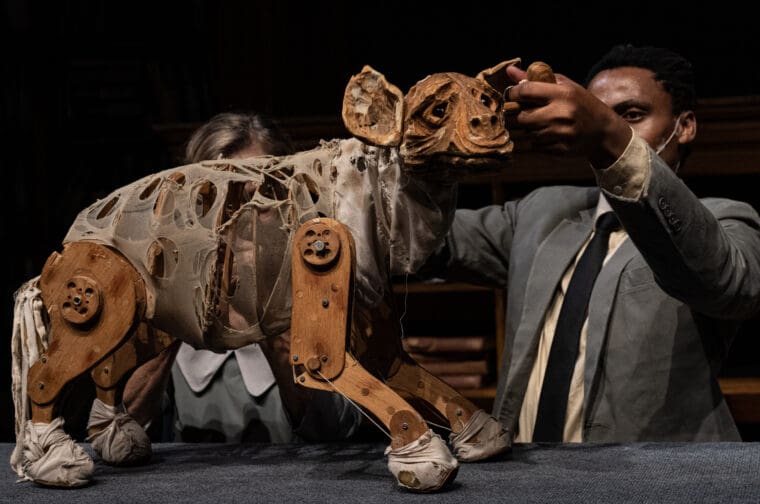
Handspring has a particular knack for creating engaging animal puppets, and this hyena is undoubtedly one of the stars of the show.
Faustus duly meets and falls in love with a beautiful young lab technician, whom, with typical colonial arrogance, he describes as “modest, virtuous, beautiful… with a touch of intelligence.”
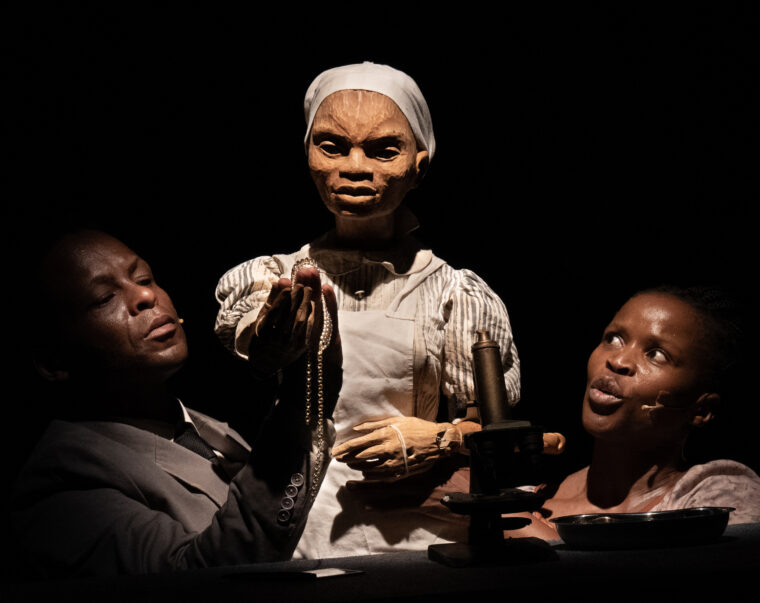
Later, the silhouette of a pregnant woman walks across the screen, no more than an allusion to the fate of the young woman seduced and abandoned by Faustus.
There is a scene where African artefacts are packed ready for auction at Sotheby’s; another where the characters pocket vast quantities of paper money; yet another where Faustus’s vision of Helen of Troy comes accompanied by the typical African dictator, red sash and multiple medals very much in evidence, as well as a leopard skin toque reminiscent of the late Mobutu of Zaire.
And as one corrupt empire dies, another seems to arise, and everybody, including Mephistopheles, wants to be part of it.
The problem with Faustus in Africa! is its cluttered and frankly messy narrative. Created originally in 1995 South Africa, just as the country was emerging into democracy after the apartheid era, Kentridge intended it as a response to the deal between the outgoing white government and the incoming ANC, which opted for peace at the expense of justice.
Thirty years later, the show was been spruced up, but not significantly changed. However, according to Kentridge’s programme note, the optics have shifted significantly and issues pointed up then, such as corruption and the pillage of African artefacts and resources, now take centre stage.
Over the show’s uninterrupted 90 minutes, the intention came across, but there were points where the narrative lost me. However, I had to admire the entire cast – Eben Genis, Atandwa Kane, Mongi Mthombeni, Asanda Rilityana, Buhle Stephane and Jennifer Steyn, as well as Wessel Pretorius – and their ability to instil life in both puppets and narrative; and I found William Kentridge’s animations truly dazzling.
Faustus in Africa is at the Coronet Theatre from 05/11 to 16/11
The Coronet Theatre
103 Notting Hill Gate
London W11 3LB
Looking for something different? We also recommend Wendy & Peter Pan, currently showing at the Barbican.

Leave a Reply