Last Updated on September 12, 2025
An Explosive Revival at the Garden
This is the second outing at The Royal Opera for Christof Loy’s production of Verdi’s La Forza del Destino. It’s a co-production with the Dutch National Opera and opened in Amsterdam in 2017. The 2019 London production starred opera superstars Anna Netrebko and Jonas Kaufmann who dazzled the critics as ill-fated lovers Donna Leonora and Don Alvaro. Antonio Pappano masterminded the musical proceedings and there were tales of tickets being resold at dizzying prices with the resulting furore causing a minor rent in the fabric of the operatic universe. A resounding success from a musical perspective, Loy’s production received mixed reviews so I am fascinated to see how it has developed and to hear Sondra Radvanovsky and Brian Jagde, who will reprise the role of Don Alvaro at the Met in 2024, singing the leads, with the redoubtable Mark Elder conducting.
The opera, with a libretto written by Francesco Maria Piave on Ángel Pérez de Saavedra’s play Don Álvaro o la fuerza del sino (1835), premiered in St Petersburg in 1862 and was subsequently revised on several occasions with an 1869 production in Milan becoming the standard performance edition. Verdi’s melodrama, composed between his Don Carlo and Aida, deals with themes of jealousy, revenge and murder.
The narrative centres around Leonora, the daughter of the Marquis of Calatrava, and Don Alvaro, a mixed-race aristocrat whose father was Spanish and whose mother was an Inca princess. The Marquis catches the young couple as they are about to elope and in the ensuing fracas he is shot accidentally by Don Alvaro’s pistol. The Marquis places a curse on the couple who are separated in the aftermath of the shooting with the rest of the opera being a series of set pieces that play out as the protagonists try to deal with the impact of the tragic event on their lives.
From the opening 3 note ‘fate’ motif, a repeated E in the brass, Mark Elder has the Royal Opera House orchestra sounding as confident as I have heard it with an immaculate performance of the overture. Throughout the 4 hours the conductor martials the dynamics brilliantly, no singer is ever overwhelmed and he wrings every ounce of emotion out of the score without becoming overindulgent.
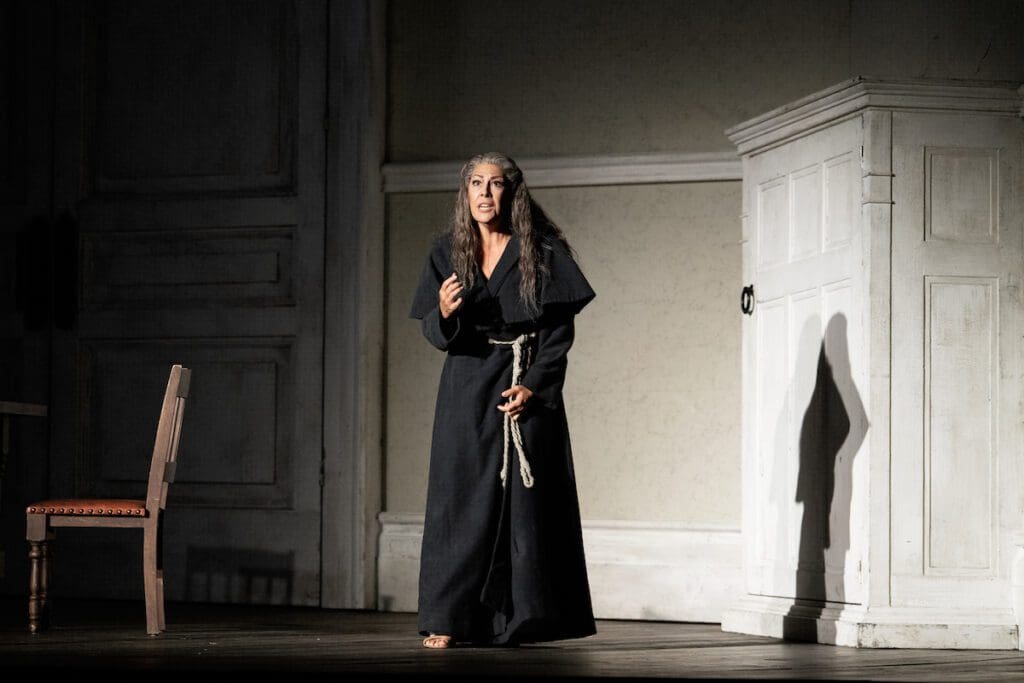
It takes an artist of great self-confidence to fill the shoes of Anna Netrebko in the role of Leonora, and American and Canadian soprano Sondra Radvanovsky is simply sensational. She has an implicit understanding of the greater emotional depth that Verdi brought to the bel canto tradition. Her character straddles the line between duty and love to her father and passion for her boyfriend, prevaricating before her elopement. Radvanovsky has a lustrous tone of great dramatic flexibility with an impassioned sense of dynamic control and an impressive ability to manage four costume changes seamlessly in the first scene.

The two male leads, American tenor Brian Jagde as Don Alvaro and French-Canadian baritone Etienne Dupuis as Don Carlo di Vargas, are well-matched vocally and dramatically. Their relationship moves between anger and physical conflict, attempts at reconciliation by Alvaro, and a short-lived comradeship built on each operating within their false identities saving the other from death. Their final duet was received rapturously.
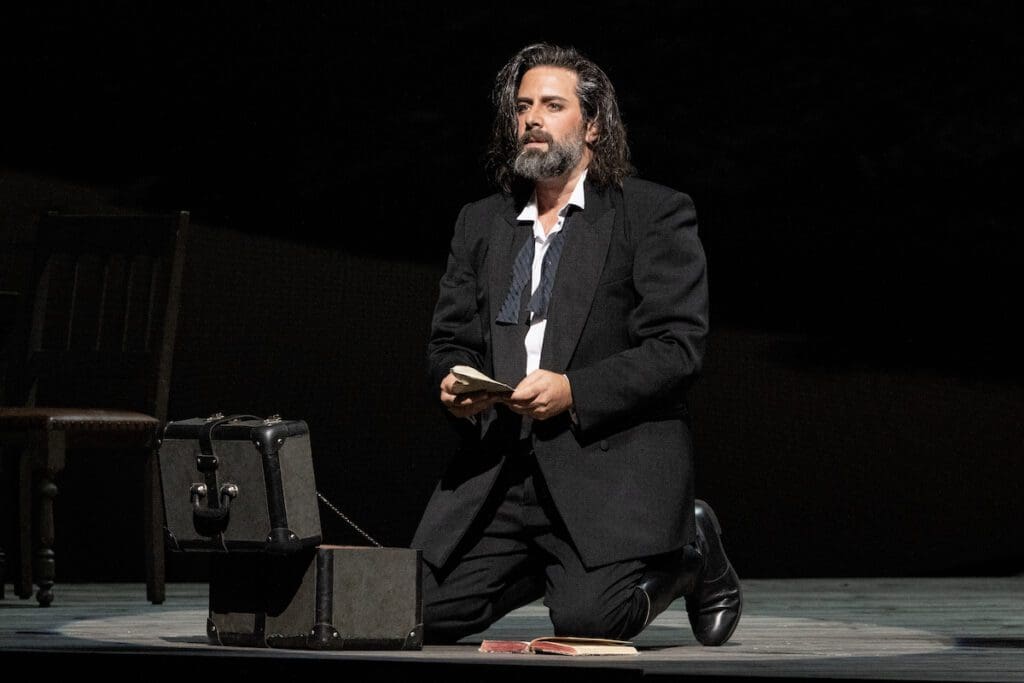
Dupuis, a clear audience favourite, playing a character locked into a murderous and ultimately suicidal act of revenge, delivers a well-paced performance with an elegance of tone that both blends and contrasts with the more forceful Jagde who, having made the unlikely transition from a baritone to tenor was reprising his onstage relationship with Radvanovsky from the Met’s 2021 Tosca. He has the vocal firepower to match hers creating a well-balanced ensemble.

American bass James Creswell is suitably stentorian as the Marquis of Calatrava and makes the most of his death and curse which motivate the drama.
Possibly the most important element in the opera is the concept of fate, a word which is sometimes preferred as a translation of “Destino” from the opera’s title. Sarah Lenton in her typically incisive programme piece sets out a fascinating contextual analysis of fate, that invisible actor as a recurring motif in Spanish culture and psychology of this time. It is an accident of fate that leads to the death of the Marquis, it is an acceptance of fate that drives his son Don Carlo to spend the rest of his life trying to avenge the death of his father by killing Leonora and Don Alvaro. However, fate is an old-fashioned concept fate that defies rationality as well as the individual’s ability to be autonomous.

At the transcendental end of the opera as Leonora dies, stabbed by her own brother, fate is given short shrift by sombre-toned Russian bass Evgeny Stavinsky as the humane Padre Guardiano, the Father Superior at the monastery, where cruelly the lovers have both ended up without realising that the other was close at hand. The priest tells us to “humble ourselves before the hand of God” and we realise that Leonora and Alvaros’s suffering is all part of God’s plan and that in the Catholic worldview of the time it is only through suffering that we can be redeemed and reach Heaven (“This angel ascends to the throne of God”).
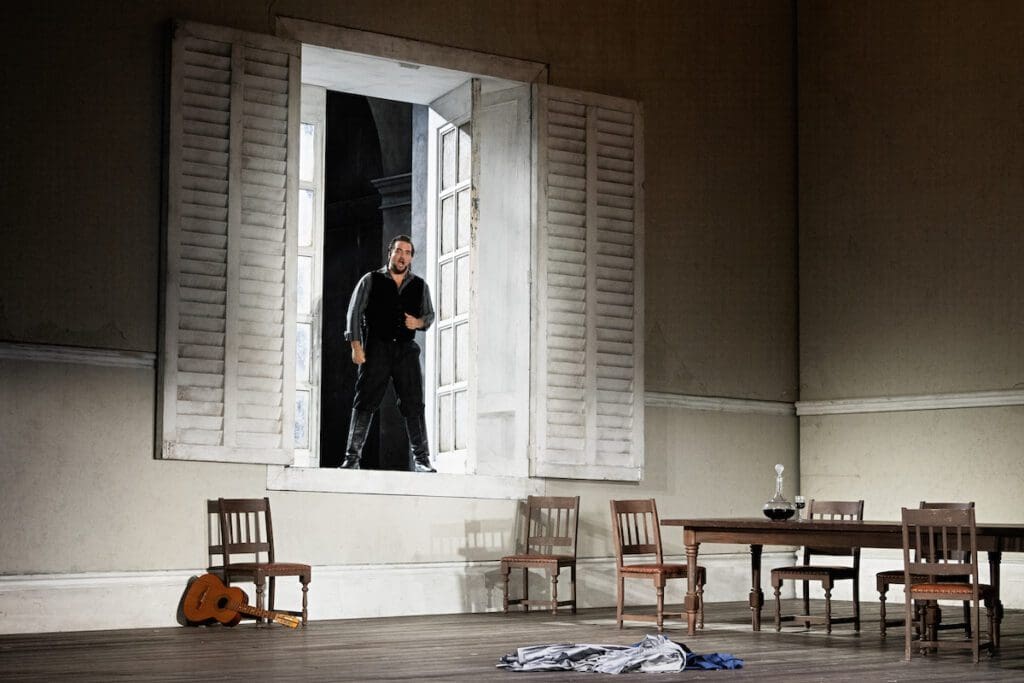
The opera is often criticized for its structure with the main event happening at the beginning and the final action, when Don Alvaro fatally stabs Don Carlo who in turn redeems his sense of honour by murdering his sister, happening off-stage. The rest of the opera is a series of set pieces that are either driven by the series of dichotomies that scaffold the drama – fate/religion, religious piety/orgiastic hedonism and rationality/honour, or by a Shakespearian comedic leavening of the melodrama that sometimes disrupts the dramatic tone. But while it can be argued that the plot lacks narrative drive, these operatic Mexican standoffs and comic interventions create a perfect substructure for the musical architecture of grand opera and afford a series of tensions out of which have sprung some of Verdi’s finest writing. It’s no wonder that Andrew Lloyd-Webber was in the house taking notes…
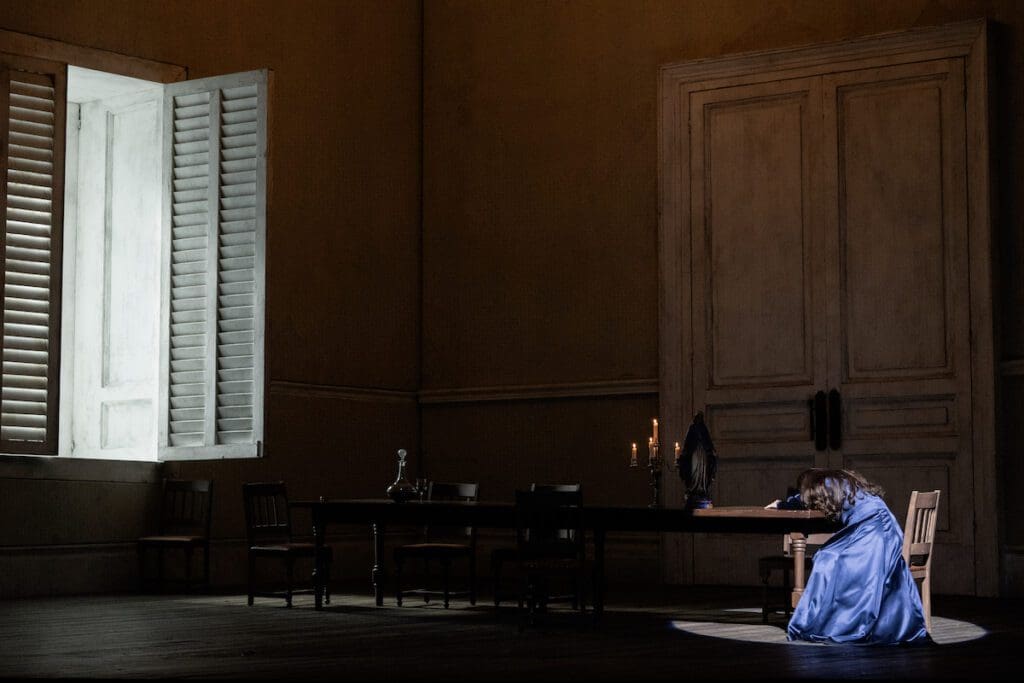
Christof Loy’s production is a mixed bag. He is strong on the psychological underpinnings of the characters. There is an opening dumb show during the overture that effectively sets out the Calatrava familial backstory. We see the Marquis, who has lost a wife and a son, preferring to shake Carlo’s hand rather than responding to his hug, so Carlo is set up as a character who wants his father’s approval; the Marquis himself has a co-dependent relationship with his daughter who has replaced his wife in his affections, so the thought of losing her is devastating. This attention to detail aids the characterisations. But black and white projections referencing of the death of the Marquis and his curse felt intrusive, distracting the focus away from the stage.
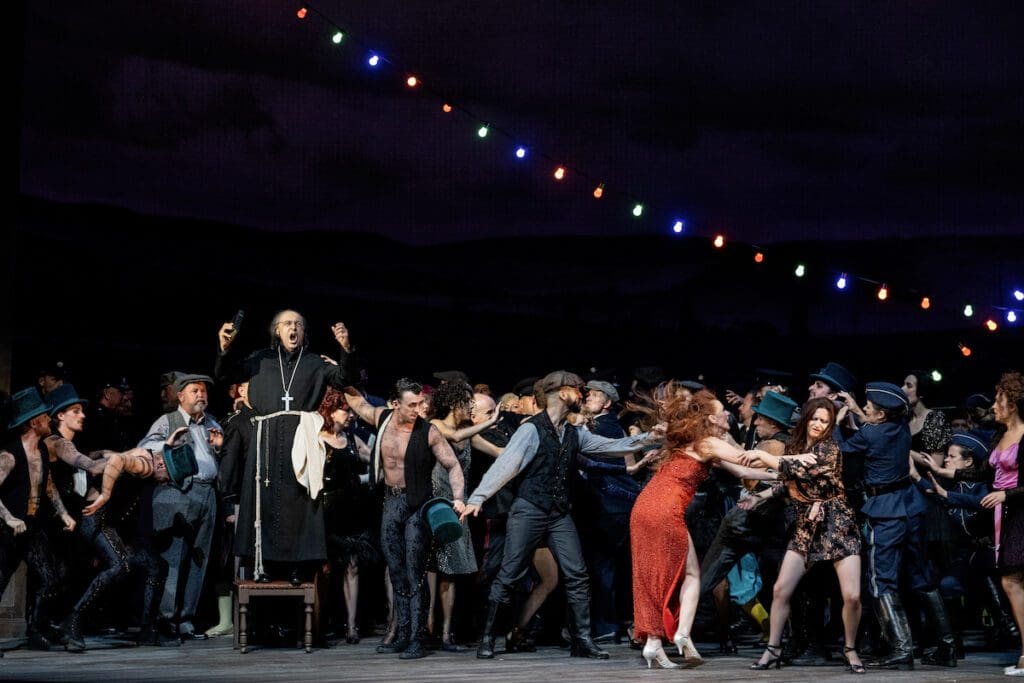
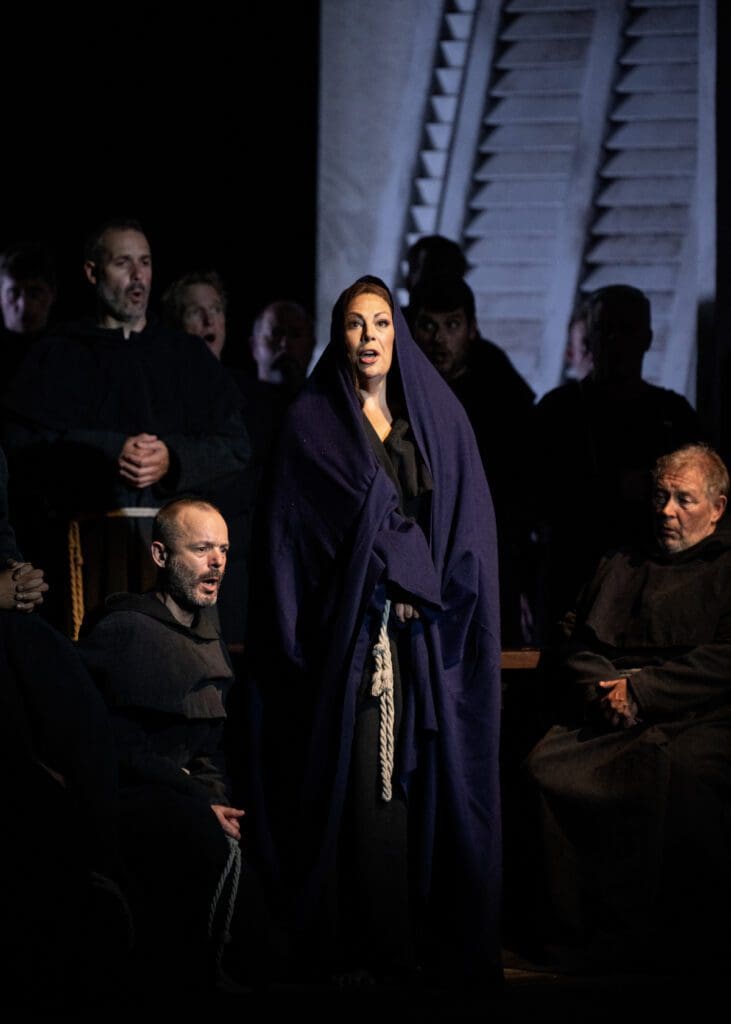
Designer Christian Schmidt has cleverly constructed a scenic frame that morphs seamlessly between family home, battlefield and monastery. However, the angle of the set cuts off much off the stage making the crowd scenes simply feel too crowded. The battlefield carnival at the end of Act 3 with Bob Fosse-esque dancers is well managed despite the constricted space There are effective moments of stagecraft that are often more painterly rather than filmic; such as the opening of Act 2 when the crowd is first presented as a photographic tableau vivant. Or the scene at the end of Act 2 when the priests are gathered in the monastery, placed as if in a Raphael fresco with lighting by Caravaggio, as Leonara is transfigured into a Madonna-like figure as she retreats into her hermitage for safety and solace.
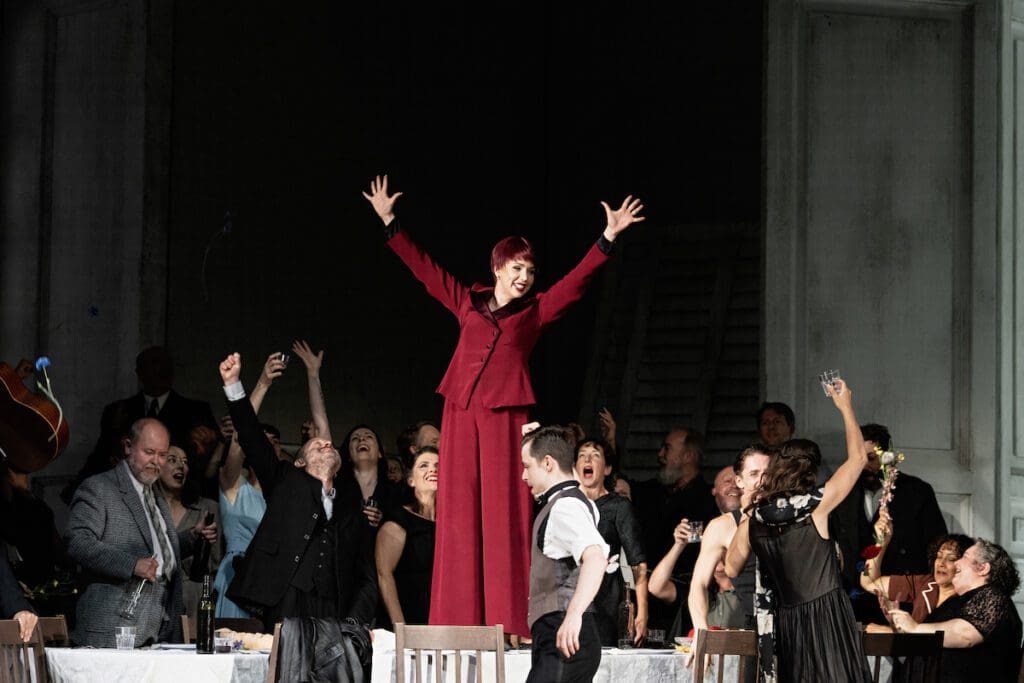
Of the minor parts, gypsy smuggler turned belly-dancing fortune teller Preziosilla, Vasilisa Berzhanskaya initially sporting a natty maroon trouser suit with matching hair before reappearing in full green harem-panted glory, urges people to fight with a Dionysian frenzy and vocal fireworks. She also leads the fantastic chorus through the evocative unaccompanied opening to the militaristic song “Rataplan, rataplan, della gloria”
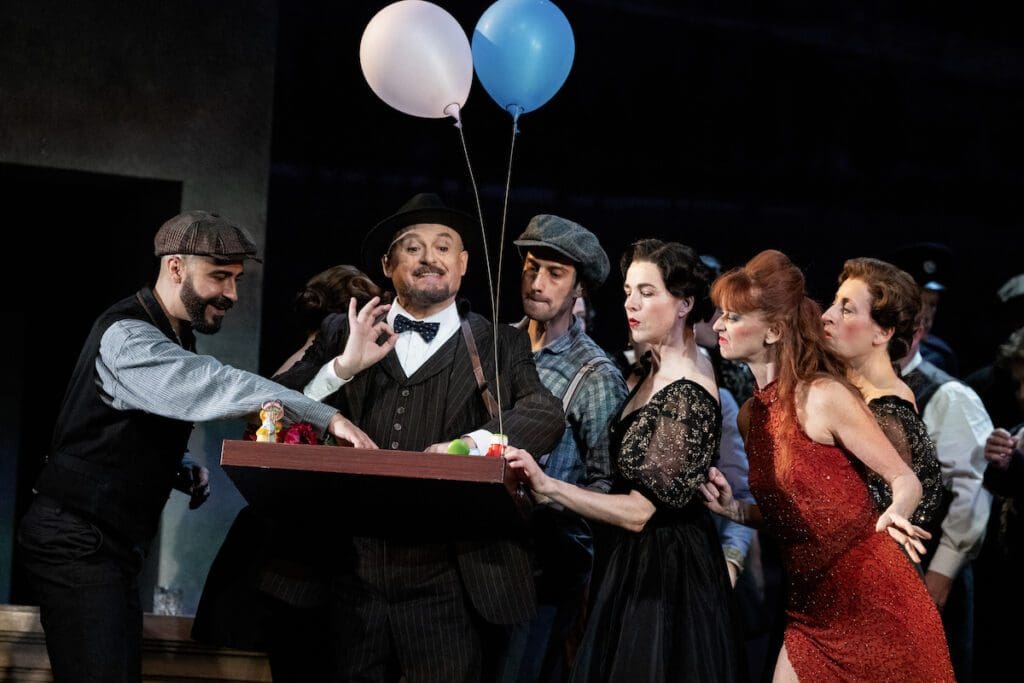
Russian baritone Rodion Pogossov brings a sonorous sense of jealousy and scorn to the dissatisfied Fra Melitone, who despises the masses, unlike his boss. And Italian tenor Carlo Bosi brings a characterful and vocally distinctive approach to the comprimario (supporting) role of Mastro Trabuco (“A buon mercato”).
It’s rare that a revival lives up to the original production, but with a stellar cast, this Forza has done that. It’s Grand Opera at its finest. With the triumphant Barrie Kosky Rheingold opening last week (see my review) it’s been quite a week at Covent Garden. The moral of the story? Try not to kill your beloved’s dad – even if it is by accident…
19 September–9 October 2023
For more information, and to book, visit the Royal Opera House website
Royal Opera House
Bow Street
Covent Garden
London
WC2E 9DD

Leave a Reply