Last Updated on September 25, 2024
An enthralling tragedy unveiled – no need for surtitles in this exemplary Lucia di Lammermoor
In 1835 Gaetano Donizetti needed a win. His last opera Marino Faliero had been a flop in Paris. His rival Luigi Cherubini wasted no time in penning dismissive articles and poising himself as Rossini’s true successor. Donizetti returned to Naples where the state theatres were on the verge of bankruptcy. In his own words “The operas fail, the public hisses.. the people have indigestion… Vesuvius is smoking and the eruption is near.” Amidst this full-time role as prophet of doom, he managed to find a spare 6 weeks to compose and orchestrate Lucia Di Lammermoor. In just 3 years it had made it to London. Now, 186 years and countless performances after its premiere here, Donizetti’s masterpiece has returned to Covent Garden.
Lucia Di Lammermoor follows its titular character as she is pushed into being little more than a pawn in her brother Enrico’s ambitions. Denied her true desire Edgardo and forced into a loveless marriage, Lucia descends into insanity.
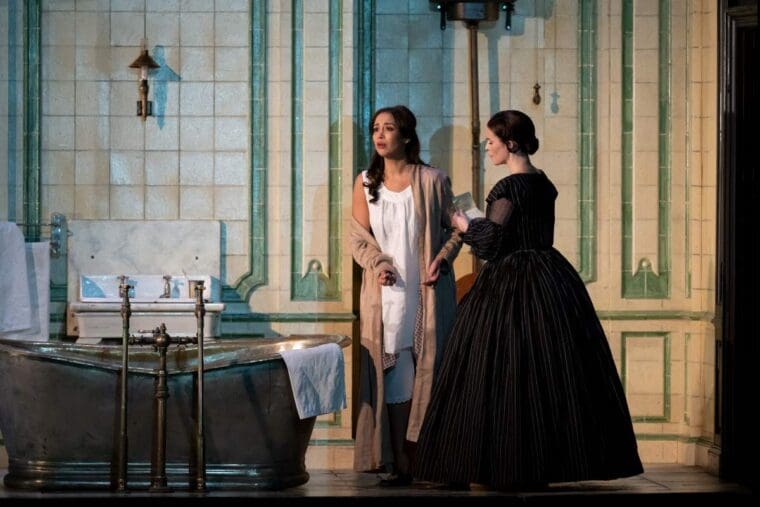
Katie Mitchell and Vicki Mortimer’s production splits the stage into two halves. This has pros and cons. On the one hand, the additional information allows almost a “backstage preview” into Lucia’s life and re-contextualises scenes. Lucia is pregnant in this production and we see her with morning sickness and eventually miscarrying. She marches into madness coated with the blood of her lost child. On the other hand, there’s so much happening in each that one can end up watching an operatic tennis match bouncing back and forth from each edge of the stage. Edgardo’s tender solo moment in the final scene was broken up by Ghosts haunting Enrico on the other half of the divide.
Musically, Lucia Di Lammermoor sounds like an Italian romantic archetype. Starting with a punchy Rossinian pomp, Donizetti comfortably switches gears into a delicate harp solo without a jarring disconnect. The singers are unquestionably the instruments we are meant to listen to though. Everything is built around their sound. This is a numbers opera, the arias are vast and colourful with short bursts of recitative to rapidly run through the plot. Conductor Giacomo Sagripanti opened with such a forceful first scene that I was somewhat worried the singers would be drowned throughout but he soon eased off and resumed a more tit-for-tat balance. Act III contained a marvellous flute duet with Lucia.
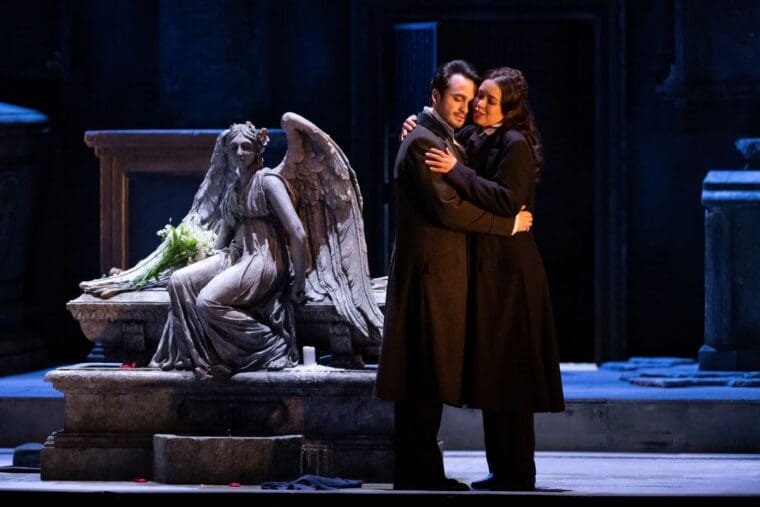
American Soprano Nadine Sierra made Lucia her own. Sierra sang with delicate and sensuous tone, the aural equivalent of a sheet of silk sliding across marble. She sang with suppleness and musicality. The penetrating ring (or “squillo”) of her voice left her soaring above her loud male companions. Moments of coloratura flow as effortless strings of semiquavers even as Sierra vividly acts out trauma. When her Act I aria “Regnava nel silenzio” finished, the utter silence in the audience was replaced with a tidal wave of applause and bravas.
Spanish tenor Xabier Anduaga made his Royal Opera House debut as Edgardo. Anduaga sang marvellously, perfectly capable of lighting up the full main stage even as he slips into delicate full-head voice moments. Anduaga did have an uphill battle with Edgardo since the character is a bastard. He declares his love to Lucia, forces her to swear to him then disappears off to France indefinitely. Returning to find her in a forced marriage, he blames her for it and leaves again. Finally, he only realises his mistake when it’s far too late. Impossible to empathise with.
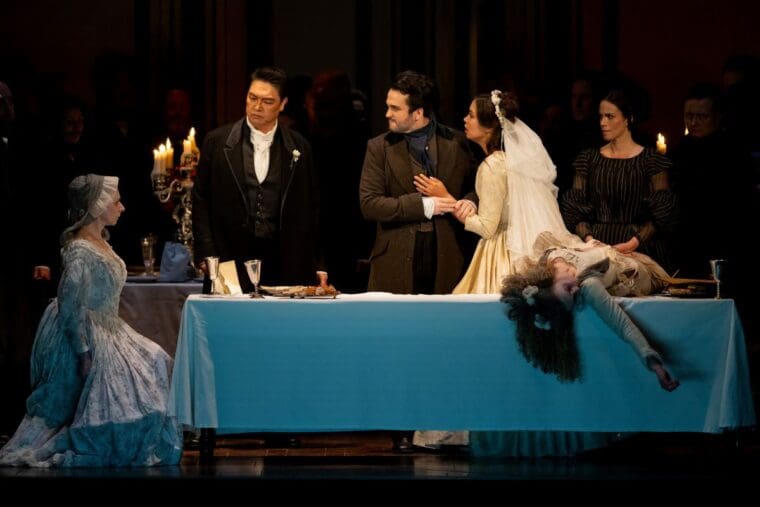
Artur Ruciński was full-voiced and richly textured as Enrico Ashton. His top notes came through bright and clear as thunderbolts. He was able to stand his own next to Sierra, which was astonishing. As for his acting, ill-intentioned malice was palpable throughout.
Korean bass Insung Sim was poised and authoritative as Raimondo. He delivered non-stop, full chest voice, fully covered low notes with a quality and consistency that would have turned the larynx of lesser singers into a collection of frayed shards.

After a while, I abandoned the majority of the surtitles. Between the music and staging it was clear what was happening. Looking at the surtitles traded focus from the sublime music to the so-so libretto and that trade-off was simply not worth making.
Lucia Di Lammermoor runs until 18th of May 2024
Royal Opera House
Bow Street,
Covent Garden,
London WC2E 9DD

Leave a Reply