Last Updated on May 11, 2024
Daniele Abbado’s incandescent production of Nabucco lights up the Garden
*Stop Press – Remaining performances for 2021 are cancelled*
Nabucco was Verdi’s first great success as an opera composer. First produced at La Scala, Milan in 1842 under the title “Nabucodonosor” (Nebuchadnezzar in the anglicised form) it ended a torrid period in the composer’s life after the failure of his second opera Un Giorno di Regno and the death of his wife and young children.

The story of Nabucco is set in 587 BC as the Babylonians are attacking the Jewish city of Jerusalem. It’s an epic story not only about the political, military and religious ramifications of invasion but is also at its heart a tale driven by pride, jealousy and patriarchal power.

In this revival of Daniele Abbado’s 2013 production, the eponymous Nabucco, King of Babylon, is played by imposing Mongolian baritone Amartuvshin Enkhbat fresh from his success in the role at the Vienna Staatsoper. We follow his journey from all-conquering king whose overweening pride drives him to declare himself a deity, to a weakened and self-doubting shadow of himself, praying for his daughter Fenena to be saved. It is his renunciation of the Assyrian god Baal and that brings about his regal resurrection and the eventual freeing of the Israelites. Enkhbat has developed into a true Verdi baritone with a rich even tone that impresses across the full range. He is able to act too, with a range that can switch from imperious to pleading (Deh, perdona).
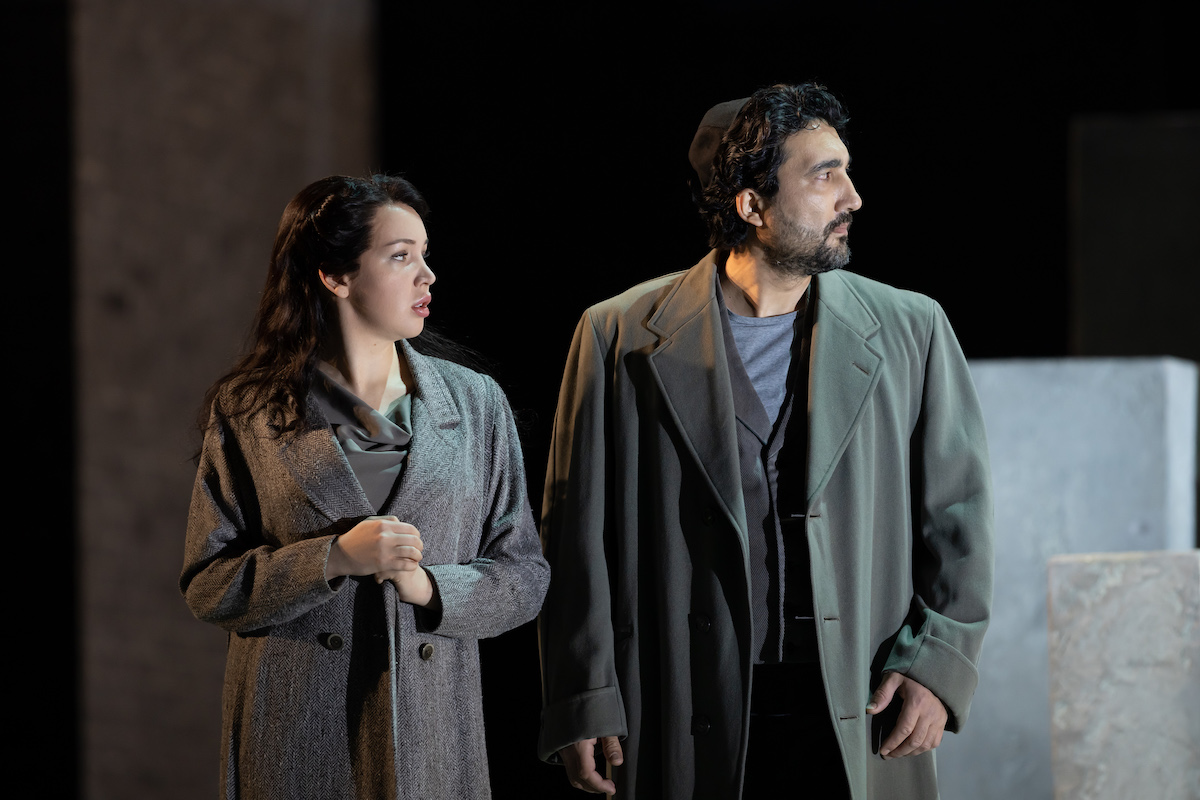
As the opera opens, the Babylonians are in the process of capturing Jerusalem from the Israelites. However, the Israelites have taken Nabucco’s devout daughter Fenena as a hostage. The underwritten role is beautifully sung by Russian mezzo-soprano Vasilisa Berzhanskaya, with the warm, velvety sound and control of her legato phrasing shining in her Act 4 aria Oh, dischiuso è il firmamento! Fenena is in love with the dashing Israelite Ismaele, a passionate performance from Uzbekistani tenor Najmiddin Mavlyanov whose ‘spinto’ tenor voice combines a pleasingly lyric quality with dramatic power.
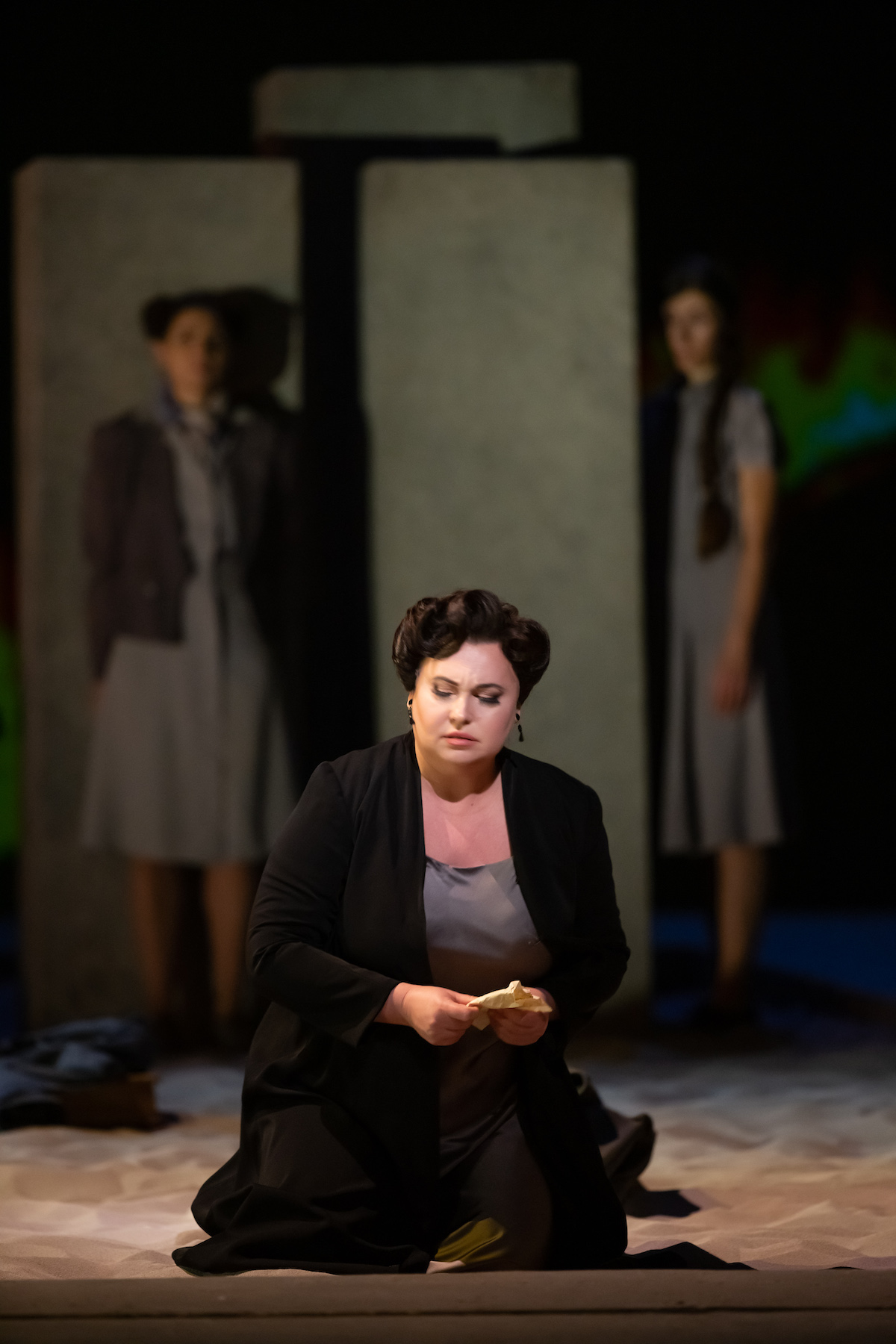
Also in love with Ismaele is Fenena’s half-sister Abigaille. The vindictive soprano role of Abigaille is one of the most vocally challenging in the operatic repertoire and is shared in this run between Russian Anna Netrebko and Liudmyla Monastyrska from Ukraine. Vocally the opera is really Abigaille’s show with Monastyrska taking the part on press night. If her acting is a bit two-dimensional, Monastyrska took no prisoners in the extraordinary punchy coloratura sections (Act 2’s Ben io t’invenni with it’s scalar and octave leaps). She was also effective when showing off the character’s softer toned and more emotional side (Su me…morente…esanime).

Abigaille with some soldiers comes to the temple where Fenena is being held and demands that Ismaele gives her up. Nabucco then arrives and threatens to destroy the temple but is thwarted when high priest Zaccaria, Russian bass Alexander Vinogradov, threatens to kill Fenena. Vinogradov brings humanity to the portentous role of Zaccaria with a wonderful resonant clarity to his voice that invokes the spirit of Hebrew cantors long gone.
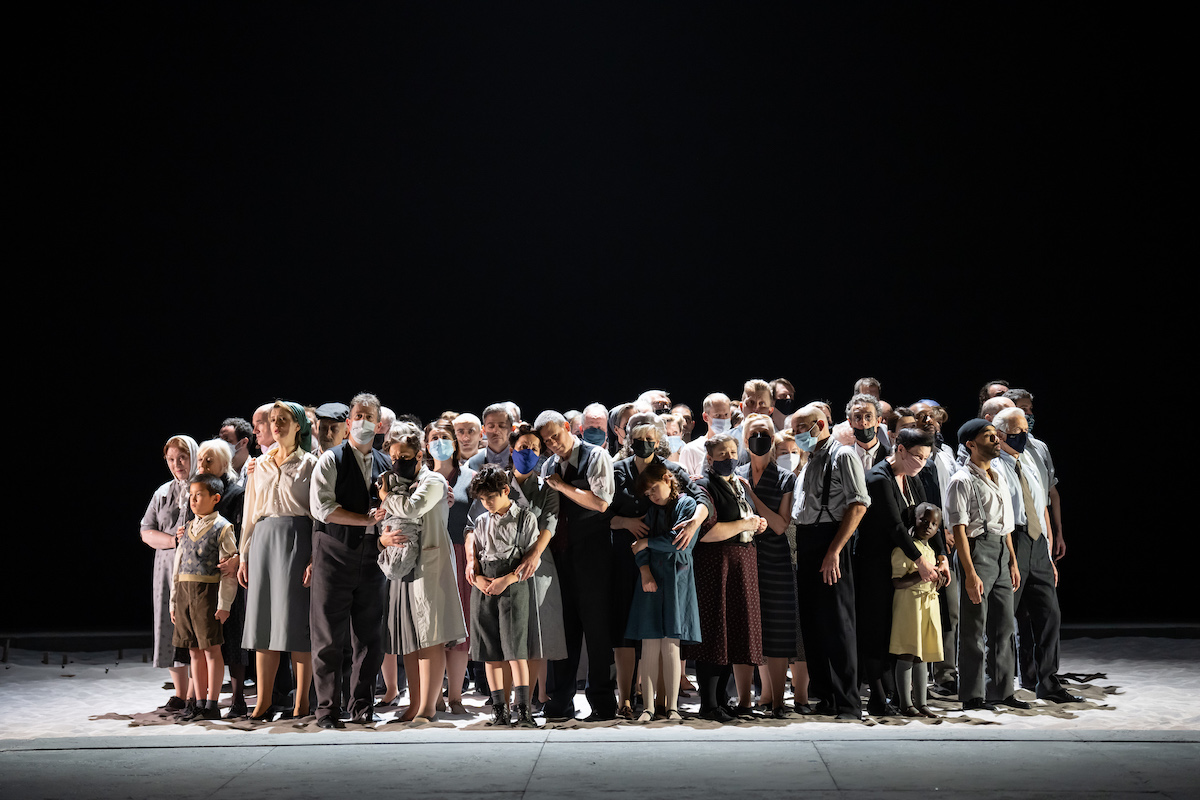
Nabucco is an opera in which the chorus takes a major role and the well-known Chorus of the Hebrew Slaves (‘Va, pensiero’), an elegiac anthem that bemoans the loss of the Jewish homeland has become symbolic of the Risorgimento, the political movement that led to the reunification of Italy with which Verdi has been associated. With the level of Covid-related closures in the West End, it was something of a miracle that the production was able to take place at all with the cast as announced but to mitigate the risk of infection the large chorus wore black masks. It did take the edge off the intensity and brilliance of the ensemble’s sonority but in this chorus, the sonic filtering of the mask created an otherworldly ambience especially on the extended sotto voce ending, with the orchestra fading out, that held the audience spellbound.
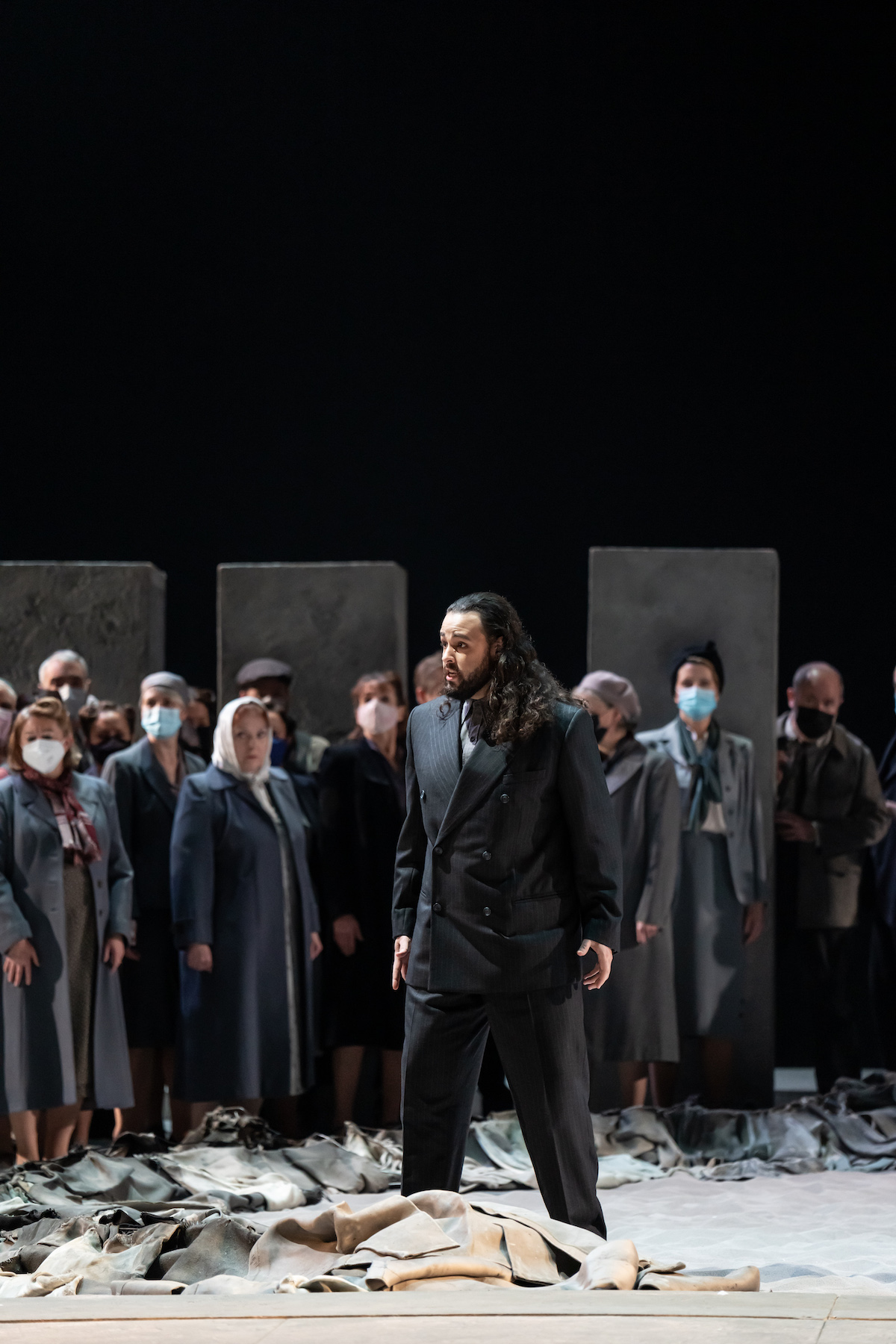
Nabucco is a difficult opera to stage and make relevant and Daniele Abbado’s 2013 production attracted some criticism for its drabness and the difficulty in distinguishing between the rival Babylonian (Assyrian) and Israelite factions both of whom look as if they have walked out of East European Jewish ghettoes of the 1930s. Of course, both groupings are Semitic peoples much like the present-day Israelis and Palestinians and maybe that’s the point.
The set is built around a series of grey oblong stones that clearly reference Eisenman’s Holocaust Memorial in Berlin. The stage is framed by grey brick walls and the sense of confinement is amplified by black and white projections with echoes of early German Expressionist film on the back wall. I found it dramatically coherent with the greys, blacks, shadows and light casting an otherwordly monochrome spell over the proceedings.
 Daniel Oren worked hard in the pit to drive the orchestra to the requisite level of ensemble intensity with the woodwinds particularly impressing, but it was really a night for the singers in a production that allows Grand Opera to have contemporary relevance and impact.
20 December 2021–23 January 2022
The performance lasts about 2 hours 50 minutes, including one interval.
The Royal Opera House,
Bow St,
Covent Garden,
London WC2E 9DD
https://www.roh.org.uk/tickets-and-events/nabucco-by-daniele-abbado-details
Nabucco is available to watch on ROH Stream for £16 from 7.30 pm GMT on Thursday 20 January 2022 until 11.59 pm GMT on Saturday 19 February 2022
Also showing at the Royal Opera House is their classic Christmas staging of The Nutcracker. And, this year, a new opera for children – Wolf Witch Giant Fairy. Do check out our reviews.

Brilliant review. When will the designers of the ROH realise that operas such as Nabucco are about spectacle. Not only are the whole set the costumes grey, drab and miserable, who knew that the King of Babylon lived in a brutalist palace. I agree with the reviewer that putting everyone into post-war grey outfits made it 100% impossible to distinguish the Children of Israel from the Babylonians, and the plebs from the royal characters.
It is odd to think that Ms Chitty’s designs must have been discussed, amended, approved, critiqued etc. and that no one at the ROH thought one whit about the audience’s impression. Shall we have an Aida where the audience can see no difference between the Abyssians and the Egyptians and just leave it to the poor audience (who do buy massively expensive tickets) to try and work out who is who.
All in all Ms Chitty’s designs, and the costume designs, the chicken-wire idol, the utterly miserable costumes, were an offence to the paying audience and the production was only saved by the glorious voices of Enkhbat and Vinograd – as well as the ROH orchestra.
A very perceptive, nuanced review; thank you. A suggestion, if I may – “‘squinto’ tenor” is likely an unkind typo.
Thank you for your comments and subbing. It was late…! Were you there?
Glad I could help 🙂 I was at the dress rehearsal.. Blown away by the voices of Alexander Vinogradov and Amartuvshin Enkhbat, and by the mastery of Daniel Oren. Liudmyla Monastyrska is a force of nature, albeit a bit uneven sometimes, Both Najmiddin Mavlyanov and Vasilisa Berzhanskaya were very good. The production is underwhelming, it is drab (totally agree with you there), and the projections are distracting – but at least it doesn’t get in the way of the music and the singers. Overall – great experience, I’d say 8.5 on the Richter scale.