Last Updated on November 23, 2025
A Classic that Never Fails to Thrill
Romeo and Juliet - Royal Ballet - Review

Romeo and Juliet is a ballet that never fails to deliver, and with a fabulous and compelling classic storyline, it would be a perfect first experience.
Event Type: Event
Event Attendance Mode: OfflineEventAttendanceMode
Event Status: EventScheduled
Performer: Organization
Performer Name: Royal Ballet
Start Date: 2025-03-04 19:30
End Date: 2025-05-26 22:30
Availability: InStock
Availability Starts: 2025-03-04T19:30:00
5
Kenneth MacMillan’s Romeo and Juliet, set to the evocative score by Sergey Prokofiev, is one of the Royal Ballet’s best-loved works. Premiered in 1965, last night was the 537th performance, though there was no sign of the production tiring. With Yasmine Naghdi and Matthew Ball in the lead roles for the opening night yesterday, the audience was mesmerised by this classic, emotional ballet with intricate choreography punctuated by grand ensemble scenes.
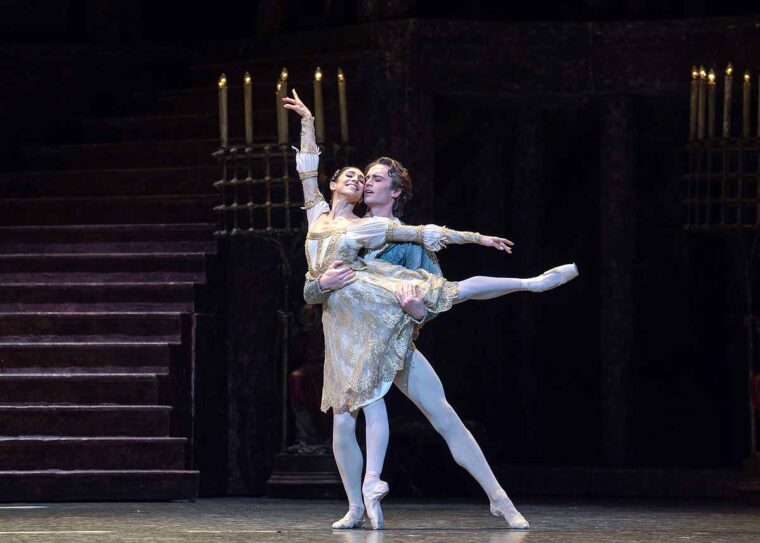
The genesis of Romeo and Juliet lay in a 1964 Canadian TV special for which Kenneth MacMillan had choreographed the famous balcony scene for dancers Lynn Seymour and Christopher Gable. MacMillan was then commissioned by the Royal ballet to complete the full ballet and given only five months to complete it for an upcoming American tour. Although the ballet was written for Seymour and Gable, the opening night was danced by Margot Fonteyn and Rudolph Nureyev, a controversial decision made for commercial reasons.
Part of the joy of this ballet for me is the stunning set design by Nicholas Georgiadis, which transports the audience to a sumptuous Renaissance Verona with towering stone walls, archways, and balconies that create a sense of both intimacy and scale. Costumes are intricate and detailed, inspired by Renaissance fashion and featuring velvets and brocades. Colour is used to distinguish between the Montagues and Capulets – deep reds and blacks for the Capulets and lighter, earth-toned hues for the Montagues. And, as Juliet emerges, her costumes transition from naive young girl at the ball to lighter, flowing robes for the love scenes and then to stark simplicity for the final tomb scene.
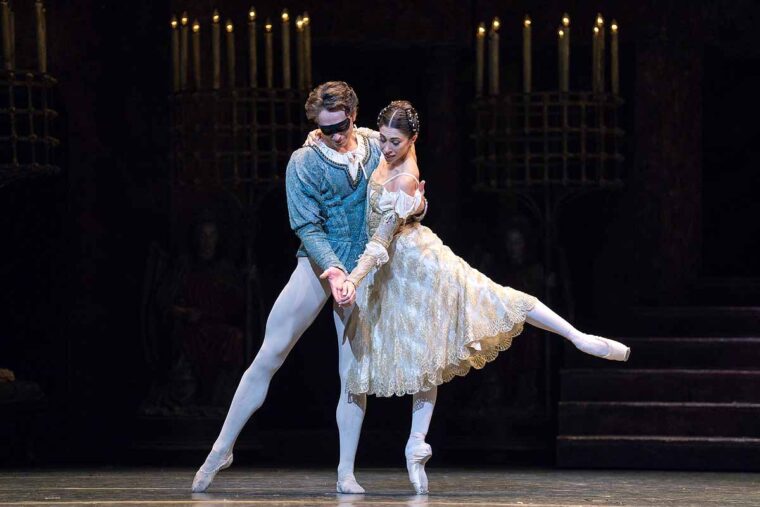
Matthew Ball’s Romeo is a young man boyishly in love with the idea of love. Set against the backdrop of Verona, we are brought into the rust and deep reds of a bustling Tuscan market, a kinetic tableau vivant replete with punk-haired harlots, traders and aristocrats all rubbing along together. Romeo is trying to woo Rosaline (Christine Arestis), but regional rivalries break open, and the bucolic scene all too quickly bursts into sword fighting, leading to tragedy for the warring Montagues and the Capulets. Matthew Ball is an excellent Romeo with fine, expressive dancing and immaculate characterisation, a tender, romantic dreamer in a trio of three young men.
Of Romeo’s two compadres, Joseph Sisson’s Mercutio is edgy and aggressive, whilst Benvolio, played by Leo Dixon, is more a peacekeeper than a fighter. But the real hard man is Ryoichi Hirano’s Tybalt. He is the Capulet’s prime enforcer, and Hirano brings a wonderfully brutish, bullying sense of aggression to the part.
We first encounter Yasmine Naghdi as Juliet when she is being introduced to her suitor, Paris, by her parents. Nicol Edmon as Paris seemed austere and proper, whereas Naghdi is skittishness and playful, seemingly suspended in the air in her coupé jeté. Her pointe technique was exquisite and coquettish, and there was a delightful comic moment as she acknowledged the growth of her newly forming breasts to her diligent nurse.
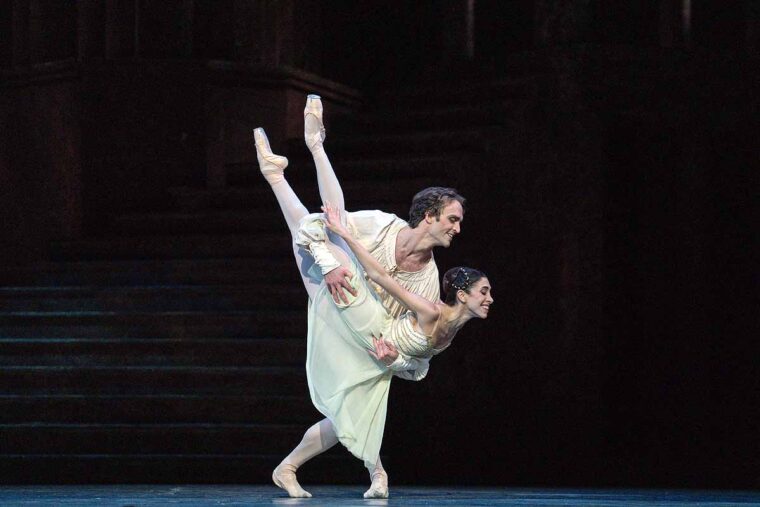
The masked ball is the pivotal scene in the first act as the young lovers set eyes on each other for the first time with an immediate and powerful sense of connection between the two protagonists. This carried over into the balcony scene as Naghdi pirouetted into her lover’s arms while he gradually lifted her higher and higher, with the strings of the orchestra driving the ecstasy of the romance. Grounded during the ball, Naghdi seemed as light as a feather in Matthew Ball’s arms later. Both dancers own their roles, with Ball sweeping his cloak around his love tenderly, gazing into her eyes. There’s a fabulous moment in the Pas de Deux when Juliet, held aloft, arches her back with a breathtaking vulnerability and elegance as she melds into her lover’s torso.

This production of Romeo and Juliet was a cornucopia of choreographic and dramatic delights with plenty of highlights. The large company is used to full effect in the ball and market scenes and special mention should be made of the harlots (Claire Calvert, Annette Buvoli and Isabella Gasparini) with their licentious swagger and the commedia dell’arte inspired mandolin dancers (Joonhyuk Jun, Harry Churches, Teo Dubreuil, Taisuke Nakao, Giacomo Rovero and Francisco Serrano) who leapt and capered with athletic grace.
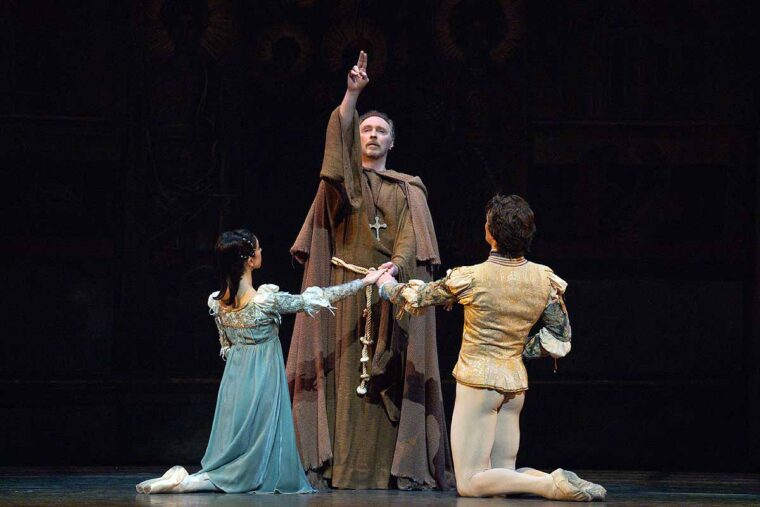
In the dramatic roles for this production of Romeo and Juliet, Christopher Saunders as Lord Capulet was in turns noble and restrained but then bullying towards Juliet, with Kristen McNally as the Nurse being protective and loving. We all know the story of Romeo and Juliet, Shakespeare’s ‘star-crossed’ lovers caught up in a deadly family feud. They arrange to marry in secret, but the tragedy plays out, resulting in Romeo killing Juliet’s cousin Tybalt as well as Paris. Juliet tries to feign death by drinking a potion, with the intention of being able to escape the city and find her lover. But her plan misfires.
When Romeo hears of her apparent death, he visits her tomb and, finding her lifeless, attempts a final poignant duet with her corpse, shadowing some of the moves from the previous pas de deux as he drags her body around the stage. Convinced she’s dead, he drinks a phial of poison. Juliet awakes to find her lover dead, and, devastated, she stabs herself.

The orchestra under the baton of Koen Kessels was, for the most part, on fine form, although there were a few brass section wobbles tackling Prokofiev’s fiendishly tricky score for Romeo and Juliet. A particular mention to the mandolin players working from a side box, who offered some convincing moments.
Inspired by Italian Quattrocento paintings and architecture as well as Zeffirelli’s 1960 production of the play at the Old Vic, the monumental sets for Romeo and Juliet emphasise the vulnerability of Juliet and the helplessness of the couple against the society they lived in. The costumes and chiaroscuro lighting effects frame the narrative particularly effectively, and Prokofiev’s rich and stirring score is one of ballet’s greats, the choreography in conversation with its intricate rhythms as well as sweeping drama. It’s remarkable to watch, with a series of fast set changes creating an almost cinematic effect.
Romeo and Juliet is a ballet that never fails to deliver, and with a fabulous and compelling classic storyline, it would be perfect if you’ve never seen a live ballet before. There’s a stellar range of principals through the rest of this run – from Marianela Nuñez dancing with William Bracewell to Francesca Hayward with Cesar Corrales and a live cinema relay on Thursday, 20th March, with Fumi Kaneko and Vadim Muntagirov in the lead roles.
The performance lasts approximately three hours, with two intervals.
4 March to 26th May 2025
Romeo and Juliet
Royal Ballet and Opera
Royal Opera House,
Bow Street,
Covent Garden,
London, WC2E 9DD
Looking for something different? Check our Dance Previews for 2025

Leave a Reply