Last Updated on January 19, 2026
Into Woolf’s inner world – Wayne McGregor’s dance response to the life and writing of Virginia Woolf.
4.6 out of 5.0 starsWayne McGregor’s first full-length work for the Royal Ballet, created in 2015, has returned to the Royal Opera House. His Olivier Award–winning triptych, Woolf Works, remains an ambitious and distinctive response to Virginia Woolf, translating her restless, questioning intelligence into movement that fractures, flows, and repeats, set to Max Richter’s hypnotic score. Drawing on Mrs Dalloway, Orlando and The Waves, Woolf Works avoids conventional narrative, unfolding instead as a sequence of sensations. Each section occupies its own carefully shaped world, with different visual designs and choreographic textures, yet all inspired by Woolf herself, her writing, her interior life, her elusiveness. More than a decade after its premiere, Woolf Works still feels strikingly contemporary. Absorbing and emotionally charged, it makes for a compelling evening.
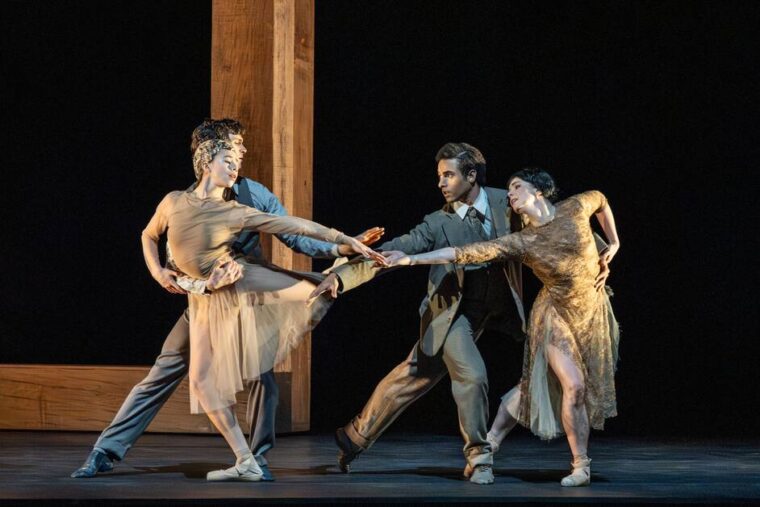
Translating three of Woolf’s novels into dance is no small undertaking. Woolf was intensely sensitive to the rhythm and music of language, and her writing privileges emotion, memory, and consciousness over plot. Stories nonetheless emerge through its poetic force. Dance works in much the same way, meaning carried through gesture and rhythm rather than words, through what is felt rather than stated. In Woolf Works, McGregor draws on this shared terrain, using movement to evoke something essential of Woolf’s imaginative world.
The ballet largely sidesteps literal storytelling. McGregor’s choreography creates atmosphere and depth through its distinctive physicality. Dancers move through extreme angles, with off-balance, out-of-sync moments, before movements sharpen into sudden clarity. Classical lines are unsettled, and the dance is driven by an inner urgency. Each section has its own distinctive feel, but Woolf’s self-reflection and her fluid, unstable sense of time run through them all. Richter’s score, combining live orchestral music with electronic and recorded sound, surrounds the stage in a shifting landscape that feels at times cinematic, at times strangely otherworldly.
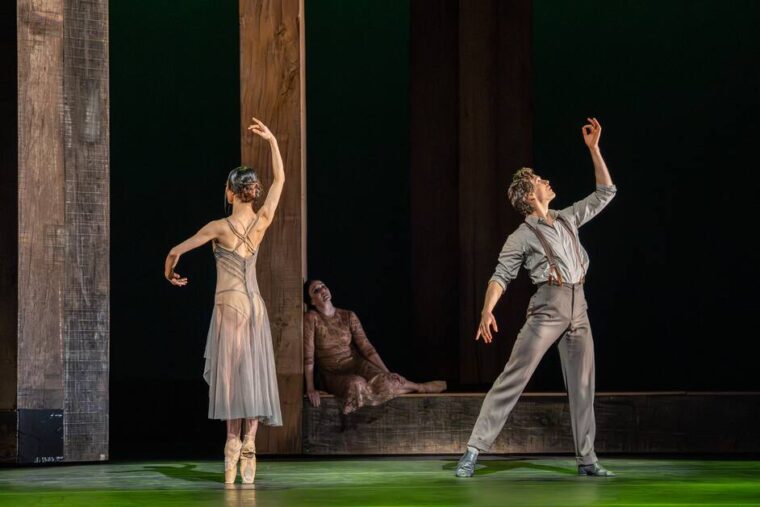
The work begins with I Now, I Then, based on Virginia Woolf’s Mrs Dalloway. The original novel takes place over the course of a day, focusing on middle-class housewife Clarissa Dalloway, who is preparing for a party, and Septimus, a shell-shocked war veteran. The score begins with a recording of Woolf herself from the BBC archive. Whilst she speaks, a projection of words shifts in and out of focus on a translucent backdrop, creating a portrait of Woolf.
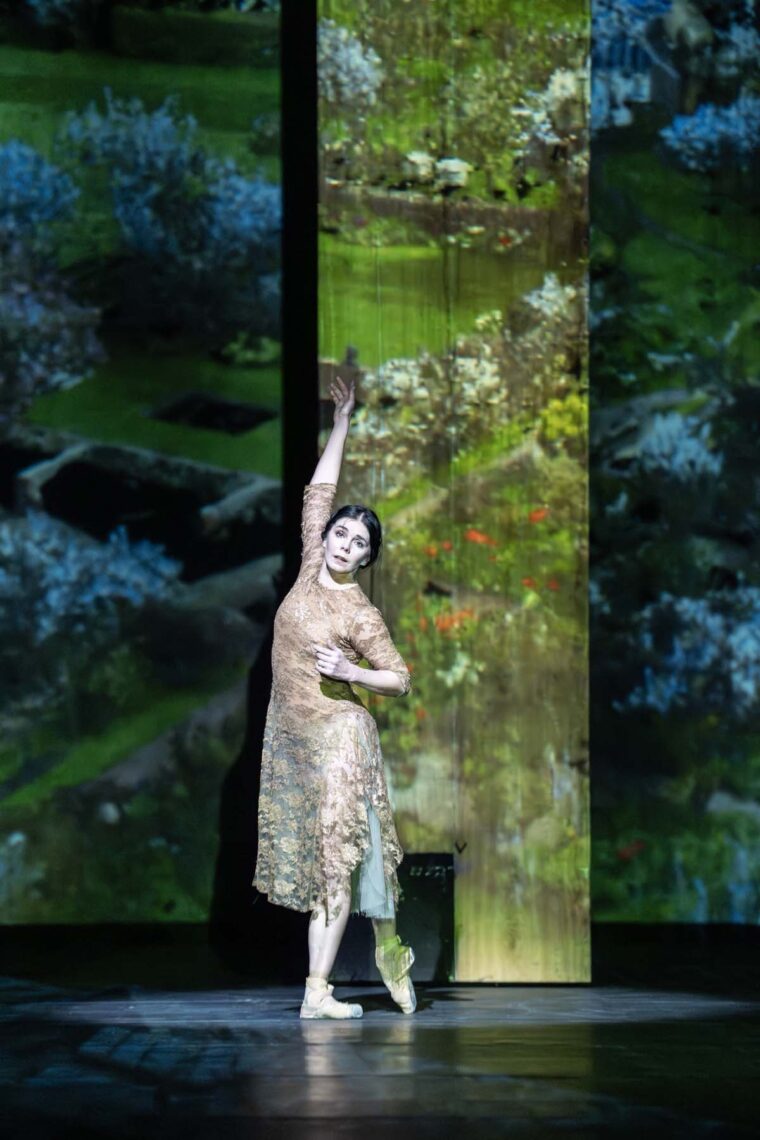
Beautifully danced last night, Natalia Osipova played Woolf and Older Clarissa in a tender and lyrical performance. She and her younger self, an energetic, joyful and flirtatious Sae Maeda, return to past loves – Peter, reprised by William Bracewell and Sally (Leticia Diaz), while Patricio Revé played her husband, the stable, thoughtful Richard.
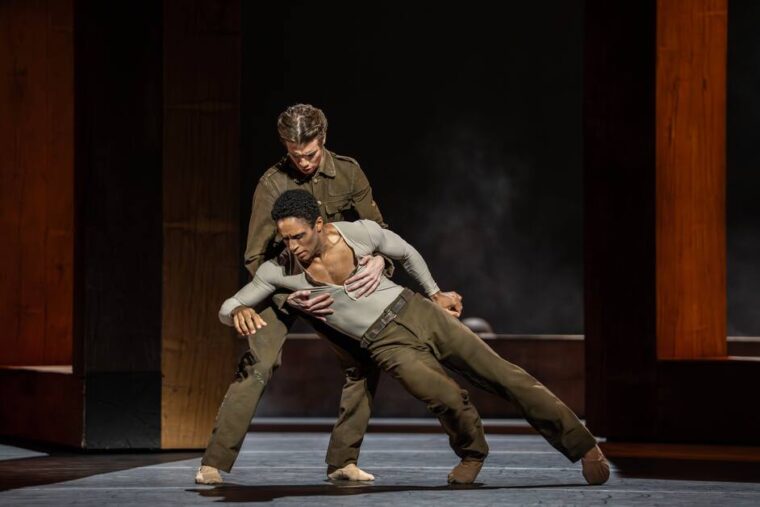
Contrasting with the joyful freedom of youth is the troubled war veteran Septimus, brilliantly danced last night by Marcelino Sambé with Evans (Marco Masciari). An evocative and moving moment in dance that will haunt me.
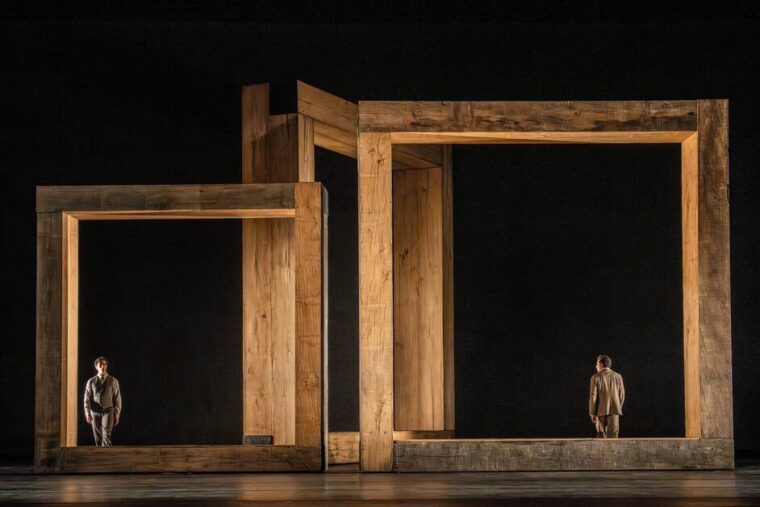
The staging is spare but effective. Three large wooden frames rotate slowly, like windows opening onto a shifting world, while cinematic projections of London and the English countryside unfold behind them. These images are set against striking Rothko-like red backlighting, creating an emotive atmosphere, with the chimes of Big Ben and the steady tick of clocks marking the passage of time
Becoming, the second ballet of Woolf Works, is an astonishing, vibrant work based on Orlando. Intensely theatrical, the dance itself seems unsettling at times. As the work begins, a spotlight illuminates gender-ambiguous bodies, clothed in gold corsets, breeches, and ruffles (designed by We Not I), from above.

The choreography is highly physical. Jerky and at times awkward movements give the feeling of a man waking up one morning to find himself a woman. There is no single Orlando character; instead, there are many overlapping pas de deux phrases.

Richter creates a variation for the modern day using the familiar La Folia fragment. It contains variations for the orchestra, solo, and chamber, as well as electronic variations. The sound design from Chris Ekers really pulls the music together.

Throughout the work, Lucy Carter’s creative and challenging lighting fills the otherwise empty stage, spilling out into the auditorium. There are moments when bodies come into contact with lasers, casting shadows and catching the light in the gilt costumes. The dancers’ eyes gleam – it’s pop-baroque meets Star Trek in an immersive work that wouldn’t feel out of place on Britain’s Got Talent. I wonder which judge would offer the golden ticket.
The final ballet in the triptych is a fitting ending. Based on Woolf’s ‘The Waves’, it begins with Gillian Anderson reading the final suicide letter. An empty stage, the horizon bisected by a slow-moving black and white seascape, the message is clear. We are watching Woolf’s final moments as she dies.

Ospiova returns to the stage, surrounded by dancers creating waves of arms, hands and legs. Having grown up by the sea and spent many an angst-ridden teenage moment watching the water, this was, for me, a mesmerising and highly emotive ballet. There are beach moments, with some of the brilliant students from the Royal Ballet playing in the sand and sea. It’s a reflective landscape that resonates with the relentless movement of the sea, part danced, part projected film, punctuated by a haunting soprano voice (Marianna Hovanisyan).
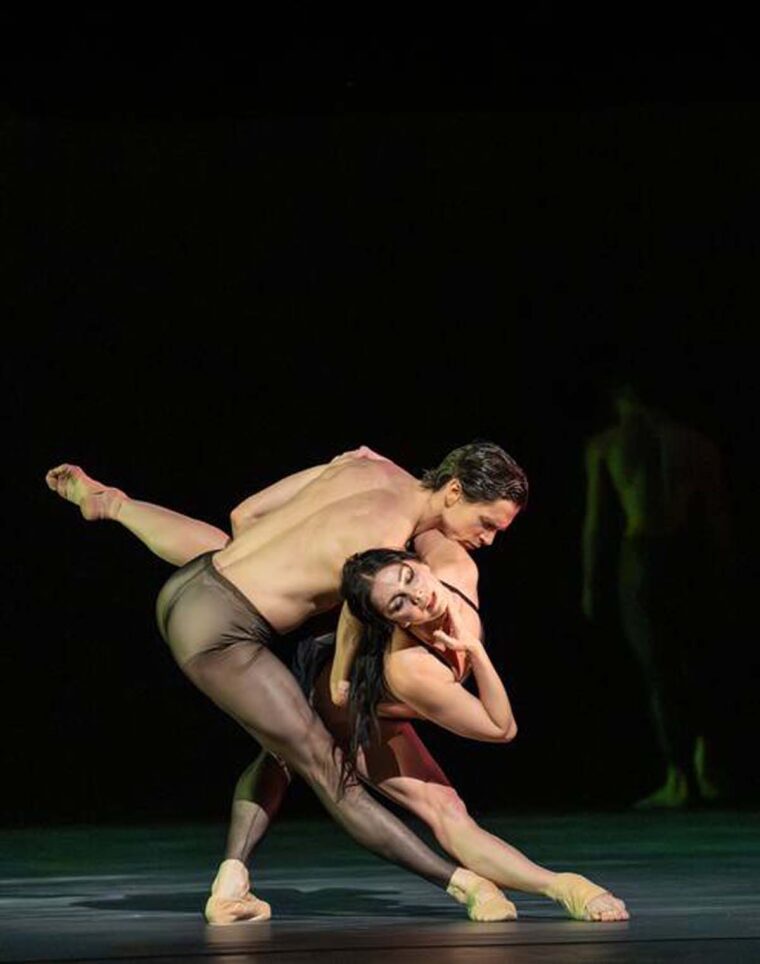
The final pas de deux, with William Bracewell as Peter and Osipova as Woolf, is tender, warm, and somehow comforting. It’s a gentle and poignant death
Woolf Works makes for a memorable evening of ballet. Both insightful and assured, it offers a thoughtful tribute to the life and writing of Virginia Woolf, capturing something of her distinctive literary voice while reaching beyond it. Woolf Works also opens a window onto the mind of a deeply troubled individual, diagnosed in her lifetime with what was termed an “erratic personality disorder”, now more commonly understood as bipolar disorder. Working on several levels at once, the triptych functions as a showcase for contemporary ballet, giving the Royal Ballet’s dancers space to shine, while also offering a nuanced and sensitive portrait of mental illness. As a tribute to a writer who continually pushed artistic boundaries, it feels both fitting and finely judged.
Royal Ballet
Royal Opera House (Main Stage)
Bow Street,
Covent Garden,
London WC2E 9DD
Woolf Works runs from 17 January to 13 February 2026
Looking for something different? Check our preview of the London dance scene for the first half of 2026

Leave a Reply