Last Updated on July 2, 2026
Magic and Mystery at Garsington
There is something otherworldly about going to see opera at Garsington. As you drive into the Getty family’s Wormsley Estate you are encased in a huge valley set in the chalk downlands of the Chiltern Hills, entering an exclusive, magical world that houses not only the Opera Pavilion and its new rehearsal space, but also a cricket pitch and a library housing the most extraordinary collection of books. It’s a fitting setting for director and designer Netia Jones’ production of Benjamin Britten’s A Midsummer Night’s Dream, originally seen in 2021 at the Santa Fe Opera, co-producers with Garsington.

The opera’s libretto is built on Britten and Peter Pears’ edits of Shakespeare’s text, cutting and reshaping it for the operatic stage. The narrative which is set in the Athens area is centred around four couples. Hermia has been ordered by her father to marry Demetrius, however, she loves Lysander and elopes with him. Hermia has confided her plans to her friend Helena who loves Demetrius. Helena tells Demetrius, and all four young lovers end up in the nearby forest.

In the fairy realm of the forest, King Oberon and Queen Tytania are quarrelling over the ’ownership’ of the queen’s young page. Oberon instructs his mischievous servant Puck to use a magic flower to make Tytania fall in love with the first creature she sees upon waking. Oberon also orders Puck to use the flower on Demetrius to make him love Helena. However, Puck mistakenly enchants Lysander instead. Chaos ensues as both Lysander and Demetrius pursue Helena, while Hermia is left confused and heartbroken.

Meanwhile, a group of amateur actors rehearses a play in the same forest for the upcoming wedding of Duke Theseus and Hippolyta. Puck also transforms Bottom, one of the actors, by giving him a donkey’s head. Tytania awakens and falls in love with the transformed Bottom. After a series of comedic mishaps and misunderstandings, Oberon sets things right. The spells are lifted, and the correct couples are paired: Lysander with Hermia, and Demetrius with Helena. Tytania reconciles with Oberon, and Bottom is returned to normal. The opera concludes with the lovers returning to Athens, where they marry alongside Theseus and Hippolyta. The amateur actors perform their humorously bad play at the wedding feast, bringing the magical and mortal worlds together in a joyous celebration.
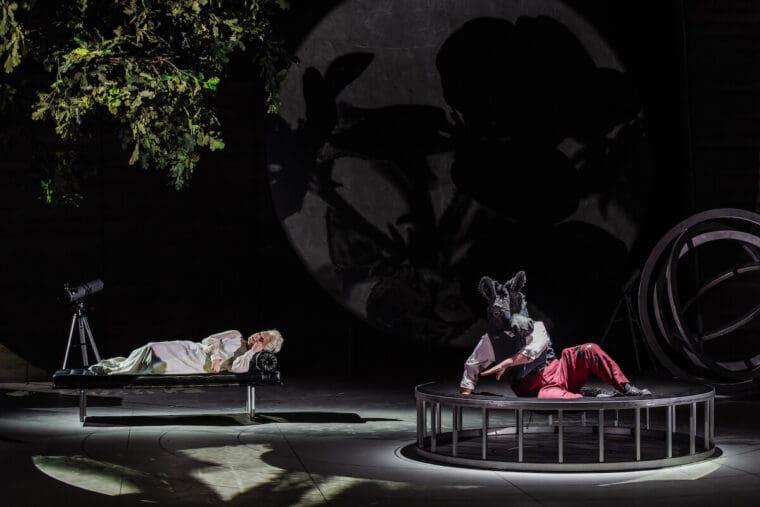
Director Netia Jones has placed the action on a steeply-raked platform. There’s a tree bursting through it, a grand piano suspended above at a rakish angle, a silver Armillary sphere, a hanging pair of scissors, a psychiatrist’s couch, and an array of telescopes. Jones also uses her trademark projections in black and white, shifting to colour as the production proceeds, and she uses the long Garsington curtains to shut off the exterior light cocooning us into nighttime. It’s an effective surreal dreamscape that brings together the arts, science and nature.

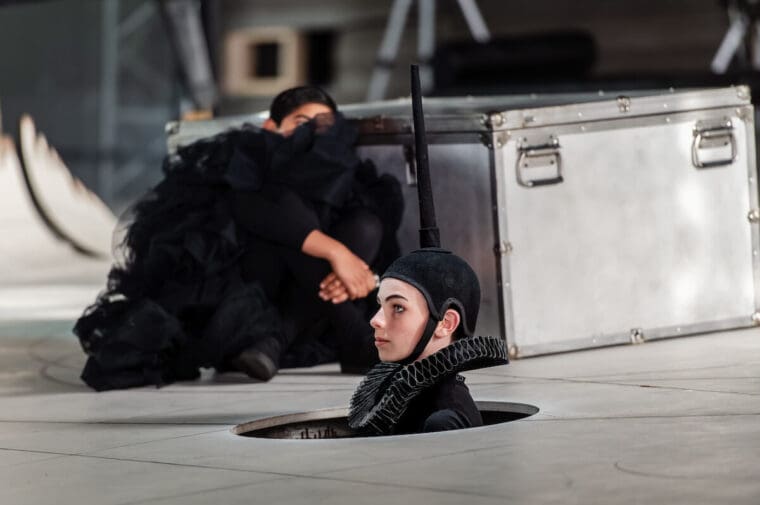
24 children from the Garsington Youth Company play Tytania’s Fairies, popping their heads through the stage like a team of gothic meerkats, bringing a spooky charm to the stage. Britten is a peerless composer for children’s choir who manage his eerie melodic shapes with aplomb.
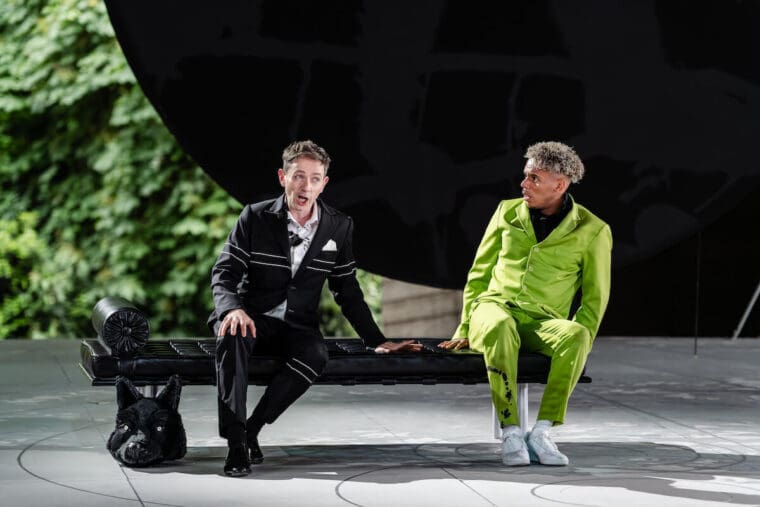
Black-suited star counter-tenor Iestyn Davies brings out the abusive dark side of Oberon. Looking like a malign version of chef Gary Rhodes, his voice is chilling, laser-focused and perfect for this cold, scheming character. Jones hints at an abusive relationship between Oberon and his servant, the sprite Puck, a green-suited Jerone Marsh-Reid who in this spoken role tumbles, jumps out of trees and cuts some shapes as he does his master’s bidding.
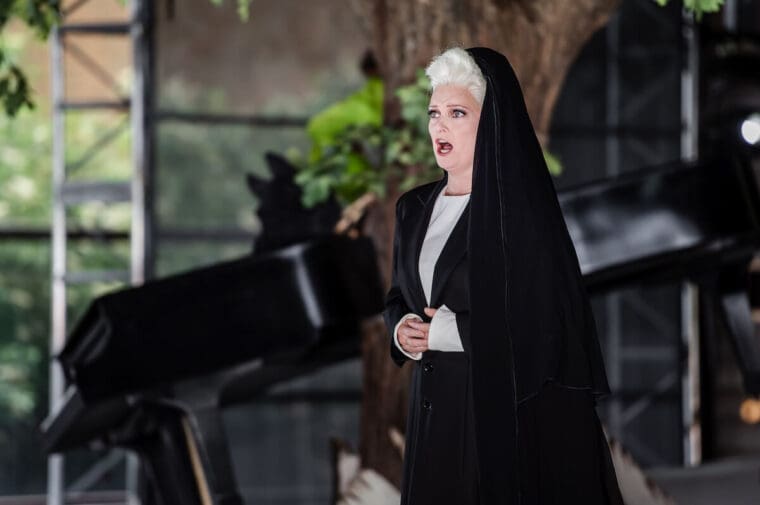
Soprano Lucy Crowe as Oberon’s Queen Tytania emerges with a long black train, otherworldly with a platinum blonde shock of hair matching her sparkling, expansive soprano Despite their reconciliation we see the ongoing tension in the power dynamics between Oberon and Tytania as he manhandles her and she then pushes him away.

The four young lovers are dressed in preppy Ivy League garb, light blues with white accents. Playing Lysander, tenor Caspar Singh’s voice with its heroic ring also manages the more passionate moments with style. As Demetrius, James Newby baritone has a wonderful resonance whilst mezzo-soprano Stephanie Wake-Edwards’ Hermia is warm-toned and rich. Camilla Harris’ powerful soprano in the role of the lovestruck Helena (“I am your spaniel, the more you beat me, the more I will follow you”) comes into play as the character starts to assert herself. There is a fabulous fight scene managed by fight director Christian Sordelet between the four lovers leading to a debagging and a slick skirt removal worthy of Buck’s Fizz. When the quartet sing together they make a mighty sound.
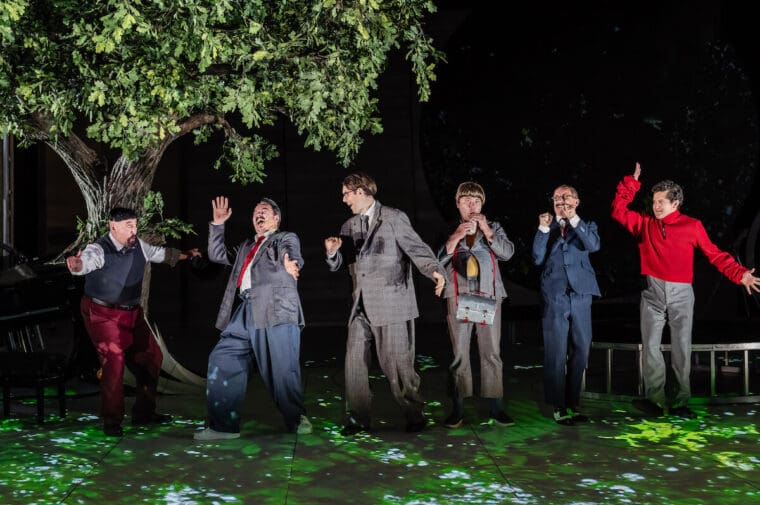
The 6 comic actors are dressed in 1920s style. I’m a huge fan of bass-baritone John Savournin who is a star of the ENO’s recent Gilbert and Sullivan productions. He plays writer-director Quince, his lanky frame engulfed in a boater and baggy suit as he soft-shoe-shuffles through his typically quirky role.
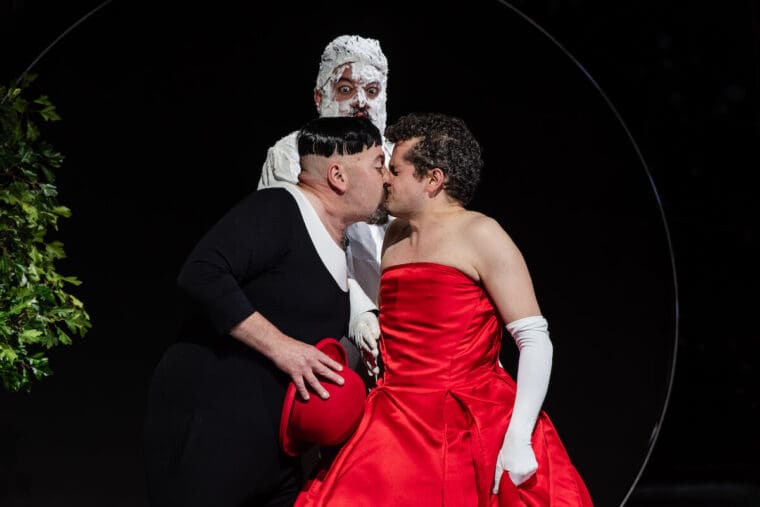
Baritone Richard Burkhard in a black skull cap is splendid as a full-voiced Bottom, both Tytania’s love interest and Pyramus, the lead male role in the play within a play. Former Britten-Pears Young Artist James Way plays Flute. He has a glowing, expressive tenor voice even when as Pyramus’ lover Thisbe he is bouncing on a trampoline. Bass-baritone Frazer Scott, as the joiner Snug, plays the lion (“I am slow of study”) and impresses with his Austin Powers haircut, whilst Geoffrey Dolton as the tailor Starveling gives a good take on Groucho Marx. Tenor Adam Sullivan as Snout has the unenviable role in the play of playing a wall and has a fine comic touch.

Baritone Nicholas Crawley plays Theseus as a drunk playboy with his bride Hippolyta, Christine Rice, as a regal mezzo-soprano.

Britten’s score operates in 3 zones – the magical, the comic and the romantic with a transparent orchestration that brings out some impeccable playing from the Philharmonia Orchestra under the precise baton of conductor Douglas Boyd that brings out the dark emotional subtexts of Britten’s score whilst marking the more comedic narrative elements. His vocal lines lack of melisma creates a theatrical sense of immediacy with some gorgeous quasi-fugal ensemble writing.
This production is impeccably cast, brilliantly sung and performed with an intriguing production that brings out the darker tones of the piece. If you can get a ticket, go!
Garsington’s A Midsummer Night’s Dream at the Proms – Tuesday 10 September
A Midsummer Night’s Dream runs until 19 July 2024
Garsington Opera
Wormsley Estate,
Stokenchurch,
Buckinghamshire,
HP14 3YG

Leave a Reply