Last Updated on April 15, 2026
What to see and where to go
Copenhagen boasts a multitude of museums and galleries that will thrill art lovers visiting the city. From large state museums to smaller private collections, bijoux contemporary exhibitions to a knockout subterranean gallery, the city is packed with exciting art. Make time too for a day trip to one of the out-of-town, must-visit art museums accessible by train. Is Copenhagen for art lovers? It certainly is.

Copenhagen is a very walkable city, which means that a museum in the morning can be followed by a local lunch before strolling on to the next visual feast. Plan your route with this idea in mind for the perfect day out. Note that most museums in the city are closed on Mondays. Having spent three days over a long weekend bingeing on art, I found that being in Copenhagen on a Monday provided an opportunity to walk the city, admiring the striking contemporary architecture that coexists alongside the 17th- and 18th-century heritage buildings.
Contents
Statens Museum for Kunst (SMK) – National Gallery of Denmark
This vast museum is located on the edge of Østre Sølvgade park near Rosenborg Castle in the neighbourhood of Rosenborg. Housed in an imposing Italian Renaissance Revival-style building, the museum was extended in 1998 with an astonishing glass extension that houses its modern art collection. The SMK boasts the largest art collection in Denmark, with over 200 000 works, originally belonging to the Danish royal family, but with the introduction of democracy in the 1800s, it became state property.

The main entrance is off a piazza where you enter the older building. Here, visitors are treated to an extensive overview of Danish and Nordic art from 1750 to 1900, including the work of Hammershøi, Eckersberg and Krøyer. One of the joys for art lovers when travelling abroad is learning about the art of distinct cultures, and at SMK there is an opportunity to experience the Golden Age of Danish art.
Also on display in this building is a large collection of European art from 1300 -1800, including works by Rembrandt, Rubens and Cranach that previously belonged to the Danish kings. I nearly missed the chance to browse the rooms of French Art 1900 – 1930, thinking I had seen so much of this in France. Don’t make this mistake – I was impressed by the sheer number of Matisse canvases and discovered that SMK holds one of the largest collections of Matisse outside of France.
Over in the extension, I found a stunning space over several floors with huge artworks displayed with room to breathe in large rooms, many overlooking the park through glass walls. Here, the works displayed are Danish and international art post-1900. Highlights included a room devoted to Emil Nolde.
I would advise two separate visits to this fabulous museum, but if your time is limited, then perhaps select areas of interest rather than exhausting yourself trying to see the whole museum. You need at least a full day to do it justice.
Afterwards, have a well-deserved rest and a wonderful smørrebrød at Aamanns, which is only a few minutes’ walk from the museum and renowned for its Danish open sandwiches.
Statens Museum for Kunst (SMK) – Sølvgade 48-50, 1307 Copenhagen. Open Tuesday – Sunday, 10.00 to 18.00 (20.00 on Thursdays).
Hirschsprungske Samling – Hirschsprung Collection
Located across the park from the SMK, this is a private collection that focuses on works from the Danish Golden Age, to the Skagen painters and the Symbolists. Unlike that of its vast neighbour, this is a smaller collection housed in a beautiful, purpose-built neo-classical pavilion, which opened in 1911, when the works were bequeathed by collectors, Heinrich and Pauline Hirschsprung.

If you are short of time, then this is a perfect way to get an introductory overview of the Danish Golden Age, with works distributed across small, interleading rooms decorated with furniture from the family. It has an intimate feel. The works of Anna and Michael Ancher and P.S Kroyer are prominently displayed. I was fortunate to visit during a special exhibition of the work of Hanna Hirsch Pauli, one of the most notable Nordic artists from the turn of the 20th century. Check the website to see what temporary exhibitions may be on while you visit.
Hirschsprungske Samling, Stockholmsgade 20, 2100 Copenhagen. Open Tuesday – Sunday 10.00 to 17.00
Kunsthal Charlottenburg
Located on a canal that forms part of vibrant Nyhavn – a colourful street lined with 17th and 18th century buildings now repurposed as restaurants and bars – Kunsthal Charlottenburg is housed in a slightly ramshackle, graceful building from 1883. It is part of the Royal Danish Academy of Fine Arts’ Schools of Visual Arts. Akin to a cultural centre, this is a fun and relaxed venue where visitors can take in one of the temporary exhibitions – I saw a memorable show of Roma artist, Malgorata Mirgas-Tas – attend a film screening, browse the impressive bookshop or chill out in some lovely seating spaces if you need a break.

The gallery closes at 8 pm on Fridays, which enabled me to visit at the end of a long day of museum visits, and I still had time to explore what was on offer. Recover afterwards with a sunset drink at one of the bars on Nyhavn, which is on the doorstep.
Kunsthal Charlottenburg – 2 Nyhavn, 1051 Copenhagen
Tuesday-Friday 11.00 – 19.00, Saturday-Sunday 11.00 – 17.00
Danish Design Museum
As the name suggests, this museum houses a collection of Danish design from artefacts to furniture. It is a somewhat esoteric place with an old-fashioned feel, and some of the collections are more or less interesting depending on your personal tastes. The museum displays an exquisite and comprehensive collection of tsuba – sword guards from the Samurai period in Japan.
Being curious about all things Japanese, I could have spent hours in this room, but I did not understand at first its link to Denmark. What I learned is that in the early 1900s, Danish artists and designers became fascinated by the Japanese aesthetic (there is a shared love of minimalism and outstanding craftsmanship), which became an important inspiration for the development of Danish modernism. I was fortunate to visit during a temporary exhibition of Hokusai block prints, part of the museum’s collection.

Where Danish design really shone was in the rooms showcasing Danish furniture – an outstanding selection of chairs that were beautifully displayed in a purpose-built room of display cases. The rooms on Pop Art were fun, and you could spend hours examining the Georg Jensen tableware and other beautiful artefacts. Don’t miss the gorgeous gift shop at the end of your visit.
From the museum, it is a 10-minute walk to Restaurant Palӕgade, where I enjoyed a top-notch smørrebrød lunch. In the evenings, the restaurant serves Danish-French cuisine. It is owned by restaurateurs who have a two-Michelin-star restaurant in Copenhagen, hence the lunch was not a casual sandwich, but rather Danish open sandwiches with bells on plus exquisite cakes for dessert. Booking is recommended.

Danish Design Museum – Bredgade 68, 1260 Copenhagen. Open Tuesday – Sunday, 10.00 to 18.00 (20.00 on Thursdays).
Cisternerne
Visiting this subterranean art space is an experience I will remember forever. It is without doubt the most unusual gallery I have ever visited and is located down a steep set of stairs that leads underground in the middle of Søndermarken Park in the leafy suburb of Frederiksberg. Look out for a pair of small glass pyramids where you will find the entrance. Google Maps helps once you enter the park to point you in the right direction.

The gallery is housed in a vast, underground chamber that was once a reservoir where Copenhagen’s water supply was stored. It is still wet underground – my feet were soaked, so be advised to wear waterproof shoes – and water drips from the roof. It is dimly lit and deeply atmospheric. Thick coats are available to keep warm while underground.
The gallery runs a series of temporary exhibitions, which you can find on the website. Each year, an internationally renowned artist or architect is invited to create a site-specific installation. I was thrilled to be visiting during a show by Marina Abramovic. Titled Seven Deaths, it was a series of seven films about death, set to arias and starring Abrmovic and William Dafoe. No matter what is on when you visit, this is a place not to be missed.
As the gallery and park are located in the eastern suburb of Frederiksberg, you can wander around this lovely neighbourhood afterwards and enjoy restaurants from Michelin-starred to small local eateries. My personal recommendation is to take a longer walk – or a cab – to the trendy, former meatpacking area, called Kødbyens. Here you will find the hugely popular Kødbyens Fiskebar, where we ate such good fish that we returned the next day for lunch. Booking recommended.

Cisternerne, Søndermarken opposite Zoo, 2000 Frederiksberg
Open Tuesday 11.00 – 18.00, Wednesday – Thursday 11.00 – 20.00, Friday – Sunday 11.00 – 18.00. Closed on Mondays except during June, July and August.
Louisiana Museum of Modern Art
A visit to Louisiana is another unforgettable experience for those who enjoy modern art. It involves a trip out of Copenhagen, which is very easy to do. I caught a direct train (several every hour) from Copenhagen Central Station to Humlabӕk which is 25 km north of Copenhagen. There is also a bus, or you could hire a car (there is a free car park). From the small station, I had a 10 -15 minute walk to Louisiana itself. It was well signposted, and there were many visitors all walking the same route.

You enter this astounding museum through the original country house (the owner had three wives all named Louise, hence the name of the museum), which has a large extension to house the collection. Part of the extension is subterranean while the rest of it is on ground level, where glass walls and corridors overlook the sculpture garden and the Øresund Sea on one side, and a lake on the other. There is also a large café restaurant where we had an excellent lunch.
You can also bring a picnic and enjoy sitting on the purpose-built stepped benches overlooking the sea. This is a place to visit for the day – not only is there a great deal to see, but the ambience is enchanting, and you might want to walk along the beach or rest in the beautiful gardens. The gift and book shop is large and packed with gorgeous arts and crafts, books, clothing, chocolates and more – a real treasure trove.
Within the museum’s collection of modern and contemporary art (1945 to the present, with an emphasis on painting and sculpture), there is Danish modern art as well as international representation of the CoBrA group, Constructivists, Pop Art and American post-war art. There is an installation by Yayoi Kusama and a major collection of Giacometti, which is one of the highlights of this museum, stunningly housed and displayed in the glass extension. There are temporary exhibitions of internationally renowned artists – currently Jean-Michel Basquiat and Sophie Calle – along with numerous rooms displaying new acquisitions of the Louisiana collection. Don’t miss the David Hockney in the Concert Hall – one of his large works from the Nevada series is on display.
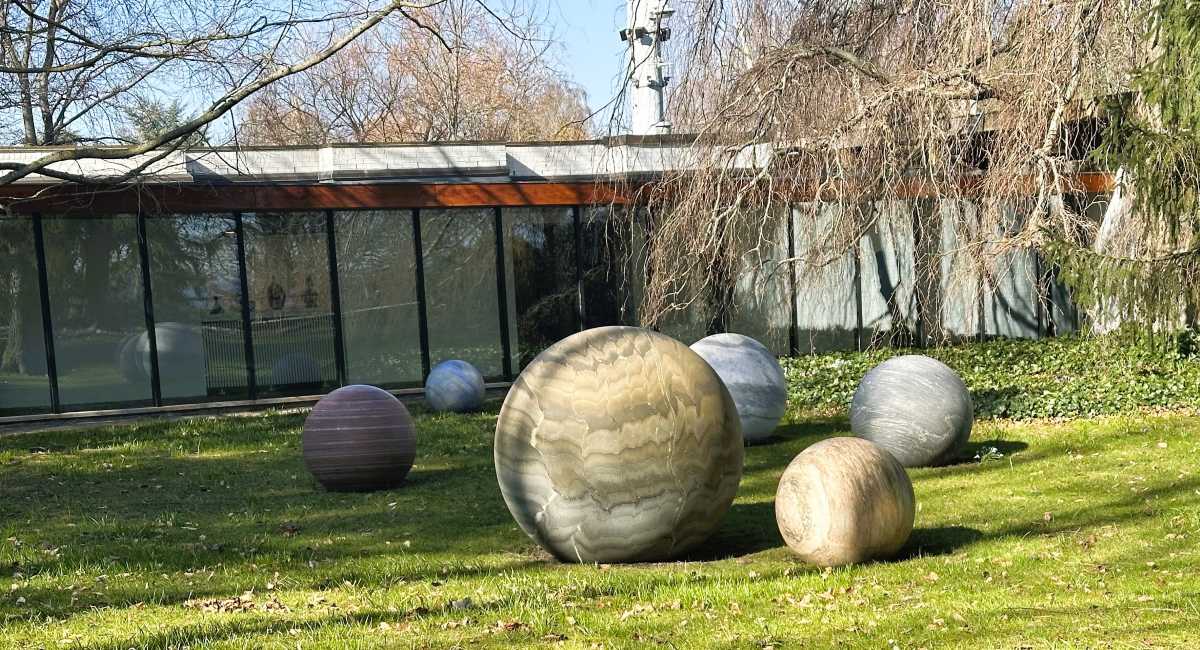
Outdoors, the sheer joy of this outstanding museum continues as art, architecture and landscape are integrated into a sculpture garden containing some 45 pieces. These range from Henry Moore to Alexander Calder, Richard Serra to Roy Lichtenstein. I was particularly captivated by the large stone spheres representing planets by Alicja Kwade. I followed a very handy map that the museum provides, ensuring that I found every piece – some are embedded in the landscape. The views are utterly beguiling, and you can walk down from the park to a jetty designed by architect Jean Nouvel.
Louisiana is a popular day trip from Copenhagen and with good reason. If you enjoy modern and contemporary art, set aside at least half a day, preferably more, if you want to have time to see everything on offer. I arrived mid-morning, spent several hours inside, had a coffee break overlooking the beach, explored the sculpture garden and then treated myself to a delicious, good-value lunch in the café restaurant, gazing out over the terrace of Calder sculptures and to the sea beyond.
If you would like to see Kronborg Castle, on which Shakespeare based Hamlet’s Elsinore, hop back on the train at Humlabӕk for a further 15 minutes and alight at Helsingør. Walk around the ramparts, see the ferries crossing the water to Sweden. Watch the sun set before getting the train back to Copenhagen.
Louisiana Museum of Modern Art, Gl. Strandvej 13, 3050 Humlebӕk.
Open Tuesday – Friday 11.00 – 22.00, Saturday and Sunday 11.00 – 18.00
Other art museums to visit
ARKEN Museum of Contemporary Art is another trip out of the city, this time to Ishøj, located south of Copenhagen. Like Louisiana, the museum is located above a beach and housed in a beautiful building that resembles a ship. It has an outdoor sculpture park, while indoors, there is a series of temporary exhibitions alongside the permanent collection (post-1945), which includes internationally renowned artists such as Olafur Eliasson, Per Kirkeby, Ager Jorn, Damien Hirst and Ai Weiwei.
ARKEN Museum of Contemporary Art, Skovvej 100, 2635 Ishøj. Open Tuesday – Sunday 11.00 – 17.00 (21.00 on Thursdays).
Ny Carlsberg Glyptoteket is located in Copenhagen and is the leading antiquities museum in the Nordic countries. It also houses one of the top European collections of French art (1800-1930). This private collection, which opened in 1897, was bequeathed to the public by Carl Jacobsen, who collected art and antiquities with the profits from his brewery, Ny Carlsberg. It is filled with marble statues, mummies, and artworks and also boasts a beautiful Winter Garden.
Ny Carlsberg Glyptoteket, Dantes Plads 7, 1556 Copenhagen. Open Tuesday – Sunday 10.00 – 17.00 (21.00 on Thursdays).
The David Collection is renowned for its collection of Islamic Art, the largest in Scandinavia and considered one of the most comprehensive in the Western world, ranging from the 8th–19th centuries. It includes manuscripts, ceramics, jewellery, textiles and metalwork. It also contains a collection of 18th-century European art, Danish Golden Age art, and modern Danish art.
David Collection, Kronprinsessegade 30, 1306 Copenhagen. Free admission. Open Tuesday – Sunday 10.00 – 17.00 (21.00 on Wednesdays).
Thorvaldsens Museum showcases the work of the late 18th and early 19th-century Danish sculptor Bertel Thorvaldsen. Opened in 1848, it is the oldest public museum in Denmark.
Thorvaldsens Museum, 2 Bertel Thorvaldsens Plads, 1213 Copenhagen. Open Tuesday – Sunday 10.00 – 17.00, free admission on Wednesdays
Restaurants I enjoyed while in Copenhagen
Kødbyens Fiskebar – a fabulous seafood restaurant with British chef Jamie Lee at the helm.
Restaurant Palӕgade – a charming restaurant serving smorrebrod at lunch and Danish/French dining in the evenings.
Olise – a modern bistro belonging to the COFOCO group of restaurants and hotels in Copenhagen, focusing on sustainable cooking, organic products and fine food.
Where to Stay in Copenhagen
I was hosted by Visit Denmark and invited to review two hotels, which you can read about here and here.
Hotel Kong Arthur is a luxury hotel located in the centre of Copenhagen and has the excellent Ni’mat Spa available for guests to enjoy.
Hotel Coco is a charming boutique hotel in the neighbourhood of Vesterbro, a trendy area filled with restaurants, bars, nightlife, and boutiques. It is also conveniently close to the central train station.
For more travel, check out Sicily’s Beating Heart, Palermo.

Leave a Reply