Last Updated on December 5, 2025
The Fairies Triumphant Return to the Coliseum
The ENO are staging a revival of their 2018 hit production of Gilbert & Sullivan’s Iolanthe. Director Cal McCrystal (Paddington 1 and 2, theatrical smash hit One Man, Two Guvnors. The ENO’s HMS Pinafore) is regarded as the go-to-director for comedy and as I didn’t catch it the first time around, I’m very pleased to be reviewing.
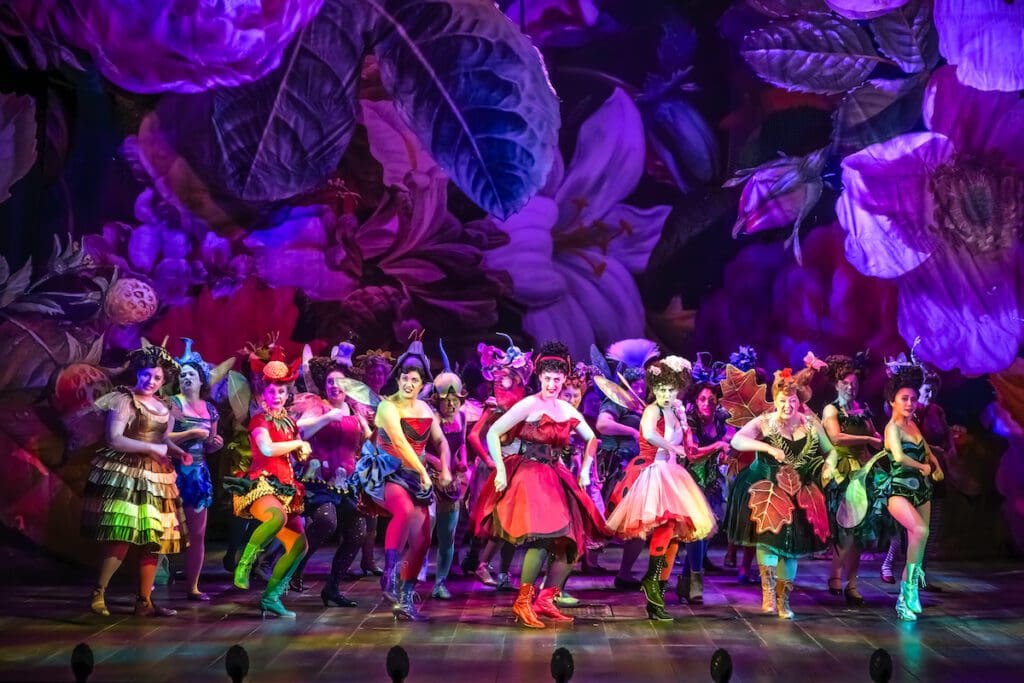
Iolanthe received its premiere in 1882 at The Savoy Theatre, the first G&S show premiered there. It was written at a time when the composer and author were at the peak of their popularity in both Britain and the USA with a run of hits and was the first show to use electric lighting. The operetta is set in a world where fairies co-exist with humans. We can’t underestimate the importance and plausibility of fairy culture within Victorian society, and it is in the fairy world that justice and order are to be found.

All the human characters are figures of fun with Gilbert’s biting if affectionate satiric lyrics take aim at the House of Lords, the absurdity of two party politics within the binary British political system of the time and the Royal Family. For good measure Gilbert also takes a look at class and gender conflict as well as the inherent tension between the natural world (the world of the fairies) versus the industrialised and politicised world of men and politics.

The story is built around a love affair. Two Arcadian shepherds Phyllis and Strephon (half man, half-fairy) wish to marry; but Phyllis is a ward of the Chancery Court and the Lord Chancellor himself – along with the massed ranks of the British peerage – is in love with her and unwilling to grant her wish. Strephon, comically mispronounced as Strap-on on several occasions, is the son of the fairy Iolanthe who has been banished from her natural domain by the Queen of the Fairies for marrying a human. The narrative charts the couple’s comic journey to its inevitable happy resolution through a series of songs that director Cal McCrystal uses as a framework for his trademark set-piece comic inventions.
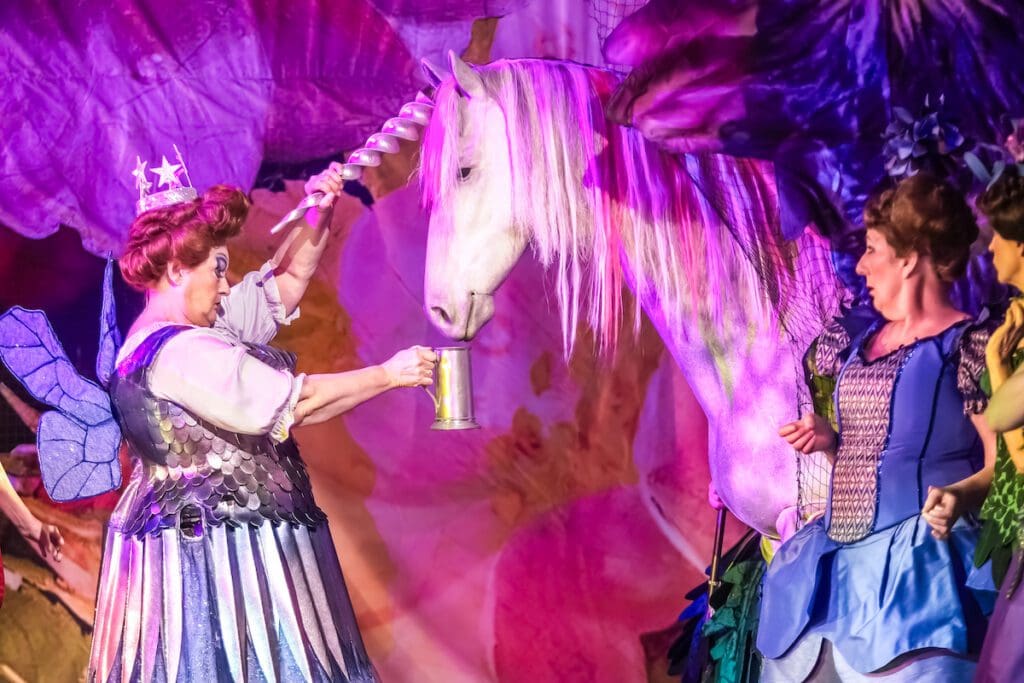
The often camp visual and slapstick humour comes thick and fast; the Queen of the Fairies pulls a pint from a unicorn’s horn, the peers throw around bottles of booze rather impressively as they sing and there are numerous animal gags with stagehand in a black bodysuit shagging a sheep to push it offstage. McCrystal references the pantheon of British comedy with subtle nods to Dad’s Army, Ealing comedies, Are You Being Served, Fawlty Towers and Blackadder to name but a few. He is also not afraid to satirise contemporary politics with hilarious swipes at Boris and Nadine Dorries, the culture secretary who oversaw the disastrous and ill-conceived Arts Council attempt to move the ENO out of London and the company’s home, The Coliseum.
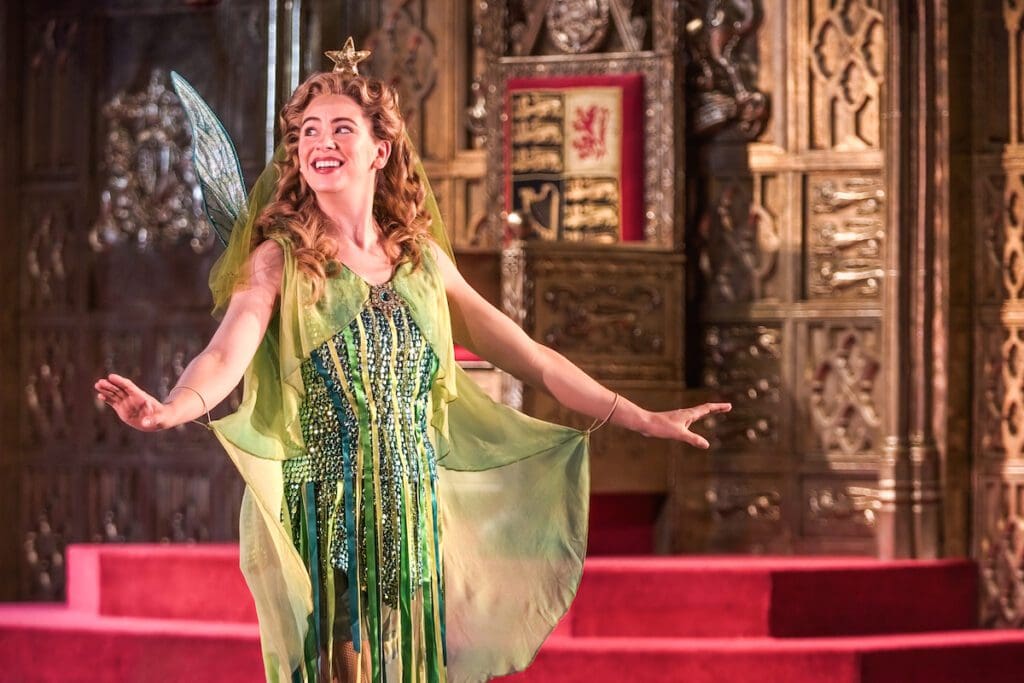
Welsh mezzo-soprano and former ENO Harewood Artist Samantha Price reprises her role from the 2018 production as Iolanthe. Decked out in shades of green as “the good fairy”, Price hyper-explicates her every utterance with a constant stream of comedic, melodramatic movements and poses. In the role’s signature aria, “My lord, a suppliant at your feet”, in which she pleads with the Lord Chancellor to allow her son Strephon to marry Phyllis knowing that this will lead to her own demise, there was a gorgeously toned sense of gravitas. The aria is the emotional heart of the piece with a compositional seriousness that maybe reflects the death of Sulllivan’s own mother not long before its composition.

Soprano Ellie Laugharne and baritone Marcus Farnsworth both return to the production as the slightly ridiculous lovestruck shepherds Phyllis and Strephon. They are a well-matched pair both vocally and physically with Laugharne’s crystalline soprano and Farnsworth’s smooth baritone coalescing beautifully in the melodic glory of “If we’re weak enough to tarry” as the couple urge each other to marry the other immediately to avoid the pitfalls of ten inevitable boredom that will set in.
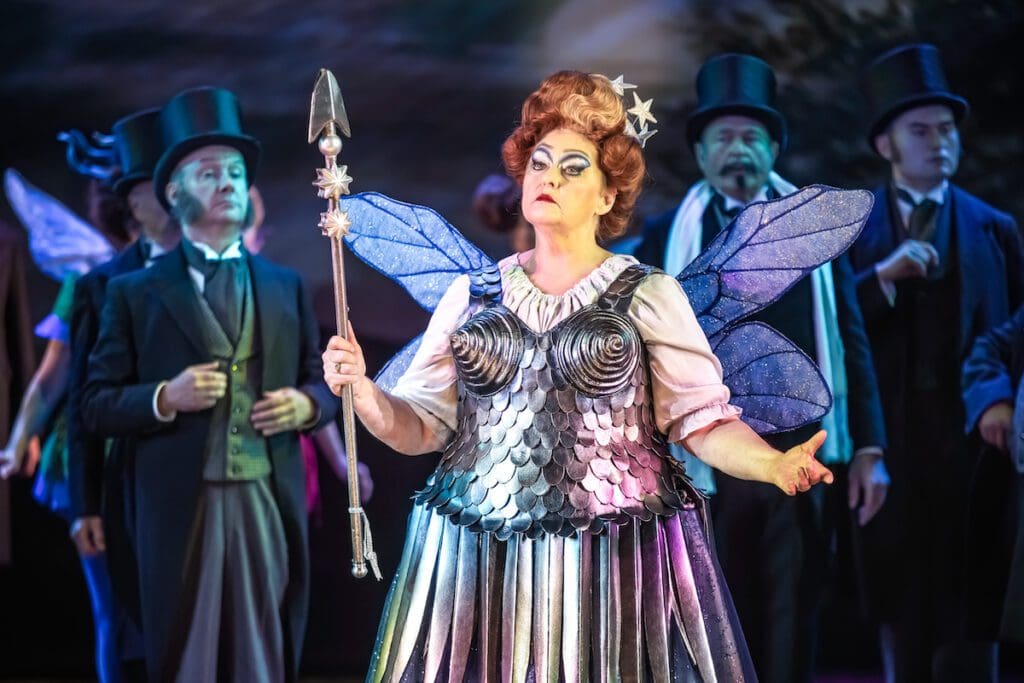
The redoubtable British mezzo-soprano Catherine Wyn-Rogers was excellent as the publican Auntie in the Royal Opera House’s Peter Grimes, but here she is delightful in her role debut as the stentorian Queen of the Fairies. Looking like a panto dame crossed with one of Wagner’s Valkyries – with a conical metal chest plate in a homage to John-Paul Gaultier – her rich mezzo tones are perfect for the repressed emotion of “Oh, foolish fay” as she admires the physical attributes of Private Willis.

Keel Watson, also making his role debut, plays the object of the Queen’s desire with a sense of dignified absurdity in a gentle lampooning of Queen Victoria and her servant and “friend” John Brown. In his feature “When all night long a chap remains” which wonders at the fact that all British men of a certain class are either born as a Liberal or a Conservative, Watson impresses with his warm bass-baritone and a precisely located lower middle-class accent.
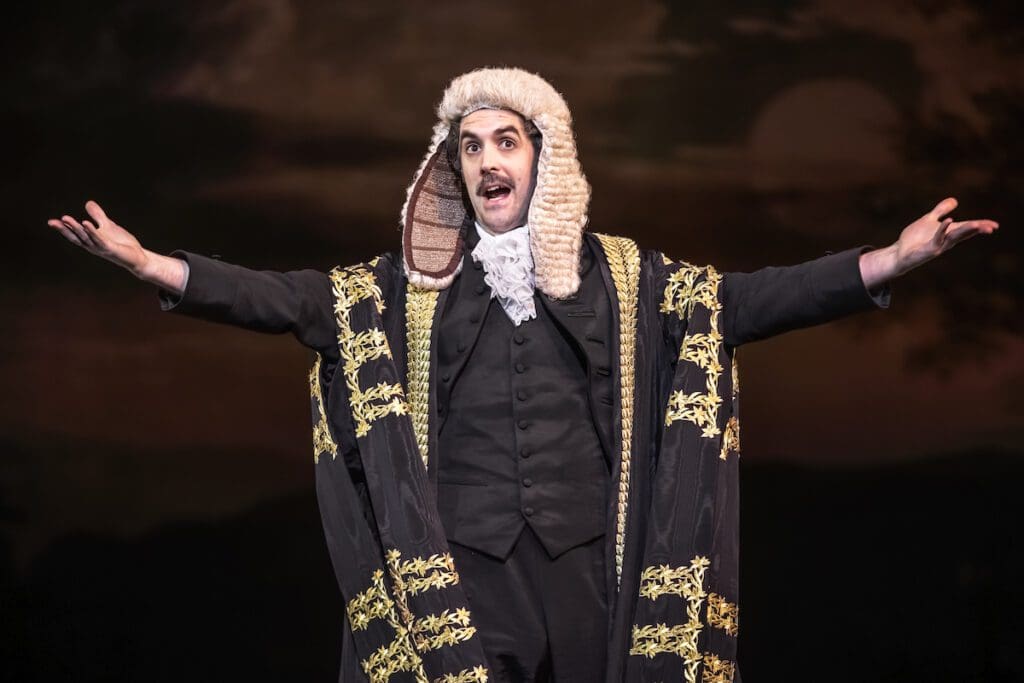
We last saw British bass-baritone John Savournin as Captain Corcoran in 2021’s HMS Pinafore (see our review). In Iolanthe, he performs the role of the Lord Chancellor again bringing a John Cleese-esque physicality to the part as well as his top-notch patter delivery.
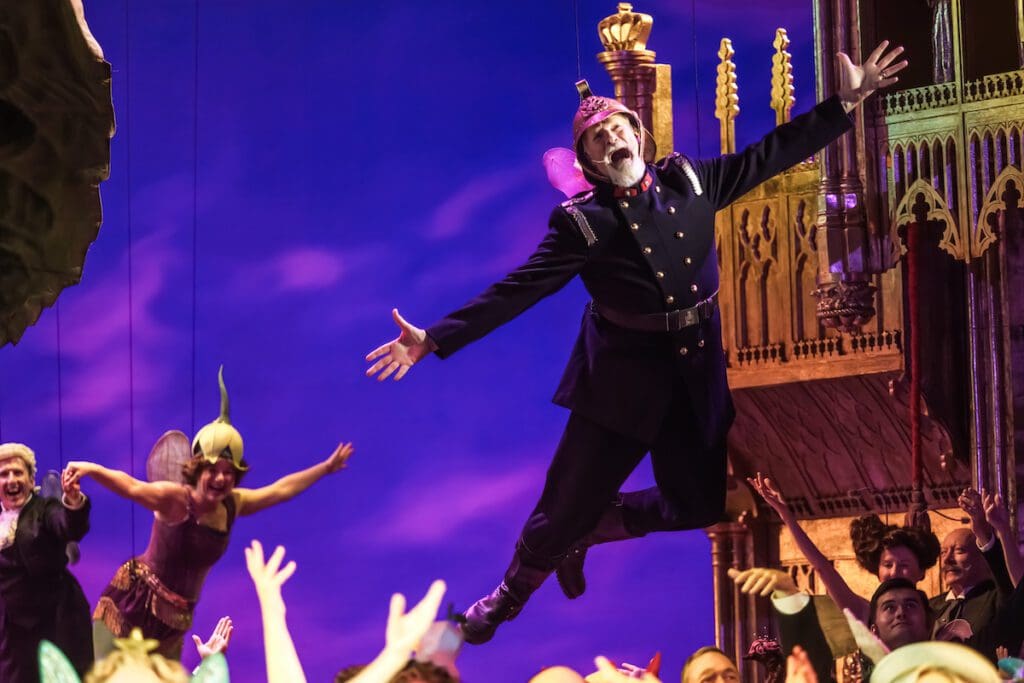
Actor Clive Mantle plays the speaking role of Captain Shaw, based on the real-life chief of the London Fire Brigade and inveterate theatre-goer, who opens both halves of the show by teasing the audience – “we have middle-class and upper-middle-class, truly a melting pot” – and the cast and conductor in an amusing period turn.
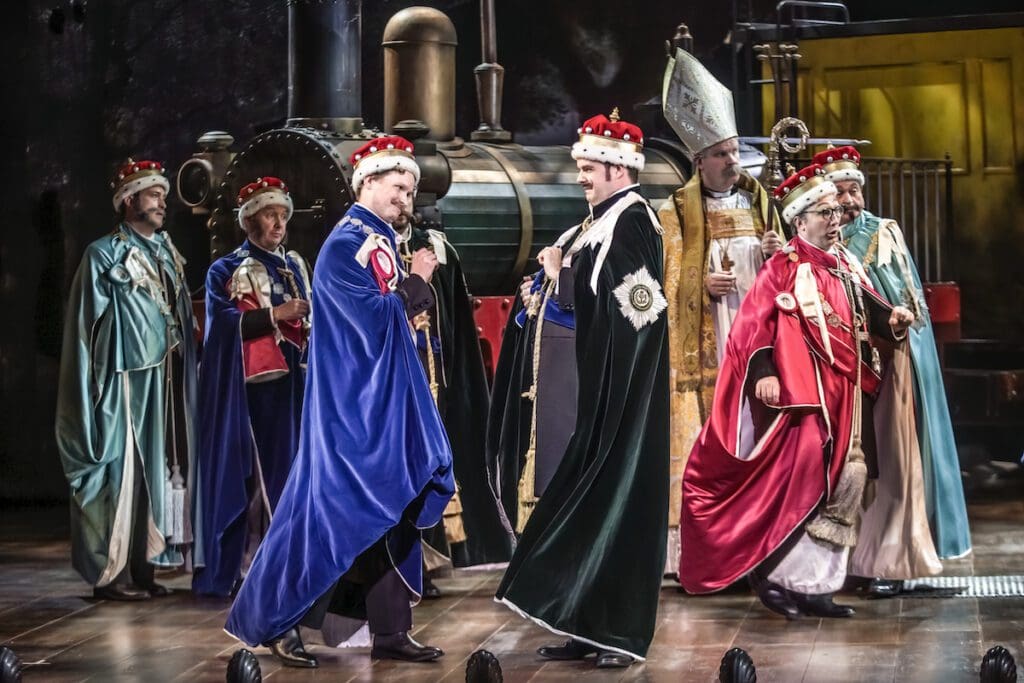
The double-act of ENO debutant, British tenor Ruairi Bowen as Earl Tolloller – plangent and affecting in the ridiculous “Spurn not the nobly born” – and Northern-Irish baritone Ben McAteer as Earl of Mountararat are a delightfully homo-erotic couple of toffs fighting over Phyllis’s affections.

Adam Brown plays the Lord Chancellor’s Page with a high degree of physical courage. He is the butt of the slapstick humour that McCrystal excels in and is treated with disdain– think Manuel in Fawlty Towers or Baldrick in Blackadder – despite coming up with a major constitutional fix and plot saver at the end of the work.
Chris Hopkins, the ENO’s G&S specialist marshalls the considerable forces of the house band with aplomb. He handles the score, with its nods to Mendelsohn and Wagner, with perfect pacing and dynamic control and the pastoral melodic overture with its glorious flute triplets is simply ravishing.
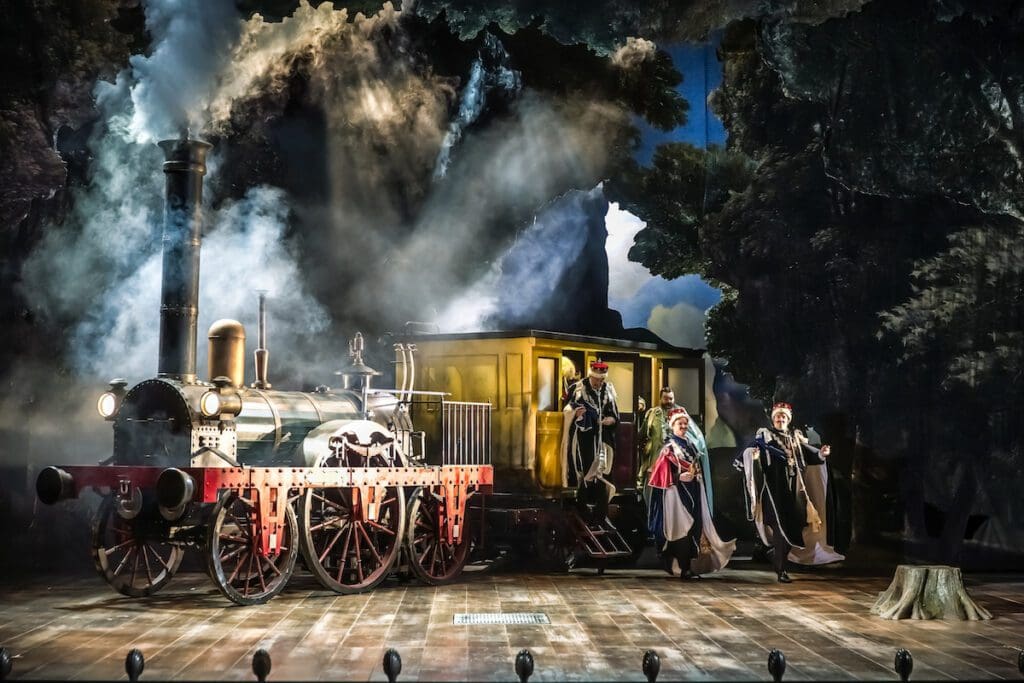
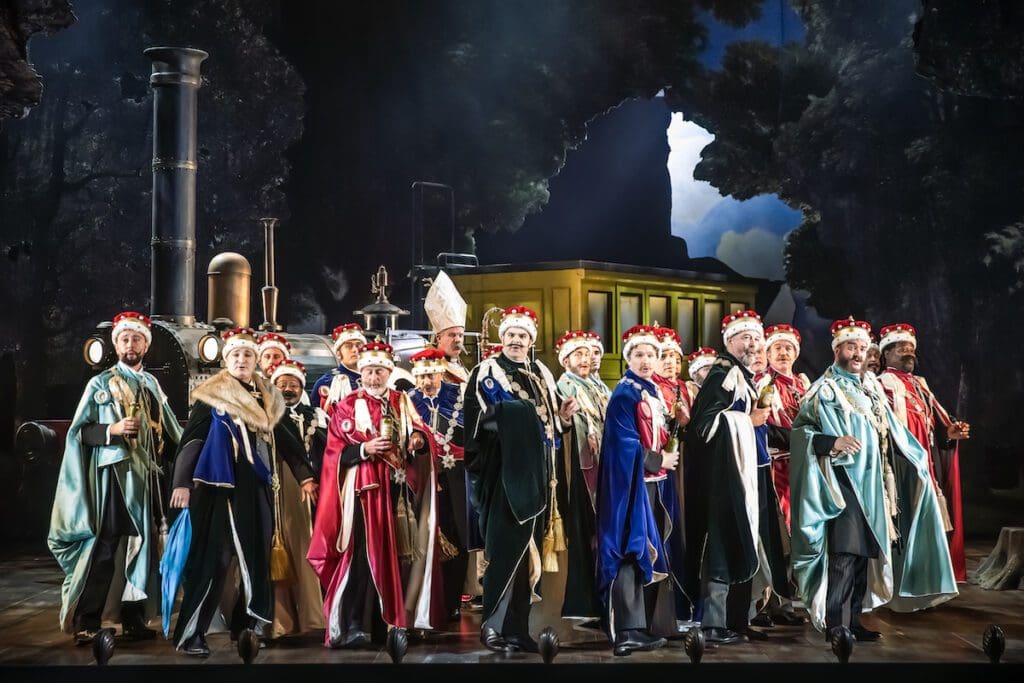
The late Paul Brown’s set and costumes were deservedly nominated for an Olivier Award in 2018. A huge Gainsborough-style backdrop, a steam train plunging onto the stage laden with coronet-wearing peers of the realm, and the gorgeous array of Victorian pantomime-esque fairy costumes combine to present a visual feast that is a pleasure to watch.

With most of the leads coming back to the show, there was a palpable sense of enjoyment from the cast as they slipped seamlessly back into character and McCrystal’s comic routines and Lizzi Gee’s energetic and playful choreography. Whilst Iolanthe may not match up to the melodic peaks of The Mikado or HMS Pinafore, McCrystal, who is something of a comic genius, has crafted a riotous romp through G&S’ most satiric work that the ENO’s diverse and young audience lapped up. My guess is that you will love it too. It’s a hit!
Iolanthe opens at the London Coliseum on Thursday 5 October for 13 performances: Oct 5, 7, 10, 13, 14, 19, 21, 24, and 25 at 19.00.
Oct 7, 14, 21 at 14.00. Oct 25 at 13.00 (relaxed performance).
English National Opera,
London Coliseum,
St Martin’s Lane,
London WC2N 4ES

Leave a Reply