Last Updated on June 1, 2026
Sisters Are Doin’ It for Themselves
To mark the centenary of Puccini’s death, last night the ENO put on two semi-staged performances of the composer’s one-act all-female opera Suor Angelica (Sister Angelica) with a starry cast. The piece was first performed on December 14, 1918, at the Metropolitan Opera in New York City as part of Puccini’s triptych Il Trittico, which also includes Il Tabarro and Gianni Schicchi.
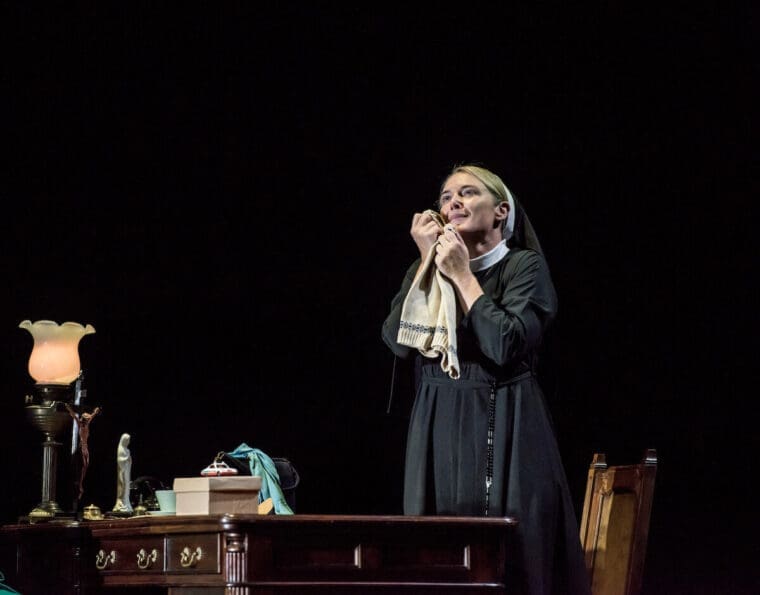
The story is centred around the character of Sister Angelica, a woman confined to a convent after bearing an illegitimate child. The opera was originally set in the late 17th century and explores themes of guilt, loss, and redemption. After seven years of isolation from her aristocratic family, Angelica learns from her aunt, the Princess, that her son had died two years previously. Overwhelmed by grief and despair, she attempts suicide but realises that this act would condemn her soul to eternal separation from her child. In her final moments before death, she experiences a vision of her son and the Virgin Mary, which offers her a sense of absolution as she dies.
The plot was suggested to Puccini by his librettist, Giovacchino Forzano, and with the composer’s sister, Iginia, serving as a Mother Superior in a convent in the Tuscan city of Lucca, Puccini had a level of understanding of the emotional complexities and spiritual dynamics of convent life. He also had an extraordinary ability amongst male composers to inhabit a female perspective. Both operas feature an abandoned heroine, Butterfly by her husband Captain Pinkerton, and Angelica by her family, and both are driven to suicide.
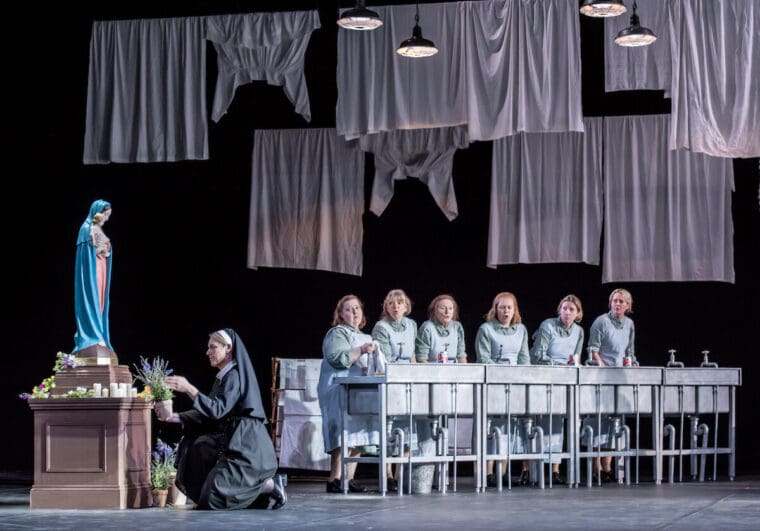
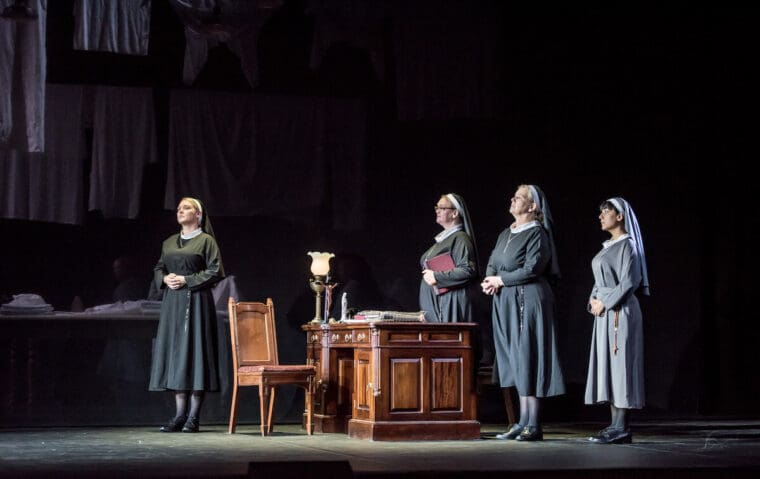
For this production, Suor Angelica has been transplanted by the ENO’s Artistic Director, Annilese Miskimmon, to 1960s Ireland, within a Magdalene Laundries institution. Miskimmon is originally from Northern Ireland and holds dual Irish/British citizenship. Over 10,000 Irish women were placed in these institutions which were run by the church and sanctioned by the Irish state. The uncovering of this scandal has been a huge story within Ireland with cultural reverberations extending beyond. This transplantation makes dramatic sense as it brings the narrative into the lifetimes of the older members of the audience (me) and connects with the contemporary ongoing narratives of institutional prejudice and exploitation of women, gay and young people that have so bedevilled the Catholic Church worldwide. The idea works in principle, and maybe the semi-staged set of some hanging laundry, the laundering stations, a statue of the Virgin Mary and a large desk as well as the costumes accurately represent the Magdalene Laundries. But with a little more imagination or (possibly) budget, we could have been brought into that Irish setting in a way that would have felt more tangible rather than just as a convenient device.
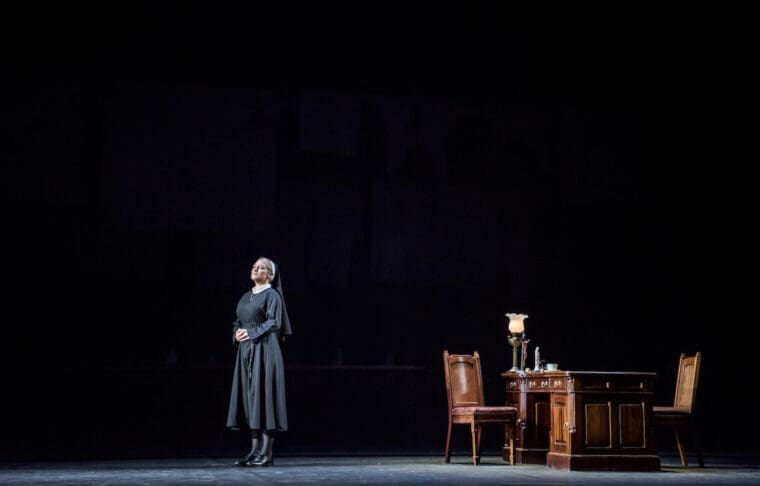
The role of Sister Angelica is taken by Irish Olivier Award-nominated soprano, Sinead Campbell-Wallace. Her Puccini credentials are impeccable – she made for a moving Mimi in the ENO’s La Bohème (see our review). With a voice that has tremendous clarity and power in the top range, Campbell-Wallace brilliantly manages the character’s mood shifts between tender religious piety (“I am prepared to be calm and submissive”) whilst having the ability to shift a gear to uttering high-pitched howls of anguish as she becomes hysterical over the news about the death of her son (“Sweetest love you died without your mother”). It’s a star turn.

The great British mezzo-soprano Christine Rice (sensational last year as Erda in The Rheingold last year at the ENO – see our review) plays the Princess, Angelica’s nemesis. Rice, resplendent in a turquoise outfit, is sombre and chilling whilst hinting at a more complex emotional hinterland for her character.

Madeleine Shaw, another great British mezzo who made a striking and dramatic Fricka in the same production of The Rheingold brings her gloriously warm focussed sound to the gently authoritarian role of The Abbess.
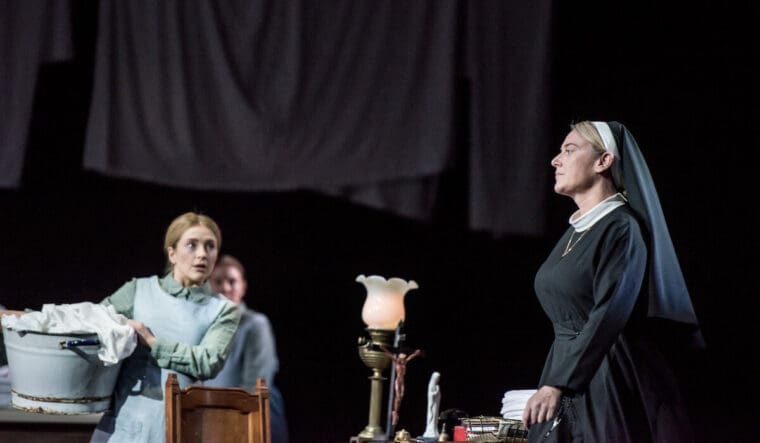
A standout performer for me was Australian soprano Alexandra Oomens as the irrepressible Sister Genevieve. A Harewood Artist with English National Opera, Oomens has a lightness of touch combined with a vocal vivacity that suggests a fine career ahead of her. There were also fine cameos from American mezzo Lea Shaw as the stern Monitress and Sarah Jane Lewis as the greedy Sister Dolcina.

Corinna Niemeyer, Artistic and Music Director of the Orchestre de Chambre du Luxembourg, making her ENO debut with Suor Angelica, managed the vocal and instrumental sound resources at her disposal quite brilliantly. The sound world of the opera is not dissimilar to that of Madama Butterfly using high string writing, harp and woodwinds to create an ethereal, spiritual atmosphere and the band did the score justice as did the chorus – their off-stage Ave Maria was almost enough to make me convert! With a team of star singers, this production of Suor Angelica was musically and dramatically first-class, with a staging that made me eager to see a more fully realised version.
Suor Angelica at the English National Opera
London Coliseum,
St Martin’s Lane,
London WC2N 4ES

Leave a Reply