Last Updated on July 2, 2026
Portrait of Lee Krasner standing defiantly outside Jackson Pollock’s shadow
4.5 out of 5.0 stars“Lee” is a compelling new play bringing to life abstract expressionist artist Lee Krasner working in her Long Island studio. Looking back at her tempestuous marriage to fellow painter Jackson Pollock (of the famous drip works) and her compromised status as a woman artist, the reappearance of an old canvas draws her earlier career into sharper focus.
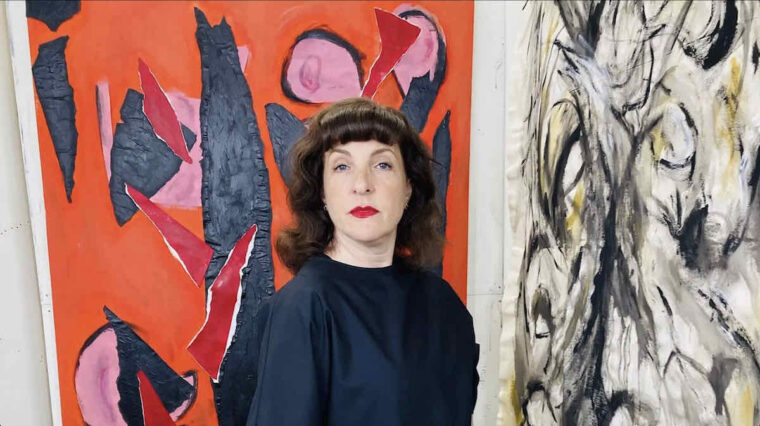
It is 1969 and Krasner has been a widow for 13 years. No longer relegated to painting in a bedroom, she has taken over Pollock’s studio space where she is still haunted by his judgement over her own work and legacy as she paints. Helen Goldwyn (Olivier winner from Regent’s Park Open Air Theatre’s Fiddler on the Roof) presents Krasner as an accomplished, driven artist, who eventually puts down her paintbrush when the persistent grocer boy Hank persuades her of his artistic promise.
Hank, portrayed by Will Bagnall (tv credit, ITV’s Grace), shares his fledgling art portfolio with a reluctant Krasner. There’s endearing sparring between the pair but when the stakes are raised, each actor has scope to display heightened emotion. Hank, though his sorry circumstances are true, has further motivation to butter Krasner up. Could selling an old painting, long rolled up in a tube, with the signature cut away, given by Pollock to his father in lieu of unpaid bills, support his ambitions to be an artist himself?

Faced with the long “stolen” canvas and knowing the boy’s future is at stake, will Krasner authenticate the work? Krasner, who we learn in flashback quarrels with her husband, has never had children – “Mothering Pollock was enough” – but finds her maternal side mentoring Hank. The story arc between Lee and Hank is tenderly and deftly illustrated.
The studio set, with white walls and a paint-spattered floor, has numerous “Krasner” works reproduced by designer Ian Nicholas on display. The position of these in Krasner’s oeuvre, and how or whether they are signed, is discussed. Cian Griffin’s script, packed with painstaking research, is set in the mid-century New York Art world and is an exploration of compromises made in personal and artistic relationships and the lengths to which artists will go to support each other’s talent.
Themes examined include plagiarism and originality, the inequality attached to female artists’ work (“This is so good, you would never know it was done by a woman”!) and the constraints and expectations that marriage places on women’s capacity for creativity. Krasner was the only American-born child of Russian-Jewish parents escaping antisemitism in what is now the Ukraine. Her Jewish immigrant background adds another layer for critics evaluating her work.

Interactions with Pollock (Tom Andrews) happen both in Krasner’s imagination and in flashback. Replaying arguments in her mind and challenging Hank over the discovered painting, “Lee” explodes any notion of Krasner as a mere muse, positioning her instead as the great woman behind Pollock’s shaky, drunken genius. Helen Goldwyn switches seamlessly between past and present dialogues, sometimes in the same breath. Pollock’s presence looms large (even when Andrews is off stage), bookending the play with occasional cigarette breaks in between. However, much of the script concentrates on Krasner’s encounter with Hank and how she will act upon the revelation he delivers.
Lee is a well-rounded piece with all three characters showing immediate depth, a tight plot that swirls neatly into the 90-minute run time. It’s especially impressive knowing this is just Cian Griffin’s second play, his first, “Aged in Wood”, debuted at The Tabard Theatre this spring. A third, a thriller called “Night Owl”, is in production, and he is currently writing another play about a painter, this time Francis Bacon. Playwriting since just 2020, Griffin is evidently a prolific playwright we will rightly hear more of.

Director/producer Jason Moore’s production company, Onbook Theatre, was also founded after the pandemic. As well as commissioning new writing from Griffin, they have produced classic plays by Patrick Hamilton and Yasmin Reza. “Lee” adds another colourful production to the always-engaging local theatre programme offered by The Park Theatre’s two spaces.
I greatly enjoyed “Lee” and found the show well-paced and emotional with touches of humour. You don’t need to know everything about abstract expressionist art to enjoy it, but there are references to peer artists such as De Kooning and Rothko that will make more sense if you are familiar with these. I left with enthusiasm to learn more about both Krasner and Pollock’s work and biographies.
One warning, though: avoid the front rows if you’re sensitive to tobacco smoke. Several cigarettes are lit during the performance.
Lee
Park Theatre
Clifton Terrace
Finsbury Park
London N4 3JP
30 September – 18 October
Looking for something different? Do check our off West End Theatre Previews for 2025
Leave a Reply