Last Updated on October 16, 2025
Family Feuds, a Lust for Power and Jealousy
Mozart’s Mitridate, Re di Ponto makes the TV drama Succession look like an Enid Blyton story. The second opera in this year’s Garsington season, part of the six-week summer festival that takes place on the Wormsley Estate an hour from West London, the three-act Mitridate was written by the prodigal Mozart when he was only 14 and premiered in Milan in 1770. Vittorio Amedeo Cigna-Santi’s libretto for the opera was based on Racine’s play Mithridate and tells the story of the eponymous warrior-king of Pontus who is at war with the all-powerful Romans.
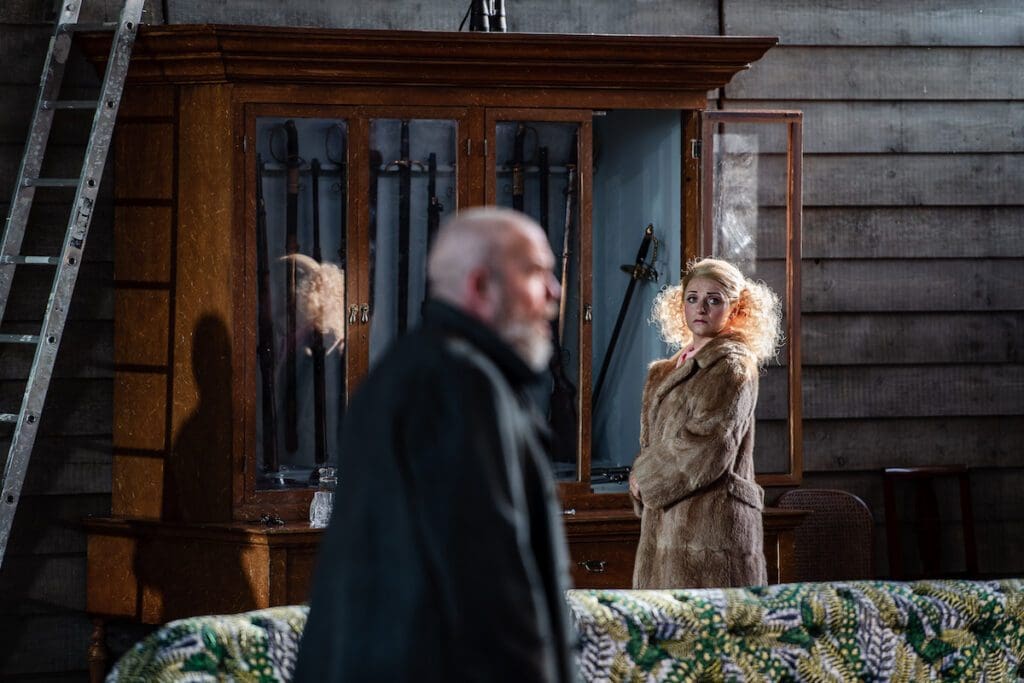
The king has two sons, the feckless and untrustworthy Farnace, secretly in league with the enemy, and the more honourable Sifare. To complicate matters, Mitridate and both of his sons are in love with Aspasia, the king’s fiancée. The character who completes this love pentagon is Ismene, Farnace’s intended bride. Ismene is a beacon of virtue in this torrid sea of emotion. She holds on to her love for Farnace despite her intended’s brutal rejection and convinces the raging king not to kill his sons and Aspasia.
The opera opens in the aftermath of a battle which Mitridate has lost. Arbate, the governor of Nymphæum and ally of Mitridate incorrectly believes that his sovereign is dead. The governor informs Aspasia, Farnace and Sifare so unleashing the brothers’ romantic rivalry for Aspasia, which is only resolved when Mitridate dies by his own hand at the end of the opera in the fallout from a final, decisive battle.

Designer Hannah Clark has created a world that mixes time periods with its own internal logic. Set against a backdrop of neutral grey wooden boards which cover the back of the Garsington’s large stage, there is a swords and sandals era breastplate and plumed helmet juxtaposed alongside more modern military grey coats, a contemporary sofa, a stuffed zebra and Farnace’s sleazy though covetable maroon dressing gown and suit. The overall impression gives us a sense of the classical world we are inhabiting without overwhelming us with detail and allows the focus to be on the music and the emotional worlds of the protagonists. It’s a sombre take on the opera and a far cry from Graham Vick’s garish and groundbreaking 1991 production for the Royal Opera House.
Mozart’s score is the work of a young composer flexing their compositional muscles. Mitridate was his fourth opera and is the precocious Wolfgang’s first foray into the conventions of opera seria, the 18th-century operatic form characterised by the singers declaiming a series of virtuosic ‘da capo’ arias that articulate their emotional state in an ABA form. These are linked by the more conversational recitatives accompanied only by the continuo of harpsichord and bass. There are only two non-solo numbers in the whole opera, the gorgeously romantic love duet between Aspasia and Sifare – “Se viver non degg’io” that closes Act 2, with the singers trading baroque flourishes and flashy semiquaver runs in 3rds, and the opera’s finale “Non si ceda al campidoglio”, a vocal quintet that provides a tantalising glimpse of Mozart’s later vocal ensemble writing. There is a vitality to the melodies that challenges the stately compositional conventions of the genre, and if it is technically hugely challenging for the singers to manage the huge leaps and rhythmic twists of Mozart’s melodies, it creates a thrilling musical ride for the audience.
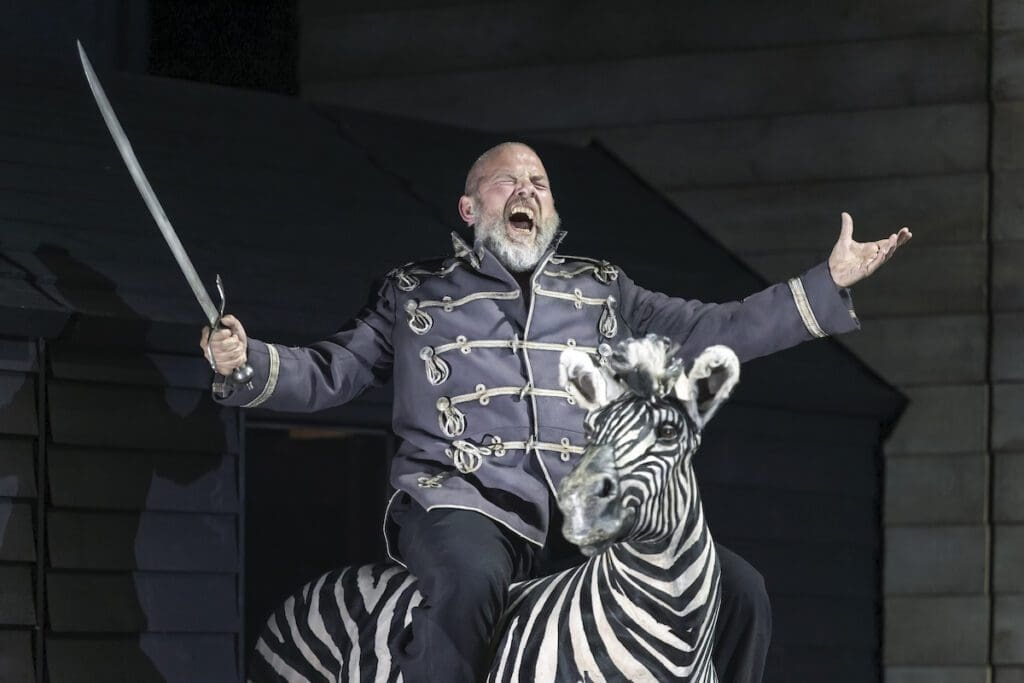
Tenor Robert Murray makes a convincingly grizzled and deluded Mitridate, believing that he can take on the might of the Roman Imperial machine. First seen dragging a huge trunk as he flees a battle scene, Murray’s textured tone is impressive as he shifts gears between expressing the reflective resignation of being a loser in war, to the jealous anger of a father feeling threatened by his children.

Mitridate’s betrothed Aspasia is sung by soprano Elizabeth Watts, dressed as if in mourning. Her emotional apotheosis comes in the aria ” Pallid’ ombre” as she contemplates drinking the poison left for her by the King. Her honey-toned soprano with its exceptional dynamic control is a highlight of the performance.

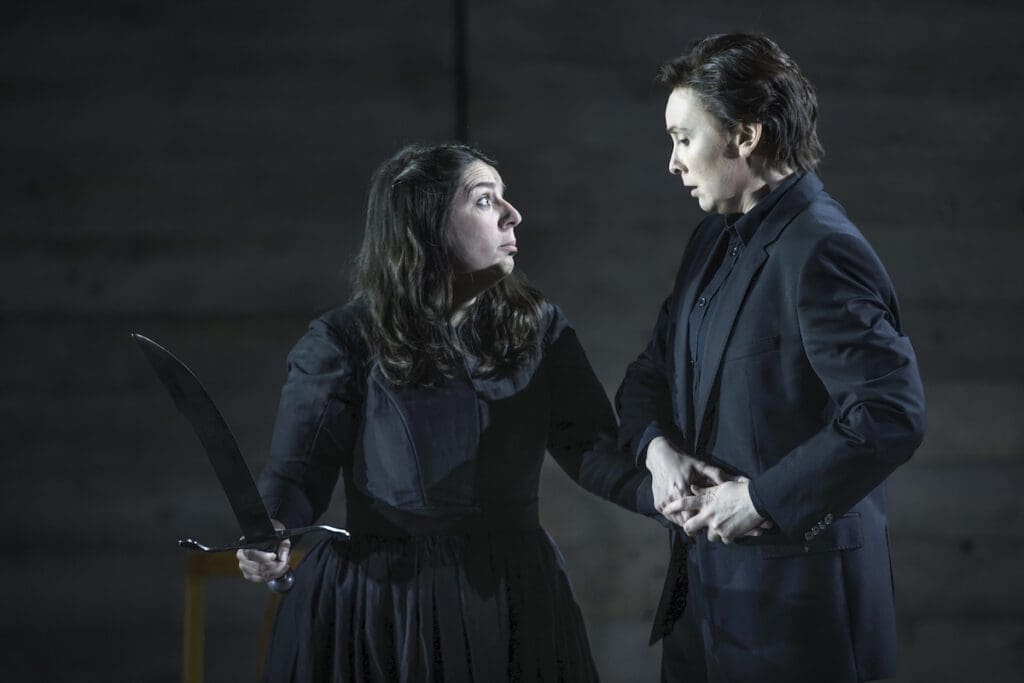
British-Hungarian soprano Louise Kemény takes on the black-suited ‘trouser role’ of Sifare, Mitridate’s ‘good’ son, a part originally intended to be played by a castrato. Kemény is passionate and expressive in “Soffre il mio cor” and the duet “Lungi da te” with virtuosic natural horn playing from Ursula Paludan Monberg, allowing her voice to soar with romantic longing.
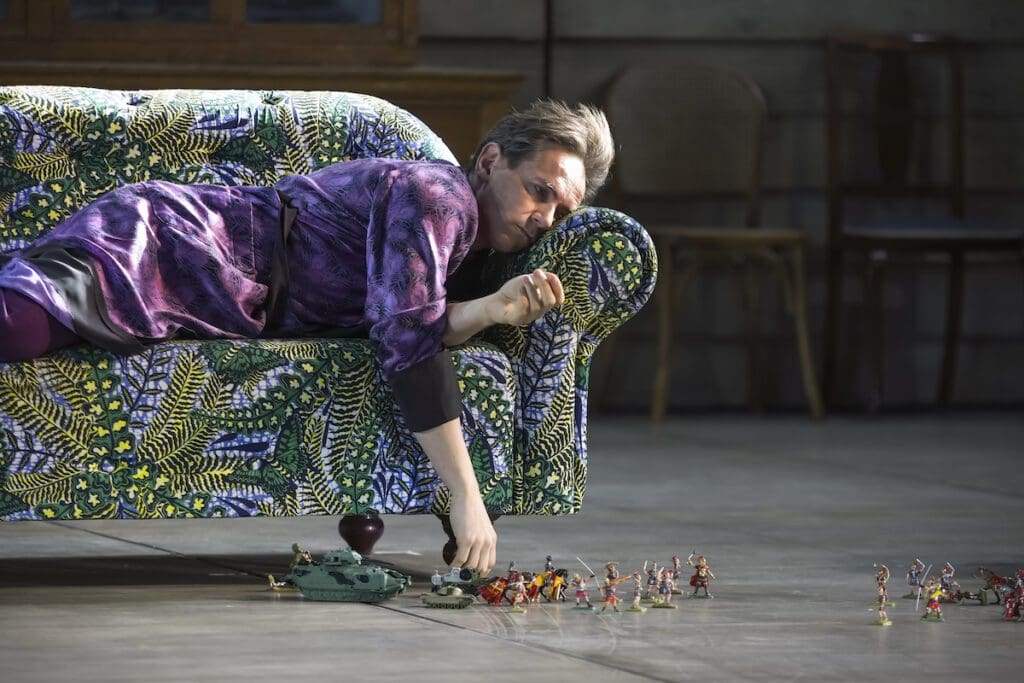
Counter-tenor Iestyn Davies plays Farnace, Mitridate’s eldest son, as a refugee from The Groucho Club, first seen sprawled on a sofa, swigging from a bottle of Johnnie Walker and playing with his toy soldiers. Davies brings a restless intelligence to the part and reveals a plangent cor anglais quality to his voice as he confesses his Roman collaboration to his father.

Young British soprano Soraya Mafi as the jilted Parthian Princess Ismene, decked out in a blancmange pink frumpy number with a dodgy-looking fur coat, impressively extends her crystalline tone into her coloratura range in “So quanto a te”.
We loved tenor John Graham-Hall as the fanatical Methodist Bob Boles in Deborah Warner’s visceral Peter Grimes at Royal Opera House and he is similarly characterful as Arbate Governor of Nymphæa. Welsh tenor Joshua Owen Mills doesn’t get much of a look-in as Marzio, a Roman legionary officer, but died very elegantly!

Director Tim Albery’s production moves at a pace with the twists and turns of the plot remaining clear at all times. In this, he was more than ably aided and abetted by conductor Clemens Schuldt who did a very fine job managing the singers and the impeccable The English Concert from the pit. The whole Garsington experience is very special. The musical bar is set very high and you feel at one with nature in the steel, wood and glass of the lakeside opera pavilion. Set on the Wormsley Estate in the stunning Hambleden Valley, when the north wind blows the roof awnings may rattle a little but the audience wraps itself up in blankets and loses themselves in the performance.
1, 3, 9, 11, 23, 27 June and 2 July 2023
The 2023 season kicked off with Rossini’s comic masterpiece Il Barbiere di Siviglia (see our review)
2, 8, 10, 12, 17 June and 7, 9, 16, 18, 22 July 2023
And continues with Richard Strauss’ Ariadne Auf Naxos with its extraordinary juxtaposition of the comic and tragic and Smetana’s vibrant evocation of Czech rural life.
18, 24, 29 June 2023 and 1, 6, 14, 19, 21 July 2023
Smetana’s The Bartered Bride is the final opera of the festival. This is a story of thwarted love and arranged marriage, an arrangement which the spirited heroine, Marienka, is not prepared to accept.
30 June 2023 and 3, 5, 8, 10, 13, 15, 20, 23 July 2023
Booking is online and the Wormsley Estate is close to the M40 at junction 5 or can be reached by train from London to High Wycombe and then a pre-booked bus.
Garsington Opera
Wormsley Estate
Stokenchurch
High Wycombe
Buckinghamshire
HP14 3YG

Leave a Reply