Last Updated on June 16, 2026
Legendary choreographer Pina Bausch’s richly textured penultimate work makes its long-awaited London premiere
4.5 out of 5.0 starsLegendary German choreographer Pina Bausch once famously said she was less interested in how people move than she was in what moves them. It is this idea that lies at the heart of Sweet Mambo, Bausch’s beautiful, emotionally intense penultimate work, which debuted in 2008 but has taken nearly 20 years to make its debut on the London stage this week. Created in the final two years of Bausch’s life, Sweet Mambo continues to build on her key recurring themes of desire, devotion, submission, power and melancholy, making it both a culmination and a continuation of her artistic legacy.

Bausch is the most famous exponent of Tanztheater (literally “dance theatre”), a dance form that developed in the 1930s out of German expressionist dance. It is characterised by its emphasis on expression of emotion over form, and combines elements of dance, everyday movement, theatre, speech and music with unusual props or set design. It enjoyed a revival during the social upheaval of the 1970s as a radical departure from the strictures of classical dance and has remained popular ever since. There is little by way of linear storytelling in Tanztheater. Instead, it portrays experiences or reminds the audience of physical or emotional sensations that resonate with their personal memories. Even to fans of the genre, pieces can be challenging or confusing, but at the same time, also profoundly touching and capable of awakening deep emotions.
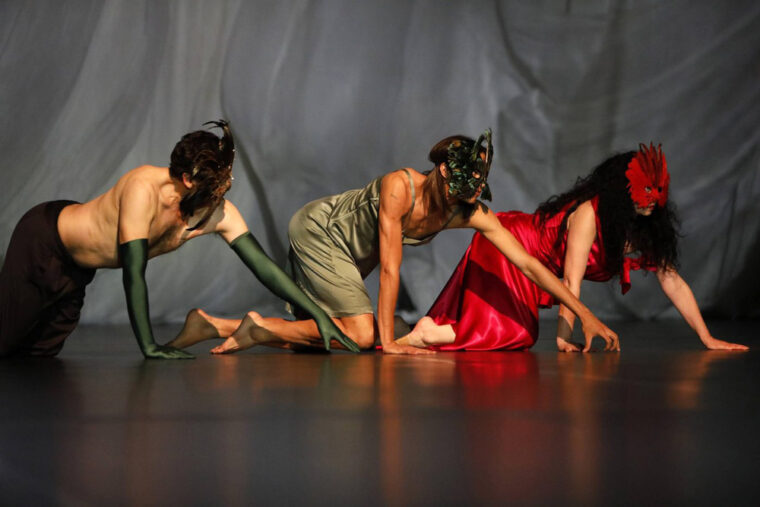
The production of Sweet Mambo, currently on stage at Sadler’s Wells Theatre, features a minimalist yet dramatic set, a product of Bausch’s nearly 30-year collaboration with set designer Peter Pabst. As is often the case with her works, the stage is bare other than for a series of diaphanous white drapes that look at first like a simple backdrop but evolve during the performance to function as an additional cast member. Dancers burst onto the stage through them; disappear into them; disguise themselves in them; and playfully pursue each other through them. Scenes from Viktor Tourjansky’s 1938 monochrome film The Blue Fox flicker silently across the undulating drapes. Additional drapes set at varying distances from the backdrop glide into view from the wings, creating a dramatic and multi-layered set. Unseen winds move the fabric with fluctuating degrees of intensity, creating everything from ripples to crashing waves. And most spectacularly, there is a drape that occasionally billows out of the wings like a ghostly, constantly morphing hot air balloon, both dwarfing and sheltering the dancers. The set feels alive, not simply decorative but actively engaged with the choreography. It is wonderfully dynamic yet at the same time calming to watch.

The music for Sweet Mambo, as usual with Bausch, is an absorbingly eclectic mix (you can find an 18-track Spotify playlist of the music). Some of it has a slightly South American feel (Mo Boma’s Walk Like a Pygmy and Mari Boine’s Vuoi Vuoi Me) but there is also the jazzy Bob Fosse-esque Le Matin des Noires by Barry Adamson and Mina Agossi’s Ain’t Misbehavin’; the louche New Orleans vibe of Hazmat Modine’sBahamut; and Black Mighty Orcherstra’s Ocean Beach (Cybophonia Cinematic Remix) which sounds like the love child of an early Depeche Mode track and a 1950s music soundtrack. My personal favourites though were Cry Me A River (a Billie Holiday-esque version by Lisa Ekdahl) and two brilliant Portishead tracks (Undenied and We Carry On) – the fragile vocals and sometimes frantic, pulsing instrumental perfectly reflect the emotional turmoil unfolding on stage. Incredibly, Bausch’s manner of working was not to choreograph movements to a specific piece of music, but to choreograph the entire piece and then add the soundscape, which was also the case with Sweet Mambo. Both the mood and the movement are perfectly matched and enhanced by the music chosen for each sequence.

Sweet Mambo is a relatively small and intimate work for Bausch, who often worked with a cast of 20 or more. It was originally written to be performed by an all-female cast, but as the work developed, Bausch added three male dancers. One of the more unusual features of the 2025 production is that seven of the dancers who worked with Bausch in the 2008 premiere return to the stage in the 2025 revival, cast alongside a few new members of the company. This golden thread connecting Bausch’s past creations with her future legacy comprises Andrey Berezin, Daphnis Kokkinos, Nazareth Panadero, Helena Pikon, Julie Shanahan, Julie Ann Stanzak and Aida Vainieri. They bring not only a deep understanding of the piece but also decades of experience in communicating complex human emotions through movement. It is wonderful seeing so many older (particularly female) dancers of all shapes and sizes on stage, not as minor characters but central to the performance. The decision to make use of older dancers is one in the eye for the fetishisation of youth and physical perfection, not only in the world of dance but in our society at large. The anti-ageist message is reinforced by a succession of dancers addressing the audience directly and instructing them to “remember my name” as if to say: “I was here, I matter – remember what I created and achieved.”

Sweet Mambo explores what moves us and makes us human: fear, anger, desire, laughter, pain. It sets up a glossy awards ceremony aesthetic (reinforced by the flickering projection images of a silver screen classic behind them) and then spends the next 2 hours prising open the cracks in the façade through a series of seemingly unrelated characters and vignettes. The show is opened by one of the newer members of the company, the electrifying Brazilian Naomi Brito, a mesmerising performer who moves her lithe limbs with feline grace and is Tanztheater Wuppertal’s first transgender dancer. The slightly uncomfortable interaction between her and the enigmatic Andrey Berezin sets the tone for much of the rest of the show. Women are the sun around which the show revolves, arriving on stage in long slinky silk slip dresses in saturated colours (designed by longtime Bausch collaborator Marion Cito) while the men fade metaphorically into the background supporting roles in drab black. The dresses are feminine, sensual and dramatic, taking on a life of their own as the skirts are whipped about by the dancing, or clinging mercilessly to Julia’s frame when she douses herself with buckets of water.

More so than in some of Bausch’s other works, we are invited to meet the performers as people – all the women are wearing microphones, and most have speaking parts in addition to their solo dances. All of them introduce themselves by their real name, and we get the feeling that they are not playing characters as much as revealing to us some aspect of themselves. The women appear poised and immaculate, yet their composure is repeatedly unsettled, either by inner demons or by the men who constantly circle them. For their part them men are attentive and adoring, nuzzling up to women’s bare backs or even acting as furniture in one clever scene, yet also ready to slip without warning into something darker. Here, a man repeatedly flicks up a woman’s skirt to expose her; there, a flirtatious mock chase ends with a man using a cigarette lighter to try to set a woman’s dress alight. “Me too” moments abound, and there are a number of scenes that make the audience squirm in uncomfortable recognition. One particularly dramatic scene involves the wonderful Julie Shanahan, whose dancing perfectly balances strength with vulnerability. She runs repeatedly across the stage towards an unseen voice calling her name, but is caught, restrained and carried back by two men time and time again. Her attempts become increasingly frantic as she screams: “Let me go!” while sounds of a thunderstorm rage and lightning is projected onto the stage. It’s powerful imagery and a viscerally uncomfortable watch, but despite this, she ultimately breaks free of the men, exhausted but not defeated. Elsewhere, the powerfully expressive Julie Ann Stanzak allows – even invites – a man to grab her long hair and her skirt and lead her around the stage like a horse, running faster and faster yet never breaking away and running in endless circles. It is control in the most literal sense that poses awkward questions about victimhood and complicity. The entire piece is infused with fizzing erotic energy balanced by carefully constructed ambiguities.
But there are also many touches of beauty, joy and levity, and a permeable fourth wall as the audience is invited to participate in the show. Stanzak offers us some advice on surviving awkward social events and invites us to play along; an audience member is asked to help unzip a dress, while another is asked what is wrong so that the dancer can scream at the injustice on his behalf. But the thread of levity that links the vignettes together is the wonderfully subversive Nazareth Panador, who struts on stage like a soprano in a strapless pink gown and delivers a series of non sequiturs, surreal declarations and flashes of comic exaggeration as her absurdity and resolute cheerfulness defuse the intensity. Bausch is brilliant at allowing humour to sit alongside discomfort and never attempts to resolve or explain ambiguity: c’est la vie. One of the most beautiful interludes features Naomi Brito dancing a solo to Cry Me a River, beautifully lit inside the gossamer billows of the drapes. Another scene of pure joy features Stanzak showing us how she has done cartwheels all over the world, dizzy with the joy of performing and the childish pleasure of cartwheels. The final scene, too, is joyous and uplifting as the entire cast is on stage dancing amongst the ballooning drapes, the sexual politics and tensions of earlier temporarily forgotten.
The dancing throughout is exquisite, the perfect balance between strength, creative freedom and balletic discipline. Brito is a smooth and sinuous spiral as she moves effortlessly across the stage; Senzak’s hands alone deserve an award for their precise expression of her inner feelings; and Shanahan brings grace and emotional intensity to every movement. Many of Bausch’s signature naturalistic movements are on show – big expressive arm movements to convey joy and despair, and that manage to look both feral and controlled at the same time. It is a style that invites the viewer to feel, rather than to evaluate the precision of movements on an intellectual basis.

Sweet Mambo encapsulates much of what defines Bausch’s oeuvre: the interplay of beauty and melancholy; satire and sincerity; sensuality and sorrow. Instead of providing the viewer with a linear narrative, the piece asks us to sit with its (sometimes uncomfortable) contradictions – to recognise that pain and pleasure are not that far removed and to recognise aspects of ourselves in the emotions depicted on stage. Nearly two decades on, Sweet Mambo’s emotional charge remains potent and its themes as relevant as ever, reaffirming Bausch’s status as one of the most influential voices in twentieth-century performance. Newcomers and die-hard Bausch fans alike cannot fail to be moved by this visually beautiful and emotionally expansive production.
Sweet Mambo runs from 11 to 21 February 2026 – limited tickets available here.
Sadler’s Wells Theatre
Rosebery Avenue
London
EC1R 4TN
Box office tel. 020 7863 8000 or e-mail Tickets@sadlerswells.com
Check our previews for more upcoming London Dance

Leave a Reply