Last Updated on November 16, 2024
Stuck under each other’s heels
Margaret Atwood’s 1985 novel The Handmaid’s Tale is a dystopian vision of a religious extremist United States, transformed into the repressive republic of Gilead. Women who have committed such crimes as “having an abortion after gang rape” and “marrying a divorcee” are forced into the role of Handmaid. Handmaids are surrogate mothers for “barren” wives, forced to attempt to bear the children of strange men. Sterility for men is a legal impossibility in Gilead and any unsuccessful parenting is blamed on the woman. Transformed into an opera in 2000, ENO’s wildly successful 2022 production has returned to the Coliseum.

There is an all-consuming aura of powerlessness in the Republic of Gilead. In the harrowing prelude of the red centre Indoctrinated “aunts” inflict savage tortures on the Handmaids for any non-conformance. The revised, patriarchal, Ten Commandments are literally beaten into them with steel cables. It’s striking at this stage that all of the violence and oppression is being inflicted on the Handmaids by other women, the men keep them at arm’s length until useful.
We follow one particular Handmaid, known to us only as Offred. That’s as in Property Of Fred. Her real name is lost to the long-gone visions of happy family past. We see Fred toying with Offred, committing forbidden acts such as playing scrabble and looking at magazines. Reading of course has been banned for women so suddenly scrabble takes on a sense of illicit sensuousness. The Scrabble game they play featured five Z’s so either they’ve committed both blanks very poorly or they’re breaking more rules than one.

From the opening, soul-crushing chord it’s clear that Paul Ruders’ score means business. An ideal companion to the sense of powerlessness in the libretto, the score is heavy and oppressive for the most part. That’s not to say it’s all misery, Messiaen style brief flashes of melody and rare moments of hope threaten to break through the mist. An out-of-key version of Amazing Grace flickers in as a twisted memory of better times. Ruders is generous to singers too, they are rarely left to battle against the full (rather large) orchestra. Keyboard and synth music also feature as well as a variety of percussive textures. Joana Carneiro conducted well although some of the pianissimo moments felt like they could have been sharper, as if they were very much gloves-on.
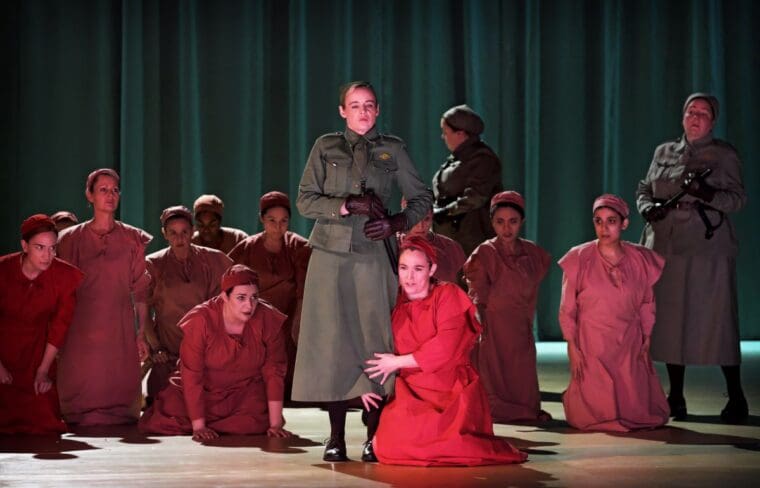
ENO’s production was designed by Annemarie Woods. Woods’ interpretation blunts some of the worst excesses of Gilead. The corpses of Gilead’s executed are hung from a central wall, this has been replaced with a selection of flattering photos. Groping doctors and ritual impregnations though lose none of their sting. Originally directed by the now Annilese Miskimmon the revival was taken up by James Hurley.
Offred was played by Kate Lindsey. Lindsey’s stunning mezzo-soprano voice is as distinguished and gripping in her low range and pianissimo moments as it is in her most extreme. She acted a complex character naturally on stage and at no stage did I ever not believe I was stuck in this nightmare. John Findon’s distinctive, clear tenor voice was instantly recognizable as Luke (Offred’s past husband). The Commander (Fred) was played by James Cresswell whose stentorian self-assuredness made no bones about his ability to crush Offred like an ant. Rachel Nicholls was harsh and brutal as Aunt Lydia.

The ENO’s continuing financial misery, wrought by the hands of the Arts Council, and strike action threatened to derail this opening night. Chorus and Orchestra threatened to walk out and were seen outside in yellow shirts, leafletting for better pay and conditions. This production and performance could not have been a clearer indication of why they are worth it.
1 February – 15 February 2024
To find out more about The Handmaid’s Tale and book check the ENO website.
English National Opera
London Coliseum
St Martin’s Ln,
London WC2N 4ES
Looking for something different? We highly recommend Till The Stars Come Down, currently showing at the National Theatre

Leave a Reply