Last Updated on March 24, 2026
A triumphant return of the swan epic to the Royal Opera House
It’s astonishing how art can be recontextualised as the world changes around us. When director David Alden’s staged Richard Wagner’s opera Lohengrin in 2018, it attracted some critical flack for what were regarded as clichéd references to Nazism. The Royal Opera’s first new production of Lohengrin for 41 years located the opera in a grim 20th-century dystopia – a bombed-out city – where a mysterious and charismatic figure appears out of nowhere to unite the will of the people. Fast-forward four years and the trope of a strong leader uniting a nation to fight a cruel oppressor in a piece with fascist overtones couldn’t be more current politically; so, I was fascinated to see if Revival Director Peter Relton was going to frame Alden’s production even more in relation to the geopolitics of 2022.
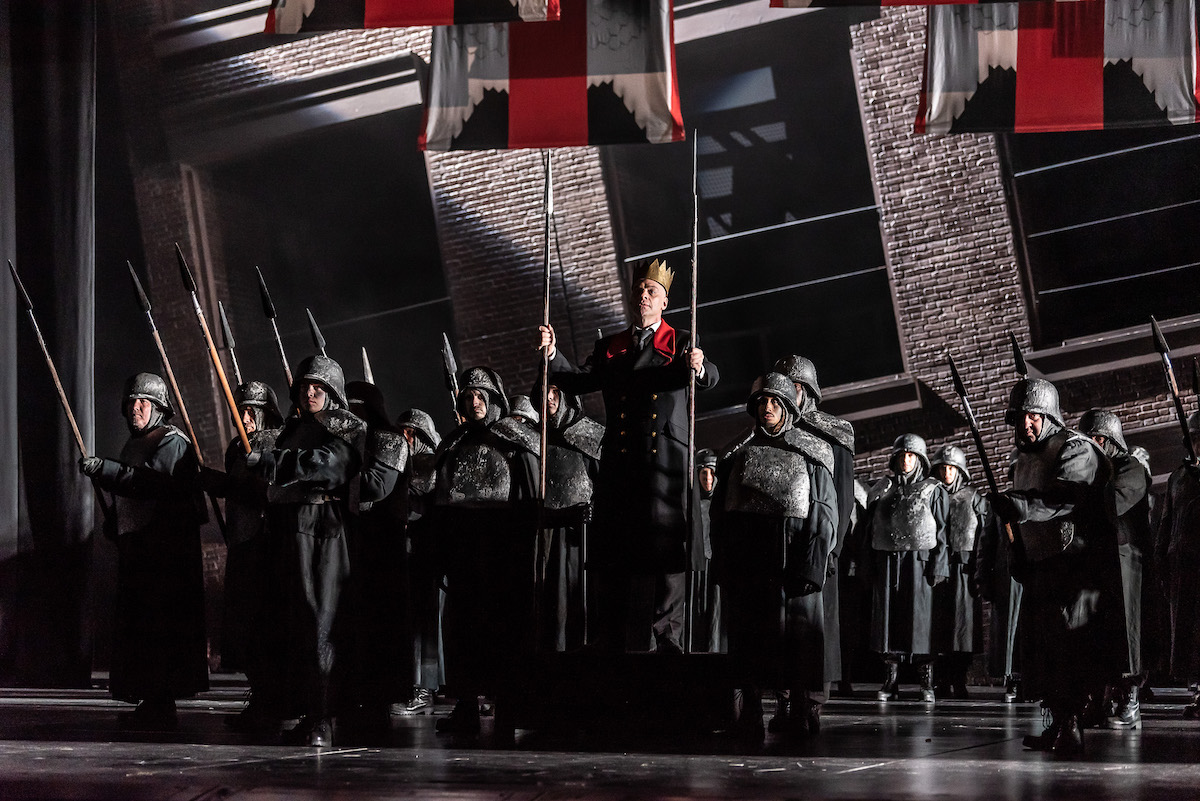
Lohengrin was premiered in 1850 in Weimar, Germany with the first UK performance in Italian at the Royal Opera House in 1875. The story weaves together threads from several medieval German myths as well as the earlier Arthurian Grail mythology. Lohengrin is the third (after Der Fliegende Holländer and Tannhäuser) of Wagner’s three ‘romantic’ operas written in Dresden that established the composer’s fame internationally. The opera has a powerful narrative drive with Wagner’s strikingly integrated libretto and score creating moments of extraordinary drama underpinned. These are underpinned by themes co-opted from German nationalism, the clash between Christianity and the older pagan Norse religion, the story of Zeus and Semele taken from Ancient Greek mythology, and the reoccurring Christian theme of betrayal. Feminists of all generations aren’t going to find much cheer here with the female characters’ machinations and weaknesses leading to the downfall of the male protagonists. It is a misogynist and patriarchal world where only men have real power and agency.

The story is set in the Duchy of Brabant – around the area of modern-day Belgium – where King Heinrich of East Francia has arrived to organise resistance amongst the fractious German tribes against the aggression of the Hungarians. Child-Duke Gottfried von Brabant has disappeared and his guardian Telramund has accused Gottfried’s elder sister Elsa von Brabant of the youngster’s murder. Telramund asks the king to make him the new Duke but the king cannot ascertain the truth of the matter and decides that the outcome can only be decided by combat. Elsa prays for a champion to fight her corner and at the third time of asking, a knight, Lohengrin, appears on the river in a boat drawn by a swan. The knight proposes marriage to Elsa and offers to fight on her behalf on the proviso that she must never ask where he has come from or what he is called. She agrees and Lohengrin defeats Telramund but chooses not to kill him.

Telramund and his wife Ortrud are banished by the King but instead stay and sow doubt in Elsa’s mind about her mysterious hero-husband leading her to demand that he discloses his name and background. Lohengrin reveals himself as a Knight and protector of the Holy Grail and tells the world what his true identity is. The tragic outcome of Elsa’s distrust is that Lohengrin has to return to the Grail, leaving her and the citizens of Brabant who were expecting him to lead them into battle. Elsa dies and her missing brother reappears to be hailed as the new Duke.

Paul Steinberg’s imposing set and Adam Silverman’s lighting design moodily echo the acute angles and dark shadows of German Expressionist cinema.
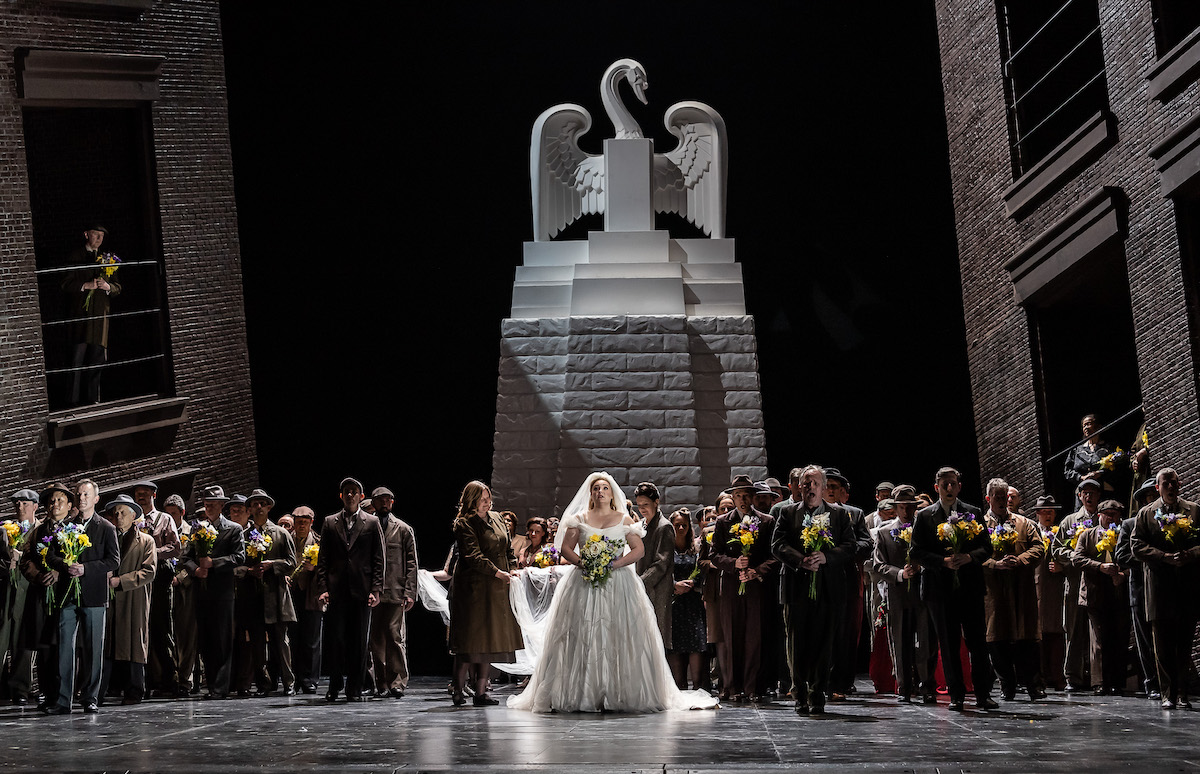
The set features building fronts of dark brick and steel which open up to feature a monolithic sculpture of Lohengrin’s signature swan, used as a heraldic replacement for the German eagle for the Brabantian state’s fascistic iconography.

But this press night performance was all about the singers with a fabulous ensemble of powerful and well-matched voices lifting the roof off the Garden. American tenor Brandon Jovanovich plays the eponymous hero, the Grail Knight Lohengrin. He enters barefoot preceded by the ethereal fluttering of lighting designer Adam Silverman’s swan wings sparing us from a mechanical bird trundling onto the set. Lohengrin is dressed all in white, with Gideon Davey’s costuming giving him an otherworldly look compared with the greys, browns, blacks and reds of the other characters. He comes over like a newly minted Dr Who learning to inhabit a human persona. Jovanovich starts his vocal journey in a sublime mezza voce tone that soon expands to a powerful yet passionate Heldentenor voice that soars above the orchestra. His is a transcendental love for Elsa that reaches its apotheosis in the tender love duet at the start of Act 3 Das süsse Lied verhallt and Jovanovich brings a heroic physicality to the role as well as a convincing sense of resignation in his wife’s lack of faith.
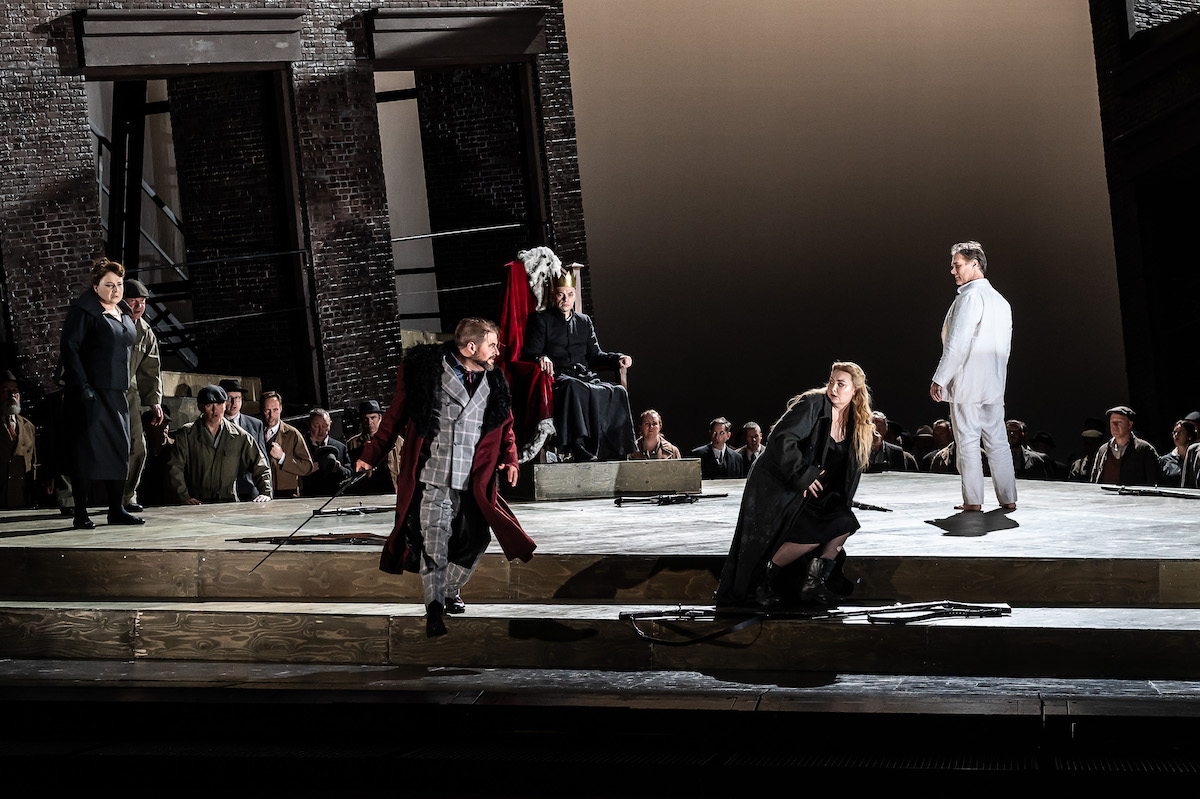
The evil Telramund is played by full-voiced American bass-baritone Craig Colclough in a deliciously melodramatic manner. He throws himself around as well as a number of chairs in director David Alden’s signature move. The character has been duped into believing in Elsa’s guilt through his wife’s attempts to re-establish her own family line in the Ducal lineage and if he becomes part pantomime villain, Colclough’s characterisation is an effective foil to the cool zen mastery of Lohengrin.

Russian mezzo-soprano Anna Smirnova, famed for her Verdi repertoire, is simply sensational as Telramund’s sorceress wife Ortrud. She flashes around in a black and scarlet outfit with a voice and persona that can cajole, seduce or explode in anger as in Act 2’s character-defining aria Entweihte Götter! She easily manipulates the naïve Elsa, played by Irish lyric soprano Jennifer Davis who scored such a success in the role in 2018 having come in as a last-minute stand having never before sung a Wagner role. Davis holds her own against the more dynamic Smirnova often inhabiting a dreamlike state that treads a fine line between piety and jealous insecurity with some gorgeously lyrical singing in arias such as Euch lüften, die mein Klagen from Act 2. Aside from the two principal couples Hungarian bass Gábor Bretz is a suitably regal King Heinrich bringing a more velvety vocal tone to the stage than the other male characters.

Czech conductor Jakub Hrusa was in the pit with and in the Act 2 finale pulled a spine-tingling full-throttle moment out of the Royal Opera House Chorus. The orchestra excelled in the bigger set-piece with fabulously sonorous brass tones dominating, but some of the score’s subtlety was lost with the band being a bit ragged at times. The sublime upper strings and wind of the opening Prelude didn’t sit accurately and with the brass divided antiphonally into several of the boxes at the finale of Act 3, there were a few split notes and problems with the ensemble’s synchronisation.
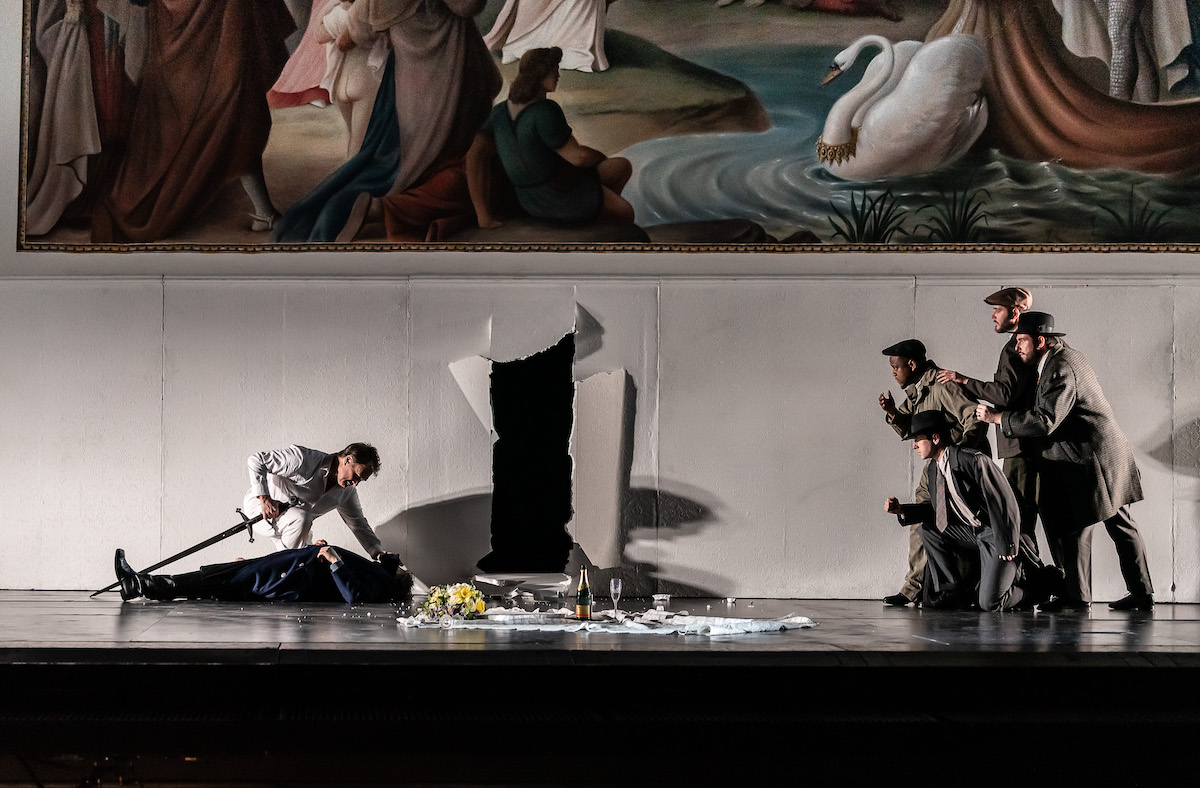
This revival of David Alden’s gripping production sustains its energy and drive throughout its four and a half hours and with the unhappy couple’s wedding flowers displaying Ukrainian blue and yellow as a nod to present circumstances, any questions about its relevance and suitability should be banished to the chip shop floor. The sheer length of Lohengrin doesn’t make it an ideal first opera, but for Wagner fans or those of you ready to explore the composer’s compelling dramatic vision, this production is a must-see.
David Alden’s Lohengrin at The Royal Opera House
Royal Opera House, Bow Street, London, WC2E 9DD
19 April–14 May 2022
The performance lasts about 4 hours 35 minutes, including two intervals.

Thanks you so much. Hope that I too can enjoy this fabulous production. This review makes it come alive.
Sublime music. Can’t wait.
Best wishes.