Last Updated on November 17, 2025
How to Make (and Eat) a Beef Wellington
5.0 out of 5.0 starsFor me, eating red meat is a bit like eating chocolate. I love both. I’m well aware that large quantities of either might not be a good idea. So, I pick my occasions and try to enjoy less but better. An invitation to learn how to make Beef Wellington with Oliver Gladwin, co-founder and executive chef of the Local and Wild group of restaurants, easily made the ‘better’ grade. I was thrilled to find myself in the Hideaway Room at the Sussex Restaurant in Soho with a few other willing volunteers, ready to roll up my sleeves and learn how to create the perfect Beef Wellington, all the while eating myself into oblivion and sampling the wines from the Gladwin Family’s own vineyards.

Let me temper this choice by explaining that I first came across Oliver Gladwin in 2012 at The Shed restaurant in Notting Hill, the first opened by the three Gladwin Brothers. I still remember the meal vividly. At a time when nose-to-tail dining had just been popularised by St John’s, the Gladwin Brothers were doing their own version of seasonal, local, no-waste dining. Many of the ingredients we ate came from the family farm in Sussex; the wine, too, was sourced from Nutbourne, and rather than a meat-forward menu, we were served a truly balanced range of dishes, from venison liver to spelt stuffed squash. Oliver was on the pass, his brother Richard running front of house. We didn’t give star ratings in those days – if we had, it would have been a resounding 5 out of 5.

The Sussex is a rather swankier restaurant, in keeping with the Soho clientele, but with the same farm-to-fork philosophy. And, they offer a Beef Wellington experience where you can learn how the famous dish is created, before settling in for a dinner that begins with Sussex’s much-loved signature “mouthfuls”, including the cult favourite mushroom-marmite éclair, before enjoying the centrepiece you have created. The evening rounds off with a seasonal pudding crafted by Oliver and his team.

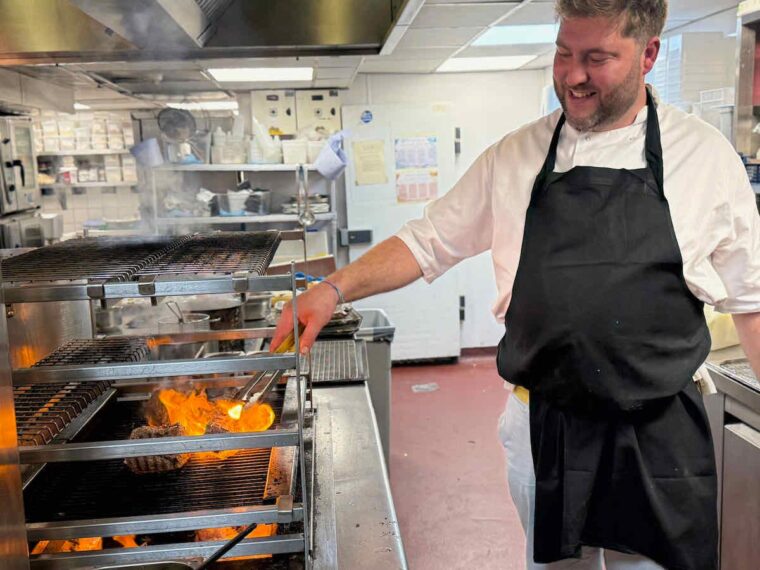
Having Oliver leading our class made it particularly special. So did the insight into what makes the perfect Beef Wellington ‘local and wild’ style. We started with a whole fillet of White Park beef from Gladwin Family’s own farm. White Park are a rather beautiful heritage breed, large white animals with black points on their muzzle, ears, eye-rims and feet and with black tipped horns. The cows are notable for their excellent foraging ability, and Oliver brought in trays of foraged greenery – sorrel, chickweed, yarrow, goose grass and oak moss for us to taste. Ingredients for the kitchen, this was also the kind of vegetation that the cows would typically graze on. ‘What grows together goes together,’ as the Gladwin family says.

We started the evening with a glass of the Sussex house fizz, Nutty Vintage. The wine list at The Sussex includes several wines from their own vineyard, and we tried a few of them throughout the evening. The most pleasantly surprising of which for me was the Pinot Noir, Nutbourne Vineyards, Sussex 2020. I generally avoid English reds, but this was perfectly rounded and fruity – an excellent pairing for the Beef Wellington itself.

The beef isn’t dry-aged for the Wellington because that would make the meat too dry and the flavour too strong. In a Beef Wellington, the meat is wrapped in pastry, which relies on a certain level of moisture in the fillet to prevent the final dish from being dry. A dry-aged fillet can easily lead to a parched centre.. Instead, it is carefully prepared, removing any bits of sinew with a flexible knife and portioning into 350g slices, each of which makes a Wellington for two. Seasoned with a lot of salt and a good rub of black pepper first, these sizeable steaks are then quickly flambéed with brandy.
As the meat needs to cool before the next stage, there’s the chance to enjoy some of the Sussex restaurant’s mouthfuls. We enjoyed the iconic mushroom marmite Éclair with confit egg yolk – something that I can’t imagine anyone hating, and the freshest AAA Maldon Oysters, served with a shallot vinaigrette all washed down with more wine from the Nutbourne estate.

Back to work again, we were shown how to roll our wellingtons first with a mushroom pate in a savoy cabbage leaf, and then in a parsley pancake, before wrapping the whole thing up in pastry and adding an egg wash.

Then, the fun task of adding a lattice. I’m not sure I’ll ever manage to make one of those happen ‘first time’, but we had some help from Oliver and from Antonio Mollo, the Senior Head Chef.

Once our meaty parcels were made, they went in the oven at 200 °C until the internal temperature reached 38 °C, then rested. While they cooked, we were served a rather beautiful Lulworth Scallop, with brown butter emulsion and sorrel and a filled tortellini, along with more wine from the Nutbourne estate.

If you were wondering how this would work for those who don’t eat meat, my companion was shown how to make a trout Wellington with beetroot and Swiss chard, and she very much enjoyed this option for her meal.

The Beef Wellingtons were truly delicious, though, and despite trying to avoid too much red meat in general, this evening reinforced my personal philosophy that a few ‘treats’ of this sort are worth indulging in. Perfectly pink meat, a delicious mushroom duxelle and a crisp pastry shell. I’d still hesitate to try making one for Christmas lunch, though!

We rounded off the evening with another indulgence: chocolate mousse with a seasonal blackberry. Perfect.

Hosted in the newly refurbished Hideaway Room, an atmospheric, glass-fronted space tucked by the kitchen, an immersive culinary experience right in the belly of the beast that would make a fantastic activity for a small group. Currently priced at £110 per person, it’s excellent value for money since not only will you learn how to make the perfect Wellington, you’ll also leave full of great food and wine.
https://www.sussex-restaurant.com| 63-64 Frith St,Soho, London W1D 3JW
020 3923 7770

Leave a Reply